
CLAMS: Redefining Social Clouds Through Clique-Aware Edge Computing
Clique-aware mobile social clouds
The paper introduces CLAMS (CLique-Aware Mobile Social), a novel system that bridges on-phone social clique identification with edge computing through Network Function Virtualization (NFV). Utilizing a massive Call Detail Record (CDR) dataset of 1 million users in Milan, the authors demonstrate that small cliques (3-9 people) not only interact intensely via phone but also frequently co-locate in specific urban spaces.
TL;DR
Social networks are not just digital nodes; they are physical clusters. This paper introduces CLAMS (CLique-Aware Mobile Social), an architecture that identifies "cliques" (highly interactive subgroups) from mobile data and uses NFV (Network Function Virtualization) to deploy cloud services at the network edge precisely where these groups meet. By analyzing 1 million users in Milan, the authors prove that 57% of social cliques physically meet, offering a massive opportunity for network traffic offloading and low-latency interaction.
Background: Beyond the Individual User
In the era of 5G and early 6G discussions, mobile operators face a dilemma: increasing data demand for social sharing vs. the physical limits of core network backhaul. Most prior work treated social links as simple pairs (dyads). However, human sociality is organized into cliques—groups where everyone knows everyone else. The authors argue that if a network is "clique-aware," it can predict traffic bursts and co-location events, moving the "cloud" to the "edge" just in time.
Methodology: From Phone Calls to Physical Encounters
The research follows a rigorous two-step process:
1. Identifying the "Mobi-Social" Group
Using a graph of nearly 300,000 nodes, the researchers extracted maximal cliques using an adaptation of the Bron-Kerbosch algorithm. They found that most cliques are small (3-4 people) but incredibly active, with intensity increasing as the clique size grows.
2. Physical Co-location Mapping
By cross-referencing Call Detail Records (CDRs) with cell tower IDs, the study reconstructed mobility traces. They discovered a surprising "Socio-Spatial" correlation: social cliques aren't just calling each other; they are physically gathering in specific urban "social spaces."
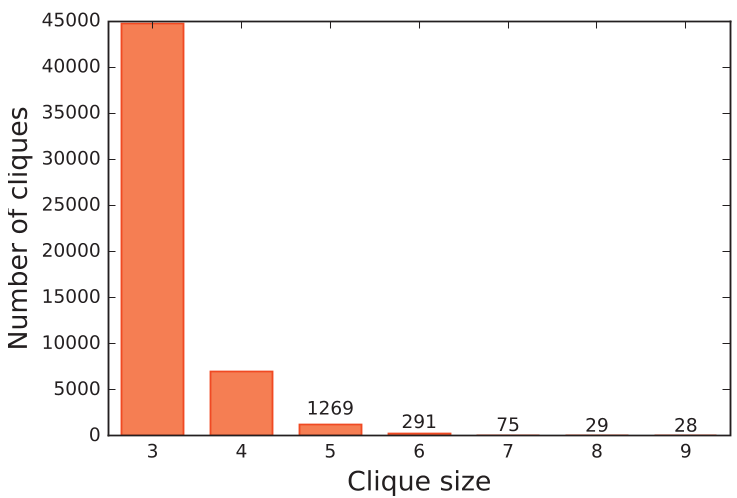 Figure 1: Distribution showing that while small cliques are predominant, they form the backbone of mobile interactions.
The CLAMS Architecture: Cloud-Edge Synergy
The core contribution is an NFV-based architecture that allows for "Dynamic Path Management."
- Micro-Data Centers (Micro-DC): Instead of one massive central cloud, the network uses localized computing clusters near cell towers.
- Service Orchestration: When the system detects that members of a specific clique are under the same or adjacent towers, it triggers the Global Orchestrator to instantiate a virtualized social service package (caching, content sharing, or D2D communication) at the nearest Micro-DC.
- SDN Integration: Software-Defined Networking is used to dynamically route traffic, ensuring that if friends are in the same square sharing a 4K video, the traffic never needs to hit the congested core network.
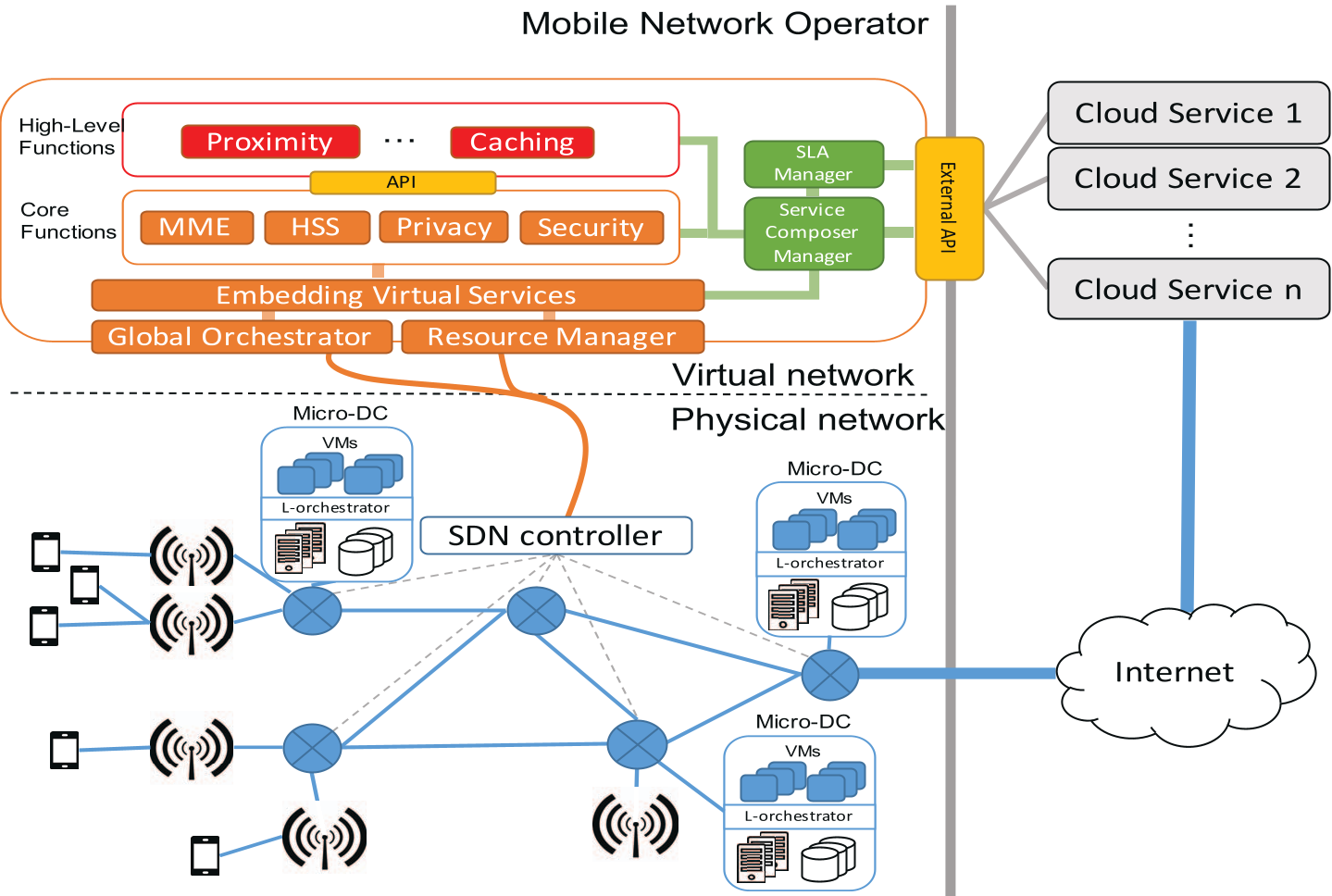 Figure 2: The CLAMS system architecture, showing the interplay between physical resources and virtualized service packages.
Experimental Insights
The analysis of Milan's urban landscape revealed that:
- Clique Intensity: Larger cliques communicate twice as much as smaller ones, making them "Strategic Targets" for premium network services.
- Meeting Locations: Over 57% of cliques meet physically. This isn't random; specific "Social Urban Spaces" (squares, malls, work hubs) act as magnets for these groups.
- Efficiency Gains: By placing services in Micro-DCs, the network dramatically reduces latency for the most interaction-heavy segments of the population.
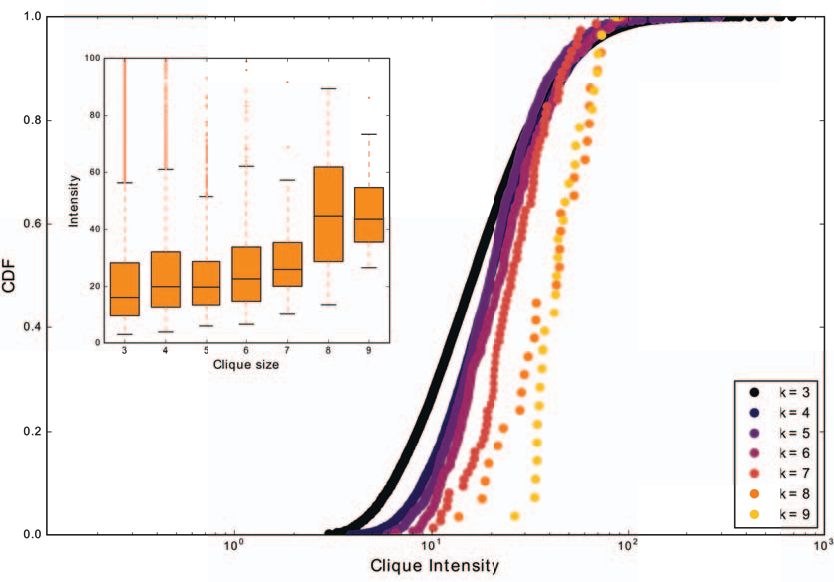 Figure 3: Cumulative distribution of clique intensity. Note how larger cliques demonstrate higher median interaction levels.
Critical Analysis & Future Outlook
Strengths: The paper provides one of the first large-scale empirical links between maximal cliques and physical mobility at a city scale. The shift from "User-to-Cloud" to "Clique-to-Edge" is a powerful paradigm shift for 5G.
Limitations: The dataset is limited to a single operator. In reality, cliques are often cross-operator (friends use different providers), which would require inter-carrier NFV orchestration—a significant regulatory and technical hurdle.
Takeaway: CLAMS proves that the future of social networking isn't just about better apps, but about "Network-Aware Sociality"—where the infrastructure itself understands our groups and optimizes the digital experience based on our physical proximity.