
Beyond the Shortest Path: A New "k" Closeness Metric for Social Networks
A New Closeness Metric for Social Networks Based on the k Shortest Paths
The paper introduces a novel closeness metric for social networks based on a weighted average of the k shortest paths. By axiomatically developing this metric and an accompanying convex optimization model, the authors improve the ability to distinguish node proximity beyond the limitations of traditional single-shortest-path metrics.
TL;DR
Researchers from Tianjin University have challenged the standard "Shortest Path" dogma in Social Network Analysis (SNA). They've developed an axiomatic closeness metric that considers the k shortest paths rather than just one. By weighting these paths through an optimal convex model, their method reveals hidden structural connections—like community density—that traditional metrics completely miss.
The Problem: The "Shortest Path" Blind Spot
In the world of social networks, distance is usually synonymous with the shortest path. However, is a person you are connected to by one common friend truly as "close" as someone you are connected to by ten different pairs of common friends?
Traditional metrics would say yes if the path length is the same. The authors illustrate this flaw with a simple graph:
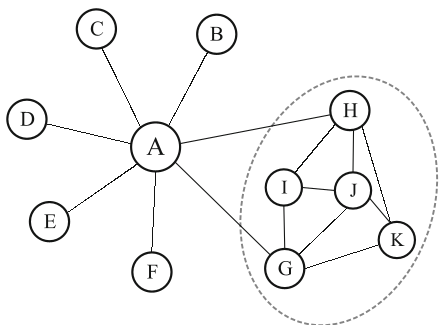 In this figure, Nodes G and H are part of a dense community. While their shortest path might be the same as other pairs, their overall connectivity is much higher. Standard metrics ignore this "closeness" information.
Methodology: Axiomatic k-Shortest Paths
The core of the paper is the definition of Relation Distance ():
where is the length of the -th shortest path, and is its weight.
The Theoretical Innovation
Simply adding paths isn't enough; the resulting "distance" must still behave like a mathematical distance (satisfying non-negativity, symmetry, and the triangle inequality). The authors prove that as long as and weights sum to 1, the k-path metric remains valid.
Optimization: How to find the "Best" Weights?
The authors suggest that the best metric is the one that provides the most differentiation between node pairs. They define a "Spread Level" () and set up a convex optimization problem to maximize it:
- Objective: Maximize the standard deviation or range of distances across the network.
- Constraints: Ensure the weights respect the path importance ranking and maintain the sign-consistency of distance differences.
Efficient Computation: Reducing the Complexity
Calculating these weights for large networks can be computationally expensive ( constraints). The authors propose Method 3, an intuitive simplification that reduces the constraints to a mere . This makes the approach feasible for larger datasets without sacrificing the core structural insights.
Experimental Validation
The metric was tested against both random (Waxman) networks and famous real-world datasets like Zachary’s Karate Club and the Dolphins network.
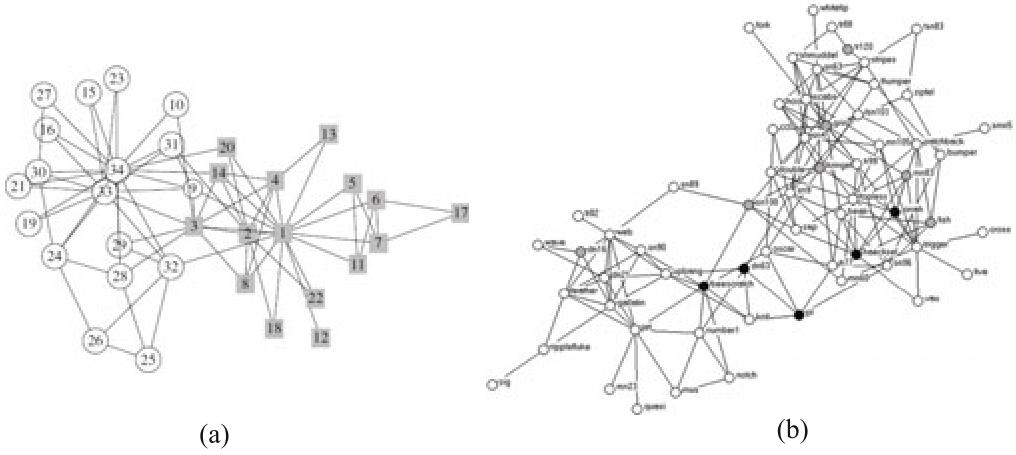 Visual representation of Zachary's Karate Club (left) and the Dolphins network (right) used for the experiments.
Key Findings:
- Granularity: In the example network, the model successfully distinguished pairs that were previously considered "equally distant" by assigning weight to the 2nd and 3rd shortest paths.
- Shortest Path Dominance: In real networks, the shortest path still carries the most weight (), but the small weights assigned to and are the "secret sauce" that allows the model to identify deep community ties.
Critical Analysis & Conclusion
The significance of this work lies in its mathematical rigor. It doesn't just suggest using more paths; it provides the axiomatic proof that doing so is valid and an optimization framework to do it "optimally."
Limitations:
- The current method still assumes is a small constant. In massive networks (millions of nodes), finding k-shortest paths for all pairs remains a heavy task.
- The model's reliance on "Spread Level" is a heuristic; different applications might require different optimization objectives (e.g., maximizing community separation).
Future Outlook: As we move toward more complex Graph Neural Networks, integrating these k-path distances as structural embeddings could significantly improve how AI understands social influence and information flow.