
Transforming Software Design Education through Crowdsourcing and Self-Organizing Learning (SOL)
A Cloud-Based Platform for Crowdsourcing and Self-Organizing Learning
This paper proposes a cloud-based education platform that integrates Self-Organizing Learning (SOL) with software crowdsourcing. By leveraging the SOL framework—communication, reflection, collaboration, community, creative tools, and amplification—the authors aim to transform the passive observation of software development into an active, self-motivated learning experience.
TL;DR
Software development is often taught through "finished products," but the real learning happens in the messy middle—the design rationales and failed attempts. This paper introduces a cloud-based platform that applies Self-Organizing Learning (SOL) to software crowdsourcing. By capturing communication, reflection, and collaboration data from real-world contests, the platform turns the entire crowdsourcing ecosystem into an automated classroom for aspiring software designers.
Problem & Motivation: The "Final Product" Trap
As the legendary computer scientist Edsger W. Dijkstra once noted, algorithms are often published as polished artifacts, while the considerations and design choices that shaped them are omitted. In modern software crowdsourcing (like TopCoder or App Store), huge amounts of "Big Data" regarding design decisions are generated but rarely utilized for education.
The authors identify a clear gap: How can we turn the competitive, high-pressure environment of crowdsourcing into a structured learning journey for observers? The challenge lies in the "rigorous nature" of software (syntax, CMMI standards) combined with the subjective creativity of requirement analysis.
Methodology: The SOL Framework
The authors adapt Sugata Mitra’s Self-Organizing Learning (SOL) principles into a technical cloud architecture. The core innovation lies in the "Guided Process," which splits the ecosystem into two paths:
- Participant Process: The "doers" who follow rules, design, and submit solutions.
- Learner Process: The "observers" who use the platform's tools to deconstruct the participants' work.
The Architecture of Collaboration
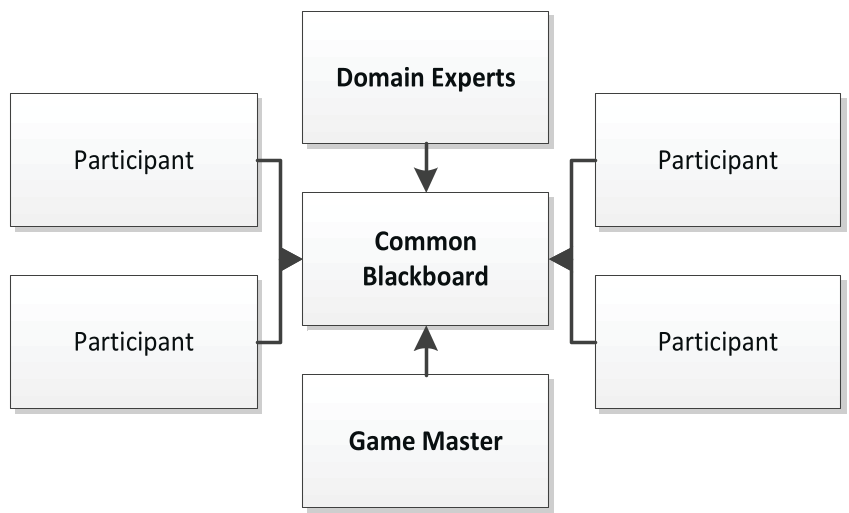
The platform utilizes a "Blackboard" structure to allow within-team and inter-team communication. This ensures that the history of rationale is preserved rather than lost in private messages.
Reflection and Amplification
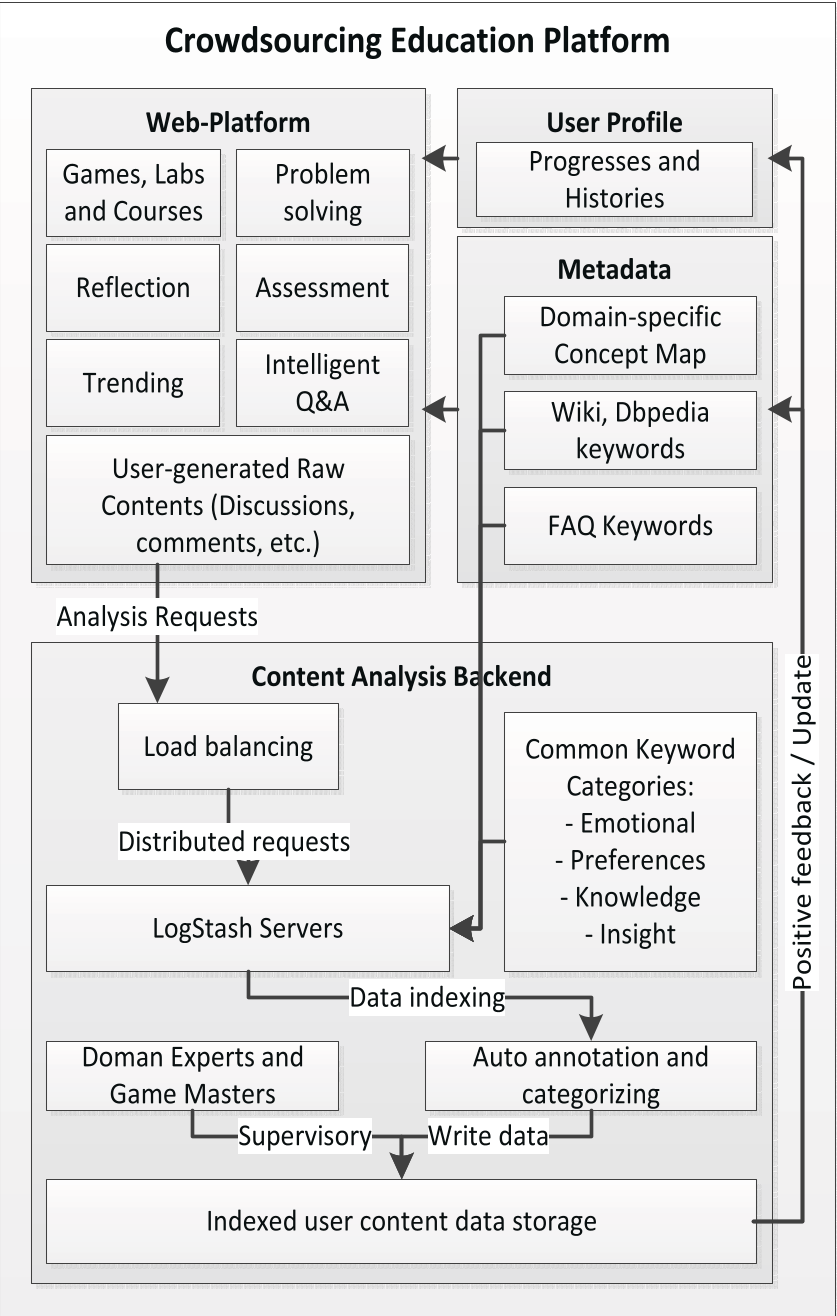
One of the most powerful features is Amplification. The system doesn't just show code; it builds Concept Maps. For example, if a developer mentions "Redis" in a post-mortem, the system automatically links it to Wikipedia, DBpedia, and categorizes it under "Document-oriented databases" to provide immediate context for the learner.
Experiments & Results: Engineering the Data Flow
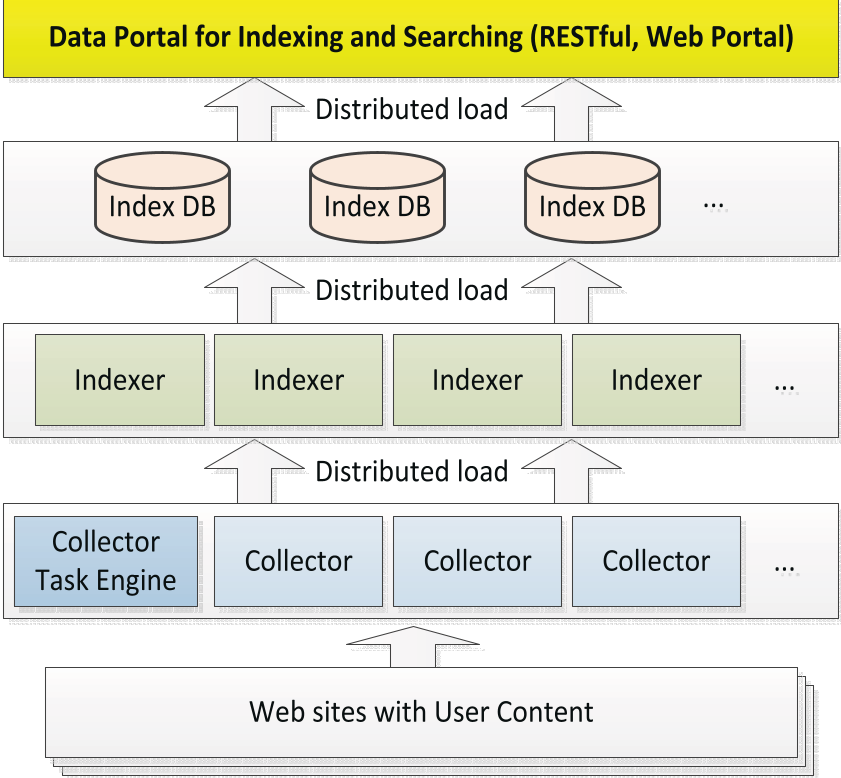
The paper outlines a robust backend architecture designed to handle the "Big Data" aspect of crowdsourcing. It uses LogStash servers and load balancers to index raw data into a data storage system supervised by domain experts.
The authors use the Instagram Engineering Blog as a case study for "Reflection." They demonstrate how raw technical narratives (e.g., solving a 40k req/s bottleneck in Redis) can be structured into "Problem-Solution" pairs that serve as high-value educational content.
Critical Analysis & Conclusion
Takeaway
The synergy between Cloud Computing, Crowdsourcing, and SOL creates a "living textbook." The true value of this paper is the realization that technical communities (like those on GitHub or TopCoder) are high-fidelity learning environments if the right "Amplification" tools are applied.
Limitations & Future Work
While the architecture is sound, the paper relies heavily on manual supervision by "Game Masters" and "Domain Experts" for data indexing. A logical next step—likely happening in todays AI-centric landscape—is the use of Large Language Models (LLMs) to automate the generation of concept maps and reflections, further reducing the need for human intervention.
Ultimately, this work moves us away from passive learning and toward an ecosystem where every software contest is an opportunity for global knowledge transfer.