
Cloud-Based Multicast: Optimizing MSNs through Social Homophily and Feedback Loops
13831_Cloud-Based Multicasting with Feedback in Mobile Social Networks.
This paper introduces a Cloud-Based Multicast (CM) scheme with a selective feedback mechanism for Mobile Social Networks (MSNs). By leveraging social homophily, it defines "destination clouds" to optimize message relaying and achieves state-of-the-art performance in intermittently connected Delay Tolerant Networks (DTNs).
TL;DR
The proliferation of smartphones has created massive demand for data in Mobile Social Networks (MSNs), but intermittent connectivity makes routing a nightmare. This paper proposes a Cloud-Based Multicast (CM) scheme that uses "destination clouds"—groups of nodes with high contact frequency with the target—and a feedback control loop to iteratively minimize delivery latency. By treating previous delivery successes as training data, the system achieves a 38.7% reduction in latency over standard baselines.
Problem & Motivation: The Chaos of Intermittent Connectivity
In an MSN, nodes (people with smartphones) move unpredictably. These are Delay Tolerant Networks (DTNs) where a path between Source and Destination might never exist at a single point in time.
Current SOTA methods face a trade-off:
- Epidemic Routing: High delivery rate but floods the network, killing battery and buffer space.
- Deterministic Metrics: Using static contact frequency to pick relays is often sub-optimal because local frequency doesn't capture the "global" shortest path.
The authors' insight is based on Homophily: "Birds of a feather flock together." If we can identify the "cloud" of nodes surrounding a destination, we can transition from expensive multi-copy replication to efficient direct delivery.
Methodology: Two Phases and a Feedback Loop
1. The Cloud Concept
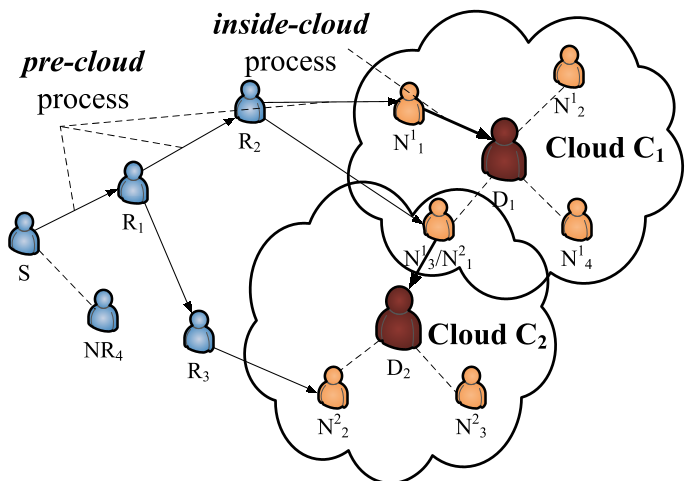
A "Cloud" consists of the destination and its "neighbors"—nodes that meet the destination more frequently than a predefined threshold .
2. The Multicast Process
The routing is split into two distinct logic stages:
- Pre-Cloud Stage: The message holder partitions copies among encountered nodes based on a Forwarding Metric (). If the encountered node is a "better" relay, it receives a portion of the message copies.
- Inside-Cloud Stage: Once a message reaches a destination neighbor (a cloud member), it stops replicating. It simply carries the message until it meets the destination directly, drastically cutting down on redundant transmissions.
3. The Feedback Control Mechanism
This is the "brain" of the paper. Instead of sticking to a fixed metric, the destination nodes track how long it took for a message to reach them via specific relays. This latency data is piggybacked onto metadata and spread back through the network.
- Nodes update their metric using the reciprocal of the actual average latency.
- The system "learns" the fastest paths over multiple rounds, converging to a stable, optimized state.
Mathematical Grounding: Markov Chain Analysis
The authors justify this approach using a Continuous Time Markov Chain. They model the transition of message copies as states in a system where contact times follow an exponential distribution. By calculating the expected waiting time at each state, they formally prove that the shortest captured multicast time provides a better guidance metric than raw contact counts.
Experimental Validation
The researchers used two famous real-world datasets: Infocom 2006 and Intel.
Key Findings:
- Convergence: The feedback mechanism is highly effective. Between Round 1 and Round 2, latency dropped by ~33%. By Round 5, the performance stabilized.
- Latency vs. Overhead: CM significantly outperformed Delegation Multicast (DM) in speed while maintaining a much lower overhead than Epidemic routing.
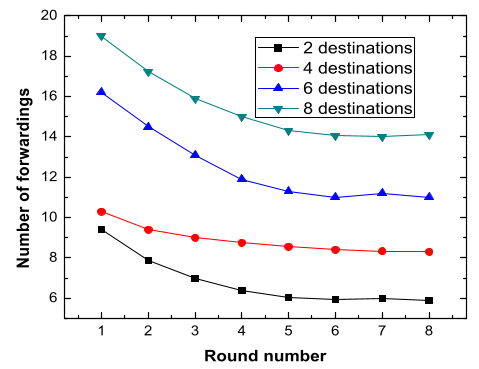 Figure: The CM scheme (represented across rounds) shows a clear downward trend in latency compared to fixed-metric schemes.
Critical Analysis & Conclusion
Takeaway: This work demonstrates that "social awareness" isn't just a buzzword—it's a quantifiable metric. By combining the physical intuition of "clouds" with the mathematical rigour of feedback loops, the authors solved the efficiency problem in MSNs.
Limitations:
- Threshold Sensitivity: The performance is sensitive to the contact threshold . If it's too low, the cloud is too big (high latency); if it's too high, the cloud doesn't help.
- Privacy: The paper assumes nodes are willing to share their contact metadata, which might raise privacy concerns in real-world deployment.
Future Outlook: The next step for this research is likely the integration of privacy-preserving computation or incentive mechanisms to ensure users feel safe and motivated to act as relay nodes in these "clouds."