
Cloud-Driven Trust: Formalizing Security in Vehicular Social Networks
A Cloud-Based Trust Management Framework for Vehicular Social Networks
The paper introduces a layered trust management framework for Vehicular Social Networks (VSNs) integrated with a three-layer cloud architecture (Central, Road-side, and Vehicular clouds). It utilizes Performance Evaluation Process Algebra (PEPA) to conduct rigorous formal modeling and performance analysis of trust evaluation processes.
TL;DR
As we transition into 5G, vehicles are no longer just transport pods; they are nodes in a Vehicular Social Network (VSN). However, authorized users can still be liars. This paper proposes a cloud-based trust management framework and, more importantly, provides a mathematical "stress test" using PEPA (Performance Evaluation Process Algebra) to ensure that checking trust doesn't crash the network's performance.
Background: The "Authorized Liar" Problem
In VSNs, users share everything from traffic jams to available parking. The core vulnerability is the authorized malicious user. Standard PKI (Public Key Infrastructure) checks ID cards, not honesty. A selfish driver might broadcast a fake "congestion" warning just to clear the road for themselves. To stop this, we need a trust model that evaluates the credibility of the message based on communal consensus and history.
Methodology: The Three-Layer Cloud & The Trust Model
The authors propose a hierarchical architecture to distribute the heavy lifting of trust calculation:
- Central Cloud Layer (CCL): Stores long-term vehicle profiles and history.
- Road-side Cloud Layer (RCL): The local manager that coordinates trust evaluations via Road-Side Units (RSUs).
- Vehicular Cloud Layer (VCL): A transient cloud formed by the vehicles themselves, sharing their local CPU/storage to run "Vehicular Virtual Machines" (VVM).
The Trust Algorithm
Trust is calculated as a weighted sum: The logic covers direct neighbors, indirect recommendations, and even external domain friends, ensuring a multi-dimensional view of requester credibility.
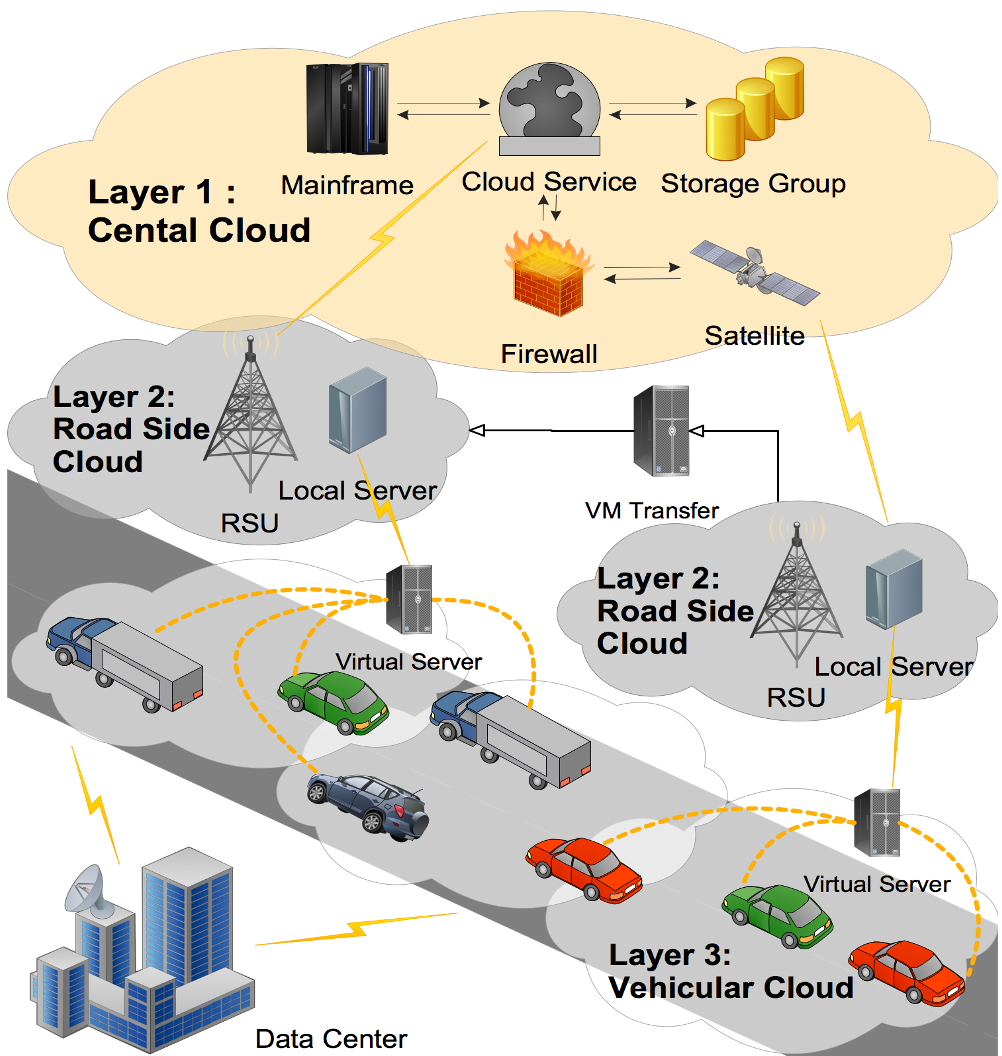 Figure 1: The Three-layer Vehicular Cloud Network architecture supporting decentralized trust evaluation.
Formal Modeling: PEPA and the Battle Against State Explosion
The true academic contribution of this paper isn't just the trust model—it's the formal evaluation.
Why PEPA?
Traditional modeling tools like Petri Nets often struggle with hierarchical layering. PEPA (Performance Evaluation Process Algebra) allows the authors to describe the system as a set of interacting components (Vehicular Nodes, RSUs, Servers) with transition rates.
Solving the "State Space Explosion"
When you have hundreds of cars, the combinations of possible states in a Markov Chain reach millions, becoming unsolvable. The authors use two brilliant strategies:
- Isomorphism & Bisimulation: Merging duplicate actions and simplifying the model while retaining the same visible behavior.
- Fluid-Flow Approximation: Instead of tracking every discrete state, they treat the system as a continuous "fluid," converting the logic into a set of Ordinary Differential Equations (ODEs). This allows for near-instant analysis of large-scale systems.
Experimental Insights & Results
The analysis answers a critical engineering question: How many VVMs do we need to keep latency low?
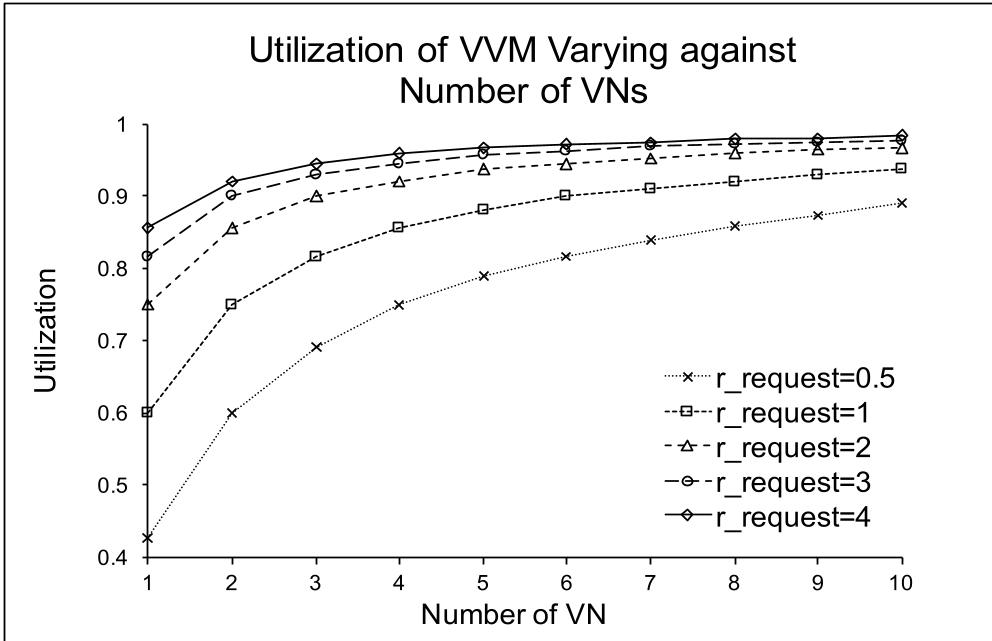 Figure 2: Utilization of VVM components versus the number of vehicular nodes. Note how request rates (rgt) dictate the saturation point.
Key Findings:
- Resource Utilization: As the workload increases, VVM utilization approaches 1.0. To avoid bottlenecks (Utilization > 95%), the service rate must be carefully balanced against the arrival rate of trust requests.
- Queue Length: Using Fluid-Flow, the authors visualized how queues of "waiting trust checks" build up and stabilize.
- Response Time: Capacity planning reveals that if the number of vehicles (VNs) jumps from 30 to 40, the system requires at least one additional RSU/VVM server to keep response times under the 15-second QoS threshold.
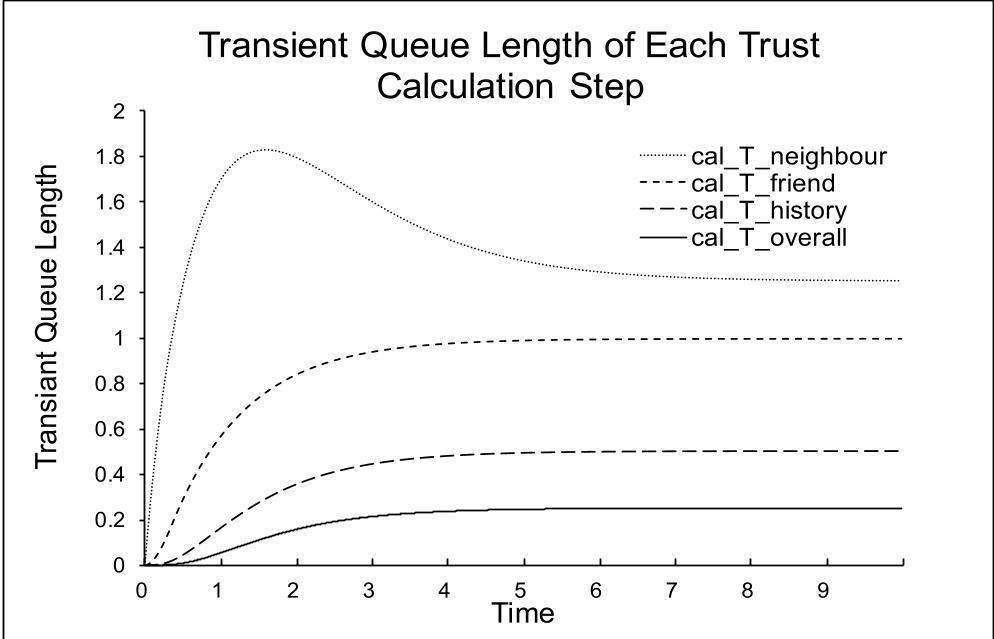 Figure 3: Transient queue length of each sub-step in the trust calculation, showing the system reaching steady-state stability.
Critical Insight & Conclusion
This paper bridges the gap between security theory and system performance. A trust model is useless if it takes 2 minutes to verify a "braking" alert.
Potential Limitation: The current model assumes a relatively static mobility pattern for the duration of a trust calculation. In high-speed highway scenarios, the "Transient Cloud" might dissolve before the ODE-predicted steady state is reached.
Future Outlook: The next frontier is incorporating Human Psychology. Trust isn't just a math problem; it's a behavioral one. Combining these formal PEPA models with game theory or machine learning "Recall/Precision" metrics will be the key to truly autonomous, social traffic.