
Cloud Offloading: Augmenting Mobile Devices for the Social Era
Extending the Capabilities of Mobile Devices for Online Social Applications through Cloud Offloading
This paper presents a PhD research framework focused on cloud offloading for Online Social Applications (OSAs). It introduces a three-fold approach encompassing workload modeling of social apps, the investigation of communication and performance (lossy/lossless) offloading mechanisms, and the development of an integrated system for mobile-cloud coordination.
TL;DR
This research tackles the "Energy-Performance" bottleneck of mobile devices by offloading heavy computations and communication tasks to the cloud and cloudlets. Key innovations include a workload model based on real-world Facebook data, a "lossy-performance" mechanism for real-time video processing, and an integrated system to handle the massive heterogeneity of modern smart devices.
Background & Positioning
As mobile devices become the primary gateway to Online Social Applications (OSAs), we face a paradox: the applications are getting heavier (AR, multimedia, real-time gaming), while mobile batteries remain a physical constraint. This PhD research marks a shift from general-purpose offloading to Context-Aware Offloading, where the social interaction patterns of users are used to predict and manage computational workloads.
The Core Problem: Heterogeneity and Social Workloads
Existing offloading solutions often treat all apps as isolated tasks. However, OSAs are different:
- Social Dependency: If your friends are active in a game, your device's workload spikes.
- Infrastructure Complexity: The jump from a smartphone (3G/WiFi) to the cloud is high-latency.
- Device Diversity: A strategy that works for a quad-core tablet might drain a single-core smartphone in minutes.
Methodology: The Hierarchical Approach
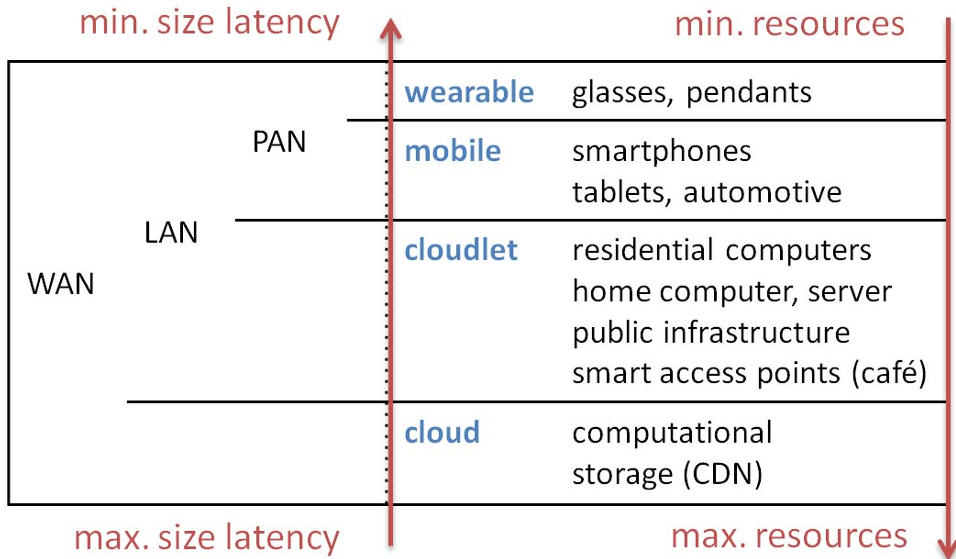
The author envisions a tiered hierarchy of computing. Instead of just "Mobile vs. Cloud," the research looks at a spectrum of resources.
1. Workload Characterization
By analyzing 630 Facebook applications over 31 months, the author found that popularity follows a Log-Normal distribution. This allows the system to predict the "Evolution Model" of an app's resource needs—from steady growth to peak and eventual decay.
2. Offloading Mechanisms
- Communication Offloading: Using custom hardware (like ZigBee USB dongles) for home automation. The finding? WiFi is significantly less efficient for tiny commands (like turning on a light) compared to low-power protocols.
- Lossy-Performance Offloading: In AR and surveillance, the system uses "frame skipping." If the CPU is overloaded, the system decides it is better to skip a frame than to lag, maintaining a smooth user experience even if precision is slightly reduced.
Experiments & Real-World Validation
The research moves beyond theory, testing on real-world collaborative learning tools and mobile tuning apps.

- Energy Efficiency: The adaptive query algorithm for pollution tracking achieved a 20x energy improvement over traditional polling.
- Video Processing: In AR applications, the system successfully managed workloads by processing only 25-50% of captured frames, preventing device overheating without sacrificing core functionality.
Critical Analysis & Future Outlook
The most profound insight in this work is the prediction that handheld devices will soon become offloading targets for wearables (like smart glasses). This shifts the mobile device from being the "limit" to being the "local hub."
Limitations: The current model relies heavily on historical traces from Facebook. In an era of increasing privacy (GDPR, ATT), collecting such high-fidelity social data for real-time scheduling might be more difficult than the author initially anticipated.
Future Work: The next phase focuses on "Lossless-Performance Offloading," specifically for pipelined applications where every piece of data is critical. Integrating this into popular open-source platforms like OpenTTD (a simulation game) will provide a true stress test for the proposed scheduling policies.
Summary
By bridging social user behavior with low-level hardware optimization, this research provides a roadmap for "Socially-Aware Cloud Offloading." It treats the mobile device not as an island, but as a dynamic node in a pervasive computing fabric.