
CloudMoV: Bridging the Social Gap and Battery Trap in Mobile TV
CloudMoV: Cloud-Based Mobile Social TV
CloudMoV is a novel cloud-based mobile social TV system that leverages a hybrid cloud architecture (IaaS and PaaS) to provide high-quality video streaming and spontaneous social interaction. By employing per-user virtual machine surrogates, the system overcomes mobile hardware limitations and fluctuating wireless connectivity.
Executive Summary
TL;DR: CloudMoV is a hybrid cloud framework that uses per-user virtual machine (VM) surrogates to handle heavy-duty video transcoding and social messaging. It solves the twin problems of battery drain and playback lag, achieving ~30% energy savings and jitter-free streaming on mobile devices.
Academic Context: This work represents a significant step in Mobile Cloud Computing (MCC). Rather than just offloading static tasks, it builds a dynamic, synchronized environment that utilizes IaaS for computation and PaaS for social scalability, positioning itself as a comprehensive solution for "social co-viewing."
The "Mobile Social" Problem: Why We Can't Just Stream
While we treat smartphones like mini-computers, they suffer from two physical realities:
- 3G/4G Power Dynamics: The network radio consumes massive power not just when sending data, but also during "tail times" (inactivity timers) after a transmission ends.
- Transcoding Overhead: Mobile devices can't handle every video codec. Pre-encoding every video into every format is impossible for live content.
Existing SOTA solutions either ignored the social synchronization factor or used Scalable Video Coding (SVC), which introduced intolerable delays. CloudMoV asks: Can we use the cloud to act as a digital twin for every mobile user?
Methodology: The Surrogate VM Architecture
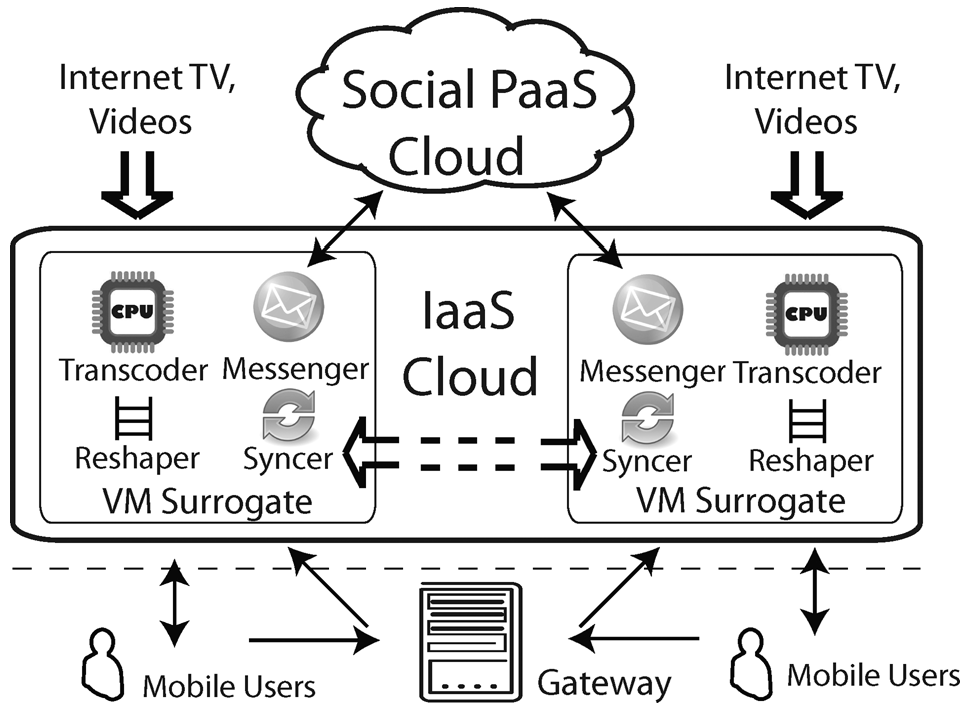
The heart of CloudMoV is the Surrogate. Each user is assigned a VM in an IaaS cloud (like Amazon EC2).
The Core Components:
- Transcoder & Reshaper: The surrogate downloads the source video, converts it to the phone's native resolution/codec, and chops it into segments.
- Social Cloud (BigTable): Utilizing PaaS (Google App Engine), the system handles thousands of concurrent chat messages without overloading the streaming server.
- Burst Transmission: This is the secret sauce for battery life. Instead of a steady stream of data (which keeps the 3G radio in a high-power state), the surrogate sends data in large "bursts" and then lets the phone's radio "sleep."
Deep Dive: Saving Battery with 3G Power States
The authors modeled the Radio Resource Control (RRC) states: CELL_DCH (High power), CELL_FACH (Medium), and IDLE (Low).
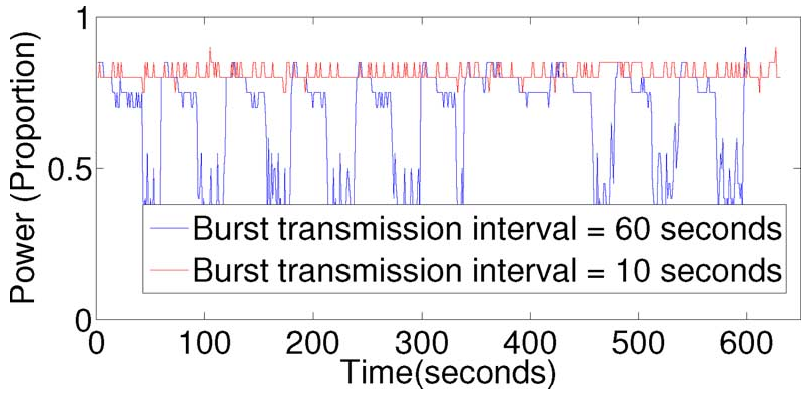
By calculating the optimal Burst Size, the system ensures the duration of the data burst allows the device to transition into IDLE before the next segment is needed. Using a 60-second burst interval instead of the Apple-standard 10 seconds allowed the device to enter sleep mode, reducing consumption significantly.
Experimental Validation
The prototype was deployed on Amazon EC2 and Google App Engine. Key findings included:
- Power Efficiency: A 29.1% reduction in power compared to normal HLS.
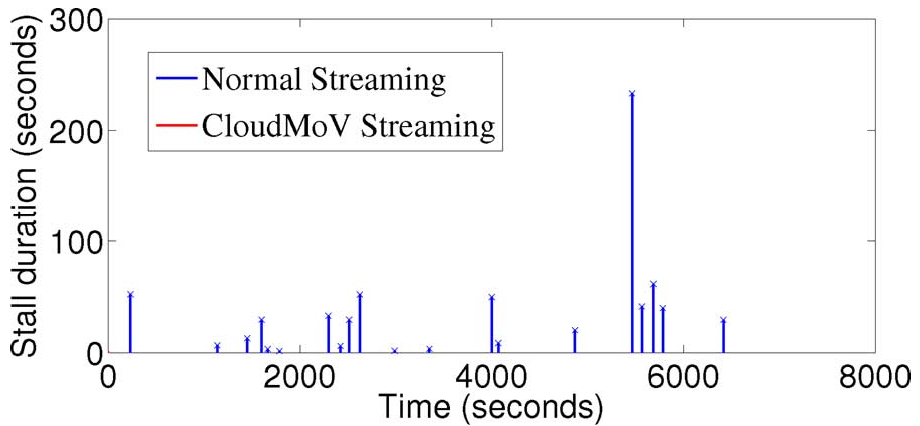
- Jitter Suppression: While normal streaming suffered over 700 seconds of stall in unstable networks, CloudMoV's dynamic bit-rate switching (High/Low quality) maintained zero jitters.
- Scalability: Even with 200 concurrent users in a single session, the "Host" surrogate only reached 70-80% utilization.
Critical Insight & Future Work
The success of CloudMoV lies in its loosely coupled interfaces (HTTP/AJAX). It doesn't require a special app—just an HTML5 browser. However, a potential limitation is the cost of running a dedicated VM for every user.
The authors suggest that future iterations could use Peer-to-Peer (P2P) surrogate sharing, where VMs exchange already-transcoded streams to reduce redundant computation. This work lays the foundation for what we now recognize as "Edge Computing" in the modern 5G era.