
CLPP: Outsmarting Inference Attacks in Modern Social Networks
CLPP: Context-aware location privacy protection for location-based social network
The paper introduces CLPP (Context-aware Location Privacy Protection), a framework for Location-Based Social Networks (LBSNs) that utilizes a Bayesian inference model and a custom s-confidence metric to prevent adversaries from deducing sensitive unvisited locations. It features two novel correlation algorithms—a Frequent-Pattern Tree (FP-Tree) and a Collaborative Filtering (CF) heuristic—to evaluate privacy risks in real-time.
TL;DR
Simply turning off your GPS when you visit a sensitive location (like a clinic) isn't enough to stay private. By analyzing the time it takes you to go from Point A to Point B, hackers can "connect the dots" and infer where you went in between. CLPP (Context-aware Location Privacy Protection) is a new framework that uses personalized AI (Collaborative Filtering) to predict what an attacker might learn and blocks risky check-ins before they happen, keeping your secrets safe without ruining your social media experience.
The "Invisible" Privacy Leak
In the era of Foursquare and Twitter, we love sharing our locations. We check in at the gym, the cafe, or the office. Standard privacy tools focus on "single-shot" protection—making your current coordinates fuzzy.
However, the spatio-temporal correlation is a massive loophole. Imagine you check in at a Cafe at 10:00 AM and then at a Mall at 11:30 AM. If the "Normal" travel time is 10 minutes, but you took 90 minutes, and there's a Hospital right between them, an adversary can easily infer your visit to the hospital. Your silence at the sensitive location actually becomes a "signal" of your presence there.
Methodology: Personalized Privacy Evaluation
The researchers moved beyond static rules. They realized that privacy is context-aware. Alice might think her workplace is sensitive on weekends, but not on weekdays. To solve this, CLPP introduces a Trusted Third Party (TTP) that acts as a "Privacy Firewall."
1. The Power of Personalization (CF-Heuristic)
Unlike previous methods that look at what everyone does, CLPP uses a Collaborative Filtering (CF) approach. It calculates a "User Rating" for locations using a scheme similar to TF-IDF.
- Insight: If you frequently visit libraries, you are more likely to stop at a bookstore than a bar. By understanding your specific "style" of movement, the system can more accurately predict if an adversary would suspect you were at a specific sensitive POI.
2. Bayesian Inference & s-Confidence
The system quantifies risk using s-confidence. If the probability () that an attacker can "guess" you visited a sensitive Point of Interest (POI) exceeds a threshold , the check-in is flagged.
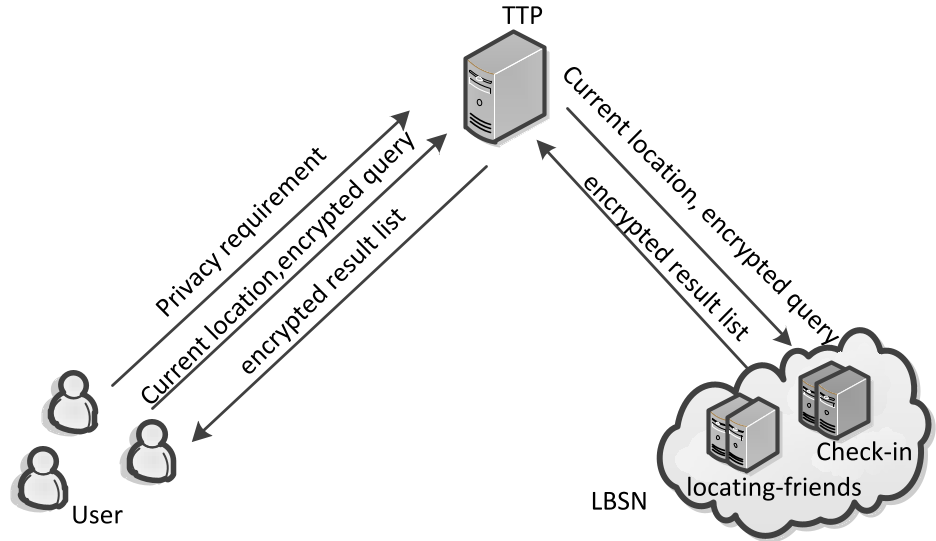 Figure 1: The CLPP Architecture showing the TTP evaluating privacy before the LBSN receives data.
Experiments: Privacy vs. Utility
A common fear in privacy research is that being too safe makes the app "useless" (Utility loss). The authors tested CLPP on a dataset of 18,000+ Foursquare users.
Key Findings:
- Accuracy: The Collaborative Filtering (CF) algorithm caught much more "leaked" information than basic pattern matching (True Positive Rate).
- Efficiency: Even with 10% of the world marked as "sensitive," users were still able to post the vast majority of their check-ins.
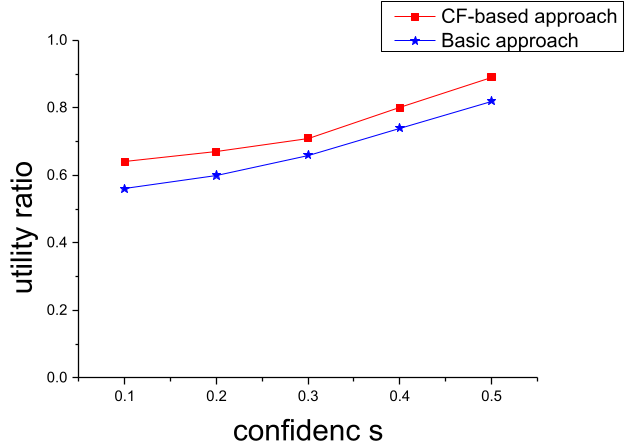 Figure 2: The CF-based approach (red line) consistently achieves higher accuracy in detecting hidden locations compared to basic mining.
Critical Insight: Why This Matters
The genius of this paper lies in its rejection of the "one-size-fits-all" privacy model. By acknowledging that human mobility is subjective, the authors created a system that doesn't just block data—it understands why that data might be revealing.
Limitations
- Trusted Third Party: The system relies on a "fully trusted" TTP. In the real world, finding a server you trust 100% is difficult.
- Computational Cost: While training is offline, calculating complex Bayesian probabilities on the fly for millions of users requires significant infrastructure.
Conclusion
CLPP shifts the landscape from "Where are you now?" to "What does your path say about you?" It proves that by using the same tools used for recommendation engines (Collaborative Filtering), we can build stronger, more personalized armor for our digital lives.