
Deciphering the Mind: Cluster Analysis of Personality Traits and Depression Risk
Cluster Analysis of Co-occurring Human Personality Traits and Depression
This study applies unsupervised machine learning—specifically hierarchical clustering—to investigate the co-occurrence of Big Five personality traits and depression levels. Using the StudentLife dataset, the research identifies specific personality profiles that correlate with higher susceptibility to depressive symptoms.
TL;DR
Can your personality layout predict your vulnerability to depression? This research leverages unsupervised machine learning to group individuals based on their Big Five personality traits and measures how these clusters overlap with clinical depression scales (PHQ-9). The findings confirm that specific "personality signatures"—particularly those featuring high neuroticism and low extraversion—are statistically closer to severe depressive states.
Background & Motivation
Psychology has long known that traits like Neuroticism are correlated with mental health struggles. However, human behavior is rarely the result of a single trait. The complexity of depression makes it hard to isolate variables using traditional linear methods.
The author's insight was to treat personality as a multi-dimensional coordinate in a latent space. By applying cluster analysis, the research moves away from "what" trait causes depression toward "which type of person" is most at risk, using data-driven classification rather than predefined labels.
Methodology: Mapping the Personality Space
The study utilized the StudentLife dataset (Dartmouth College), which tracks students via smartphones and standardized questionnaires.
The AI Pipeline
- Normalization: Raw scores from the Big Five and PHQ-9 were mapped to a 0-1 scale.
- Distance Metric: Used Euclidean Distance to measure the "dissimilarity" between individuals' personality vectors.
- Clustering Algorithm: Employed Hierarchical Clustering with the "Complete Linkage" (full binding) method. This method defines the distance between two clusters as the distance between their most distant members, ensuring compact, well-separated groups.
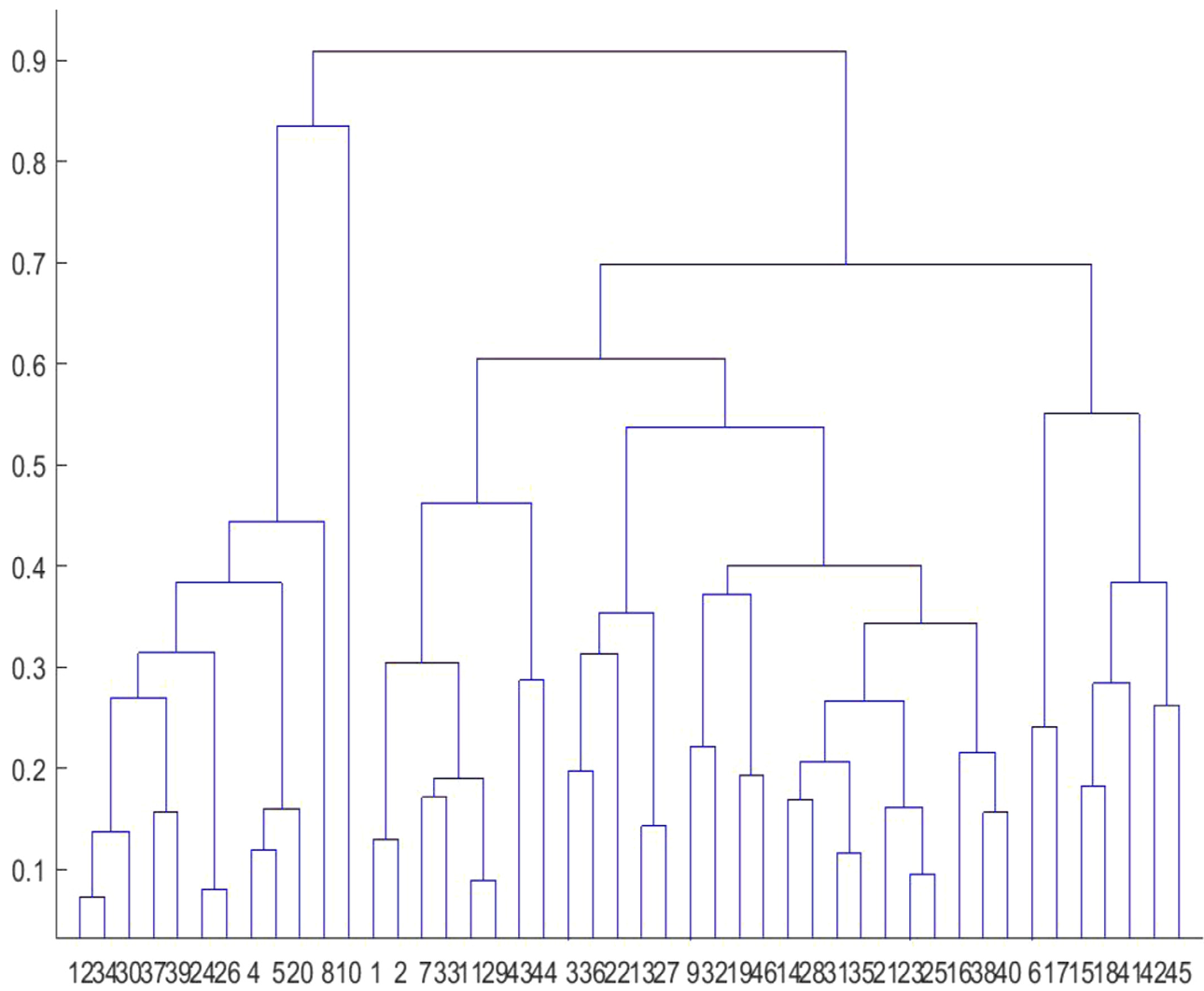 Figure 1: The Dendrogram used to determine the optimal number of clusters (dividing the data at d = 0.55).
Experimental Insights
The research identified four meaningful clusters. By calculating the maximal distance between these clusters and clinical depression levels, a clear mapping emerged:
- Cluster 1 (The Baseline): Characterized by average traits across the board. This group was closest to the "None-to-minimal" depression level.
- Cluster 3 (The Risk Group): Defined by Low Extraversion and High Neuroticism. This cluster exhibited the shortest distance () to the Moderate-to-severe depression group.
- Cluster 4 (The Resilient Group): High Extraversion, Low Neuroticism, and High Agreeableness. This group was the most "distant" from severe depressive symptoms.
 Table 1: Quantitative distance analysis showing Cluster 3's high proximity to moderate-to-severe depression.
Critical Analysis & Conclusion
Why this matters
The study demonstrates that unsupervised learning can validate psychological theories. The association of "Low Extraversion + High Neuroticism" with depression aligns with the vulnerability model of personality. By using AI to identify these clusters, clinicians could potentially flag at-risk students based on a simple personality test before symptoms become debilitating.
Limitations
- Sample Size: With only 46 complete datasets, the granularity of the clusters is limited.
- Self-Reporting: As the author notes, questionnaire data is subject to "self-presentation bias," where respondents may not accurately define their characteristics.
Future Outlook
The integration of AI into psychology is a "force multiplier." Future work should include dynamic data (sensor data from smartphones) alongside these static personality clusters to create a real-time "early warning system" for mental health.