
TCOL-Miner: Maximizing Social Influence via Community-Aware Leader Discovery
A cluster-based opinion leader discovery in social network
The paper introduces TCOL-Miner, a two-stage cluster-based method for identifying opinion leaders in social networks. By combining community detection (H_Cluster) and behavior-based k-means clustering with semantic analysis, it effectively finds influential users while minimizing influence overlapping.
TL;DR
TCOL-Miner is a novel framework designed to identify opinion leaders in large-scale social networks by addressing the dual challenges of computational efficiency and influence overlapping. Unlike traditional methods that focus solely on individual popularity, TCOL-Miner uses a two-stage clustering process—first identifying social communities and then filtering for leadership quality—to ensure discovered leaders have a broad, non-redundant reach.
Problem & Motivation: The Overlap Trap
In social network analysis, an "Opinion Leader" is not merely someone with many followers, but an information generator whose commentary shapes public opinion. However, the industry faces two major hurdles:
- Influence Overlapping: High-profile users often belong to the same social circles. Selecting them simultaneously results in "preaching to the same choir," failing to reach unique segments of the network.
- Structural Complexity: Large social graphs are notoriously difficult to process. Many SOTA algorithms like PageRank variants are time-consuming when applied to millions of nodes.
The authors' insight is to prioritize the Network Structure first. By partitioning the network into "communities" (where users interact more with each other than with outsiders), they ensure that leaders are selected from different social "islands."
Methodology: The Two-Stage TCOL-Miner
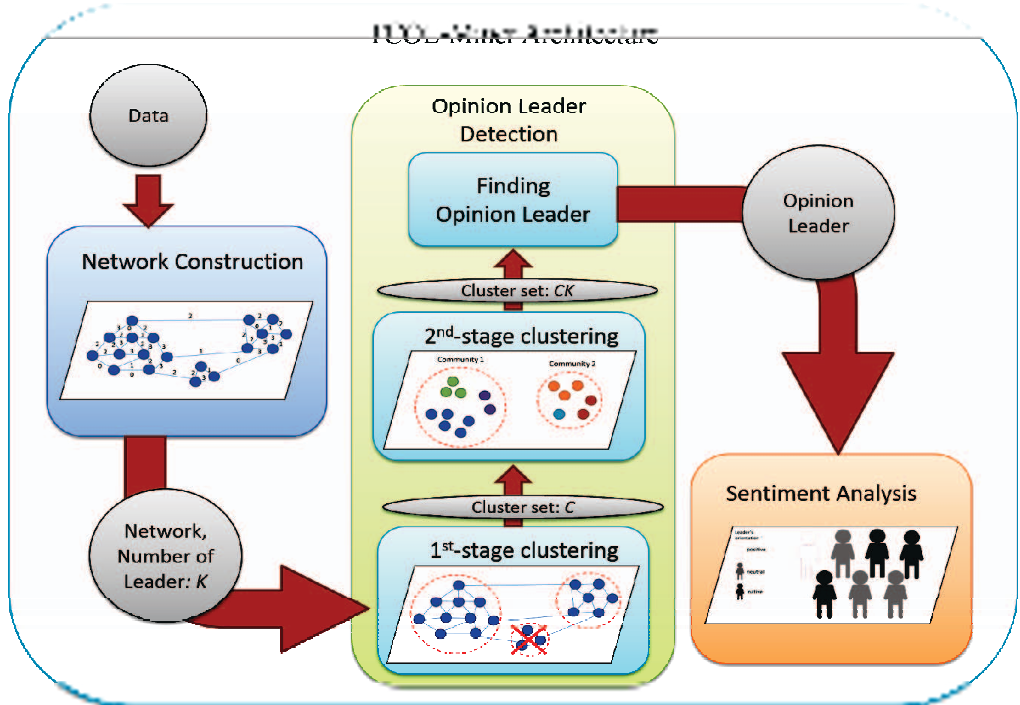
The framework consists of three logical components:
1. Social Network Construction
The authors construct a graph where edges represent "reply-article" relations. A unique feature is the inclusion of Temporal Weights. They segment 24 hours into four activity windows; users active at similar times are assigned higher similarity weights, reflecting the physical reality of real-time interaction.
2. The Two-Stage Clustering Core
This is where the heavy lifting occurs:
- Stage 1: Community Detection: Using a modified H_clustering approach, the system merges nodes into communities based on structural weight. Crucially, it uses Modularity Gain as a termination criterion—it stops when further merging no longer improves the network's partition quality.
- Stage 2: Candidate Ranking: Within each community, users are evaluated based on four dimensions: Article Count, Replied-by Probability, Expertise Degree, and Reply Probability. A k-means algorithm then prunes unpromising nodes to find the elite "cluster" of potential leaders.
3. Sentiment Analysis
Identifying a leader is only half the battle; knowing their stance is the other. TCOL-Miner utilizes the NTUSD lexicon to classify leaders as positive or negative based on the keywords in their posts, allowing brands to avoid "negative leaders" who might criticize their products.
Experiments: Superior Influence Spread
The authors tested TCOL-Miner on two large datasets from the Mobile01 Forum: LEXUS (23,797 members) and AUDI (21,130 members).
- Benchmark: They compared their approach against
att_clustering, a method that clusters users based only on individual attributes without considering community structure. - The Result: As the number of selected opinion leaders () increases, TCOL-Miner shows a significantly steeper and more consistent growth in "Influence Spread."
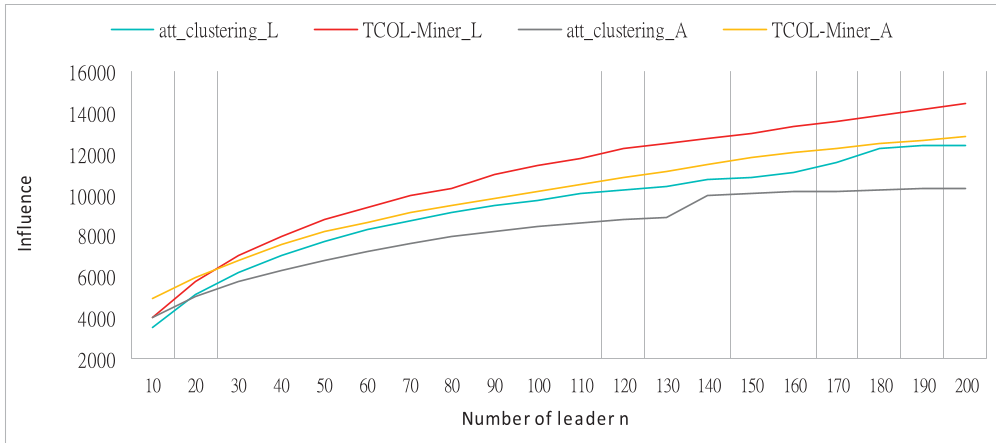
The data suggests that while traditional methods hit a plateau (because they keep picking leaders within the same community), TCOL-Miner continues to find leaders in "undiscovered" parts of the social graph.
Critical Insight & Conclusion
The true value of TCOL-Miner lies in its Inductive Bias that social influence is a localized phenomenon. By enforcing a "one leader per community" logic (effectively), the algorithm acts as a diversified portfolio manager for social capital.
Takeaways for Practitioners:
- Diversity over Density: Don't just hire the top 10 influencers by follower count; hire the top 1 influencer from 10 different sub-communities.
- Timing Matters: Incorporating user activity times into graph weights is a clever, low-cost way to capture hidden social ties.
Limitations: The sentiment analysis relies on a static lexicon (NTUSD), which may struggle with sarcasm or rapidly evolving internet slang. Future iterations could benefit from LLM-based sentiment scoring for higher nuance.