
DCPL: Overcoming Complexity in Social RL via Dynamic Clustering
Cluster-Based Social Reinforcement Learning
The paper introduces Dynamic Cluster-based Policy Learning (DCPL), a Social Reinforcement Learning (RL) framework designed for large-scale social networks. By dynamically clustering agents based on interaction patterns and contribution features, it reduces policy dimensionality from to (where ), achieving SOTA performance in fake news mitigation tasks on Twitter datasets.
TL;DR
Scaling Multi-Agent Reinforcement Learning (MARL) to social networks with thousands of users is notoriously difficult due to the exponential growth of action spaces and the sparsity of interactions. Dynamic Cluster-based Policy Learning (DCPL) solves this by grouping users into dynamically updated clusters. This reduces the number of parameters from to , effectively mitigating the "curse of dimensionality" while maintaining high performance in tasks like fake news suppression.
The Sparsity Trap: Why Social RL is Hard
In a typical social network, we have thousands of agents (), but each agent only interacts with a tiny fraction of others. This creates two massive hurdles for standard RL:
- Dimensionality: A joint policy considering all interaction dependencies requires learning a staggering number of parameters.
- Noise: Because interactions are sparse, there isn't enough signal to accurately capture "higher-order" relations between agents, leading to high-variance and "noisy" policy estimates.
Previous SOTA methods either ignored agent dependencies to maintain scalability or suffered from high variance. DCPL suggests a "middle way": agent-grouping that evolves as the agents' behaviors change.
Methodology: The Logic of Dynamic Abstraction
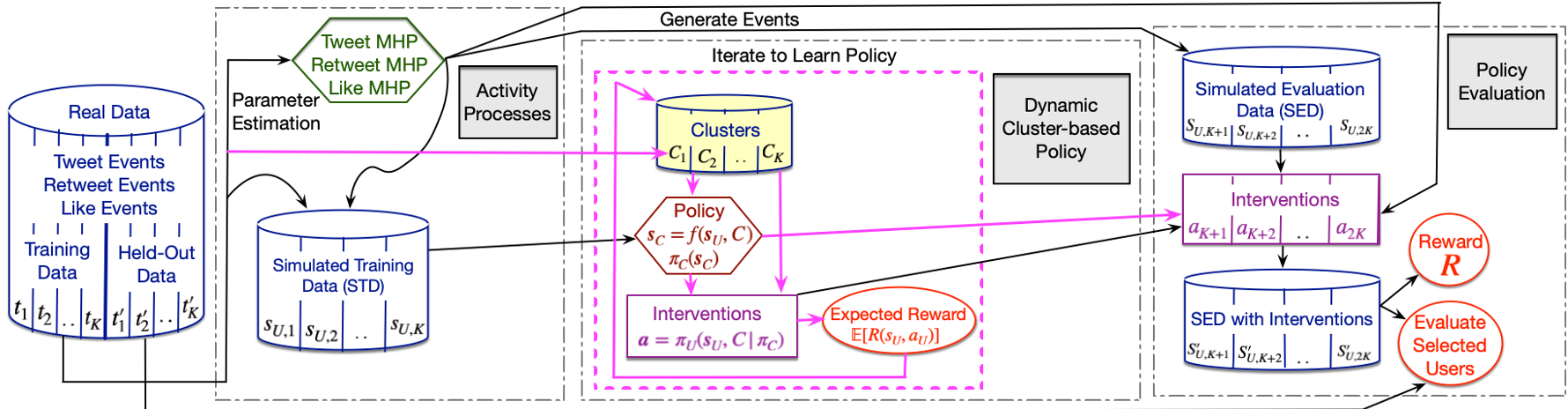
The core innovation of DCPL is its Cluster-Based Policy Learning architecture. Instead of treating every user as a unique decision point, the system treats clusters as the primary entities.
1. Modeling Dynamics with MHP
The system uses Multivariate Hawkes Processes (MHP) to model the continuous-time event streams (tweets, retweets). This captures how one user's action triggers another's—essential for simulating the "spread" of news.
2. Strategic Clustering Features
Unlike simple K-Means, DCPL clusters users based on two reinforcement-learning-specific features:
- Payoff: How responsive a user was to previous interventions.
- Contribution: The marginal benefit of applying a policy to a specific user versus not applying it (inspired by Difference Rewards).
3. Dynamic Alignment
Clusters are not static. As the policy improves, user behavior changes, and thus the clusters must be updated. DCPL uses weighted centroids to ensure clusters stay aligned across training epochs, preventing the "moving target" problem that often destabilizes multi-agent systems.
Experiments and Results
The authors tested DCPL on real-world Twitter 2015 and 2016 datasets. The task was to increase the spread of "True News" to mitigate "Fake News."
- Efficiency: DCPL achieved faster convergence than non-clustering (NC) methods. By reducing the search space, the agent finds an optimal policy in fewer iterations.
- Stability: The clustering approach showed significantly lower variance. By aggregating interactions, the model effectively "smooths out" the noise caused by data sparsity.
- Performance: DCPL outperformed static clustering (KM-R), proving that updating cluster memberships dynamically is crucial as agents adapt to the learning policy.
Critical Insight & Conclusion
The brilliance of DCPL lies in its personalized action derivation. Even though the policy is learned at the cluster level, the actions are applied at the agent level by weighting action intensity based on the distance to the cluster centroid. This maintains the "similarity" of the group while respecting the "variability" of the individual.
Future Outlook: While highly effective for fake news mitigation, the DCPL framework could theoretically be applied to any massive multi-agent system where interactions are locally sparse but globally complex, such as epidemiological modeling or targeted pandemic interventions.
Takeaway: In the world of massive MARL, sometimes the best way to see the forest is to group the trees.