
Beyond Flat Data: Harvesting Semantic Wisdom through Ontology-Based Clustering
Clustering Ontology-Based Metadata in the Semantic Web
The paper introduces a novel framework for clustering ontology-based metadata in the Semantic Web environment. It proposes a multi-dimensional similarity measure—comprising taxonomic, relational, and attribute levels—integrated into a hierarchical clustering algorithm to group semantically rich instances like those in the CIA World Factbook.
TL;DR
The paper presents a sophisticated method for grouping Semantic Web resources by leveraging the rich structure of ontologies. By combining taxonomic position, relational networks, and literal attributes into a unified similarity metric, the authors enable hierarchical clustering that "understands" the context of metadata, successfully reconstructing geographic and political blocs from raw RDF data.
Background: The Semantic Web as a Goldmine
In the vision of the Semantic Web, information is not just text but machine-processable metadata linked to formal ontologies. While this provides a rigorous structure, it poses a challenge for traditional Machine Learning (ML). Standard clustering algorithms expect "flat" feature vectors, but ontology-based metadata is a complex web of hierarchies and relationships. This paper shifts the focus from "what is the value" to "where does this instance sit in the global knowledge structure."
The Core Challenge: Measuring Similarity in a Web of Links
Prior work often treated relationships as simple strings or ignored the taxonomy of concepts. The authors argue that to truly cluster metadata, we must consider three distinct dimensions:
- Taxonomy: Is a "Country" more similar to a "City" than to an "Organization"?
- Relations: Do these two countries share borders with the same neighbors or belong to the same trade blocs?
- Attributes: Are their population growth rates and infant mortality figures comparable?
Methodology: The Triple-Threat Similarity Measure
The backbone of this research is a weighted similarity function that balances three specialized sub-measures.
1. Taxonomy Similarity & Upwards Cotopy
The authors use Upwards Cotopy (UC) to define the semantic distance between concepts. If two instances belong to concepts that share many super-concepts (ancestors in the hierarchy), they are deemed more similar.
2. Relational Similarity (The Recursive Heart)
This is perhaps the most innovative part. The similarity of two instances depends on the similarity of the objects they relate to. For example, two countries are similar if they both "BELIEVE" in religions that are themselves taxonomically similar.
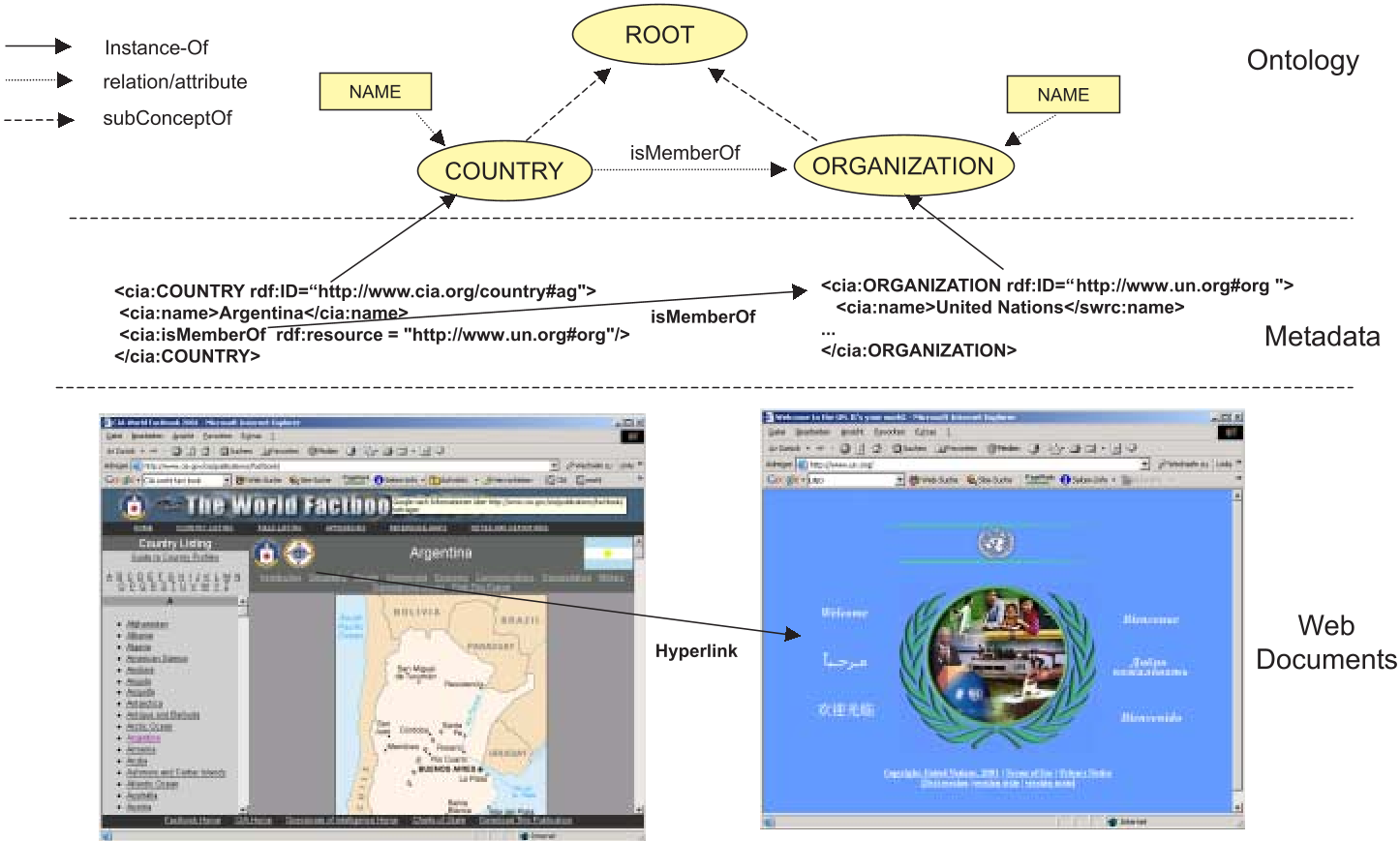 Figure 1: Illustration of the interplay between Ontology structure, Metadata instances, and Web documents.
3. Attribute Similarity
The system attempts to parse literals (Date, Number) and performs normalization. It calculates the maximum difference across the dataset to provide a normalized similarity score between 0 and 1.
Performance & Experiments: Reconstructing the World
The researchers tested their approach on the MONDIAL database (a derivative of the CIA World Factbook). Using Hierarchical Bottom-Up Clustering, they allowed the algorithm to merge the most similar instances until a tree (dendrogram) was formed.
Key Findings:
- Scandinavian Cluster: The algorithm grouped Norway, Finland, Sweden, Denmark, and Iceland together purely based on their relations (languages, borders, religions), even though the word "Scandinavian" never appeared in the source data.
- The Weight of Relations: The authors found that "Relation Similarity" was the most potent predictor of real-world groups. In their evaluation, they weighted it twice as heavily as others.
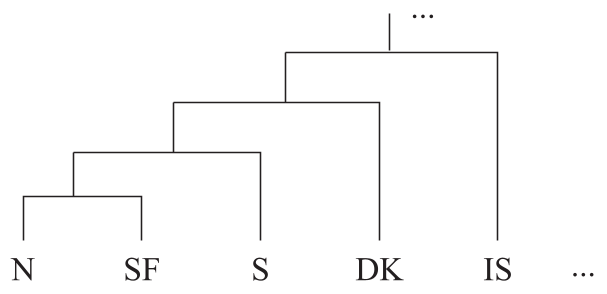 Figure 2: Dendrogram showing the successful clustering of Scandinavian countries based on metadata relations.
Critical Insight: Why This Matters
The fundamental "Aha!" moment of this paper is the realization that in a Semantic Web context, identity is defined by association. A metadata instance has little meaning in isolation; its value is derived from its position in the taxonomy and its links to other instances.
Limitations & Future Work
The study highlights a significant bottleneck: the lack of widely available, high-quality pre-classified ontology metadata for benchmarking. Furthermore, the approach's recursive nature for relational similarity can be computationally expensive on very large graphs, suggesting a need for optimization in future iterations.
Conclusion
By moving away from "keyword" or "vector" based similarity and toward a structural, ontology-aware metric, Maedche and Zach have provided a roadmap for ML in the Semantic Web. Their work bridges the gap between formal knowledge representation and exploratory data analysis, proving that the machines of the future can indeed "discover" the latent structures of our world.