
Beyond the Bound: How Clustering Shapes Opinion Dynamics in Social Networks
Influence of Clustering on the Opinion Formation Dynamics in Online Social Networks
This paper introduces a novel opinion formation model that incorporates the human cognitive ability to perceive opinion clusters in Online Social Networks (OSNs). By utilizing K-means clustering and a multi-factor influence metric, it challenges the traditional distance-based "bounded confidence" paradigm to better reflect real-world polarization and lack of global consensus.
TL;DR
Researchers have developed a new model for how opinions form in Online Social Networks (OSNs) by replacing the traditional "distance threshold" with a human-centric clustering perception. The model shows that we aren't just influenced by people "close" to us, but by the size, consistency, and social power of groups we perceive in our digital neighborhood. This explains why global consensus is nearly impossible in the modern age of polarization.
The "Confidence" Problem in Prior Work
For decades, social dynamics research relied on Bounded Confidence (BC) models. The logic was simple: if your opinion is too far from mine, I ignore you. However, this fails in the OSN era. Imagine a large, vocal group of influencers on the "other side" of a debate. Even if their views are distant from yours, their collective volume and social status (Centrality) make them impossible to ignore.
The authors argue that humans naturally perform "clustering" to make sense of the noise. We don't see 100 individuals; we see 3 distinct "camps."
Methodology: The Anatomy of Influence
The researchers treat each agent as a mini-data scientist. When updating an opinion, an agent performs the following steps:
-
Clustering: Uses the K-means algorithm to group neighbors' opinions into clusters.
-
Influence Assessment: Each group is evaluated using a formula that balances several physical and social properties:
- (Consistency): How unified is the group? High entropy means a weak, scattered group.
- (Centrality): Does the group contain "Opinion Leaders"?
- & : The distance to the group and the variance within it.
-
The Weighted Update: The agent shifts their opinion toward the centroid of the most influential cluster, regardless of whether it is within a traditional "confidence bound."
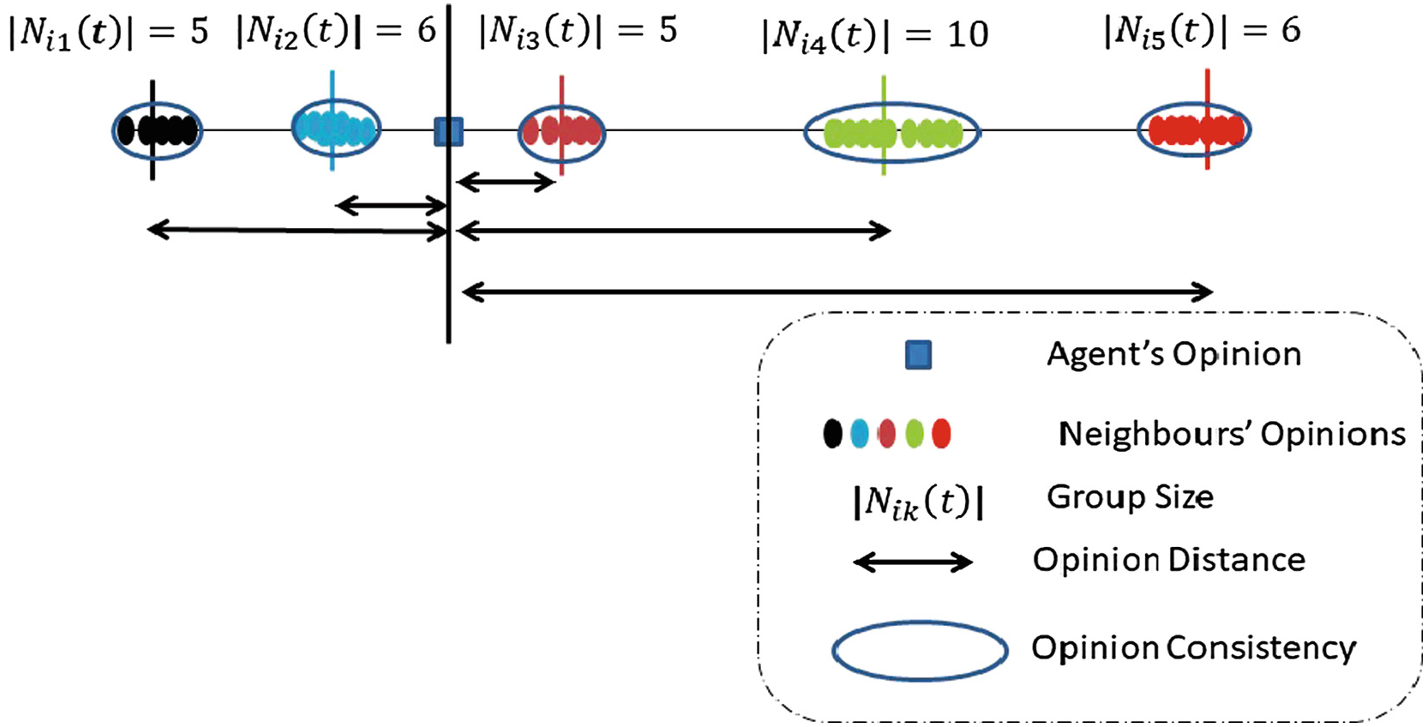 Figure 1: Conceptual diagram showing an agent at 0.3 observing five distinct neighbor groups.
Simulation Results: The Reality of Polarization
The study simulated 1,000 agents on a scale-free network (mimicking the "power-law" structure of real social networks).
1. The Death of Consensus
Unlike BC models that often lead to everyone agreeing if the threshold is high enough, this model never yields a steady-state global consensus. Instead, it generates multiple "polarization groups." This mirrors the persistent "Vaccination" or political debates seen in OSNs today.
2. The Impact of "Fine-Grained" Perception ()
When agents are "coarse" (), the society settles into two clear poles. However, when agents are "fine-grained" (), the dynamics become volatile. Agents frequently "jump" between groups as the influence levels shift, eventually settling into one massive pole and several smaller, stubborn "fringe" groups.
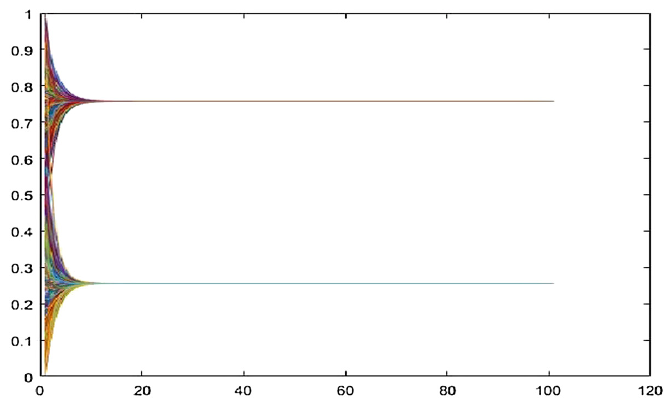 Figure 2: Evolution of opinions over time across different clustering perceptions ().
3. The Power of Influence (Centrality)
The model confirms a harsh social truth: agents with high degree centrality (more connections) can "pull" the center of gravity of the entire network. When high-centrality agents are placed at one end of the opinion spectrum, the resulting final cluster at that end is significantly larger, effectively swallowing neutral agents.
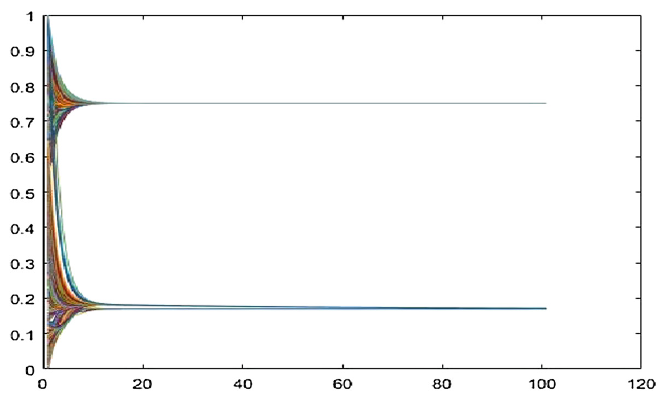 Figure 3: Final opinion distributions showing how clusters shift toward high-centrality nodes (Leaders).
Critical Insight & Conclusion
This work provides a vital theoretical bridge between Cognitive Psychology and Network Science. By proving that "influence" is a product of group consistency and social status rather than just proximity, it explains why "echo chambers" are so resilient.
Limitations: The model assumes a fixed number of clusters () for each agent, whereas in real life, a human might dynamically change how many groups they perceive based on the complexity of the topic. Future research should look into Dynamic Selection to further refine our understanding of OSN radicalization.