
Kernel CCA: Decoding the Semantic Fabric of Social Event Images
Clustering Social Event Images Using Kernel Canonical Correlation Analysis
The paper introduces an automatic multi-view clustering framework using Kernel Canonical Correlation Analysis (KCCA) to group large-scale social multimedia into unique events. By projecting diverse modalities into a correlated semantic subspace, the method achieves a high Normalized Mutual Information (NMI) score of 0.92 on a dataset of 100,000 Flickr images.
TL;DR
Navigating the chaos of social media multimedia requires more than just looking at pixels. This paper proposes a Kernel Canonical Correlation Analysis (KCCA) framework to aggregate images into unique events by maximizing the correlation between different "views" like visual SIFT features and textual metadata. The result? A robust clustering mechanism that achieves over 0.91 NMI, proving that who uploaded the photo and how they tagged it is often more telling than the image itself.
Problem & Motivation: The Multi-Modal Mess
When thousands of users upload photos from a single concert or a political rally, browsing them becomes a nightmare. Existing methods often rely on simple textual queries or basic PCA, which ignore the rich, non-linear relationships between different data modalities.
The authors identify a core challenge: Visual inconsistency. Two photos from the same event might look entirely different due to angles or lighting, while photos of two different concerts might look remarkably similar. To solve this, we need a way to find the "semantic glue" that binds different info-streams (images, tags, usernames, timestamps) together.
Methodology: High-Dimensional Correlation
The core of this work lies in Multi-View Clustering. Instead of treating an image and its tags as a single flat vector, the authors treat them as separate "views."
The KCCA Pipeline
- Feature Extraction: Images are converted to SIFT-based Bag-of-Words (BoW) vectors, while text (titles/tags) is transformed into TFIDF vectors.
- The Kernel Trick: Since real-world data is non-linear, the authors use a Gaussian (RBF) Kernel to map features into a higher-dimensional space.
- Maximizing Correlation: KCCA finds project directions ( and ) such that the correlation between the projected views is maximized. This creates a "Semantic Space" where related items are pulled together.
- Clustering: Standard k-means is applied within this newly learned, low-dimensional coordinate system.
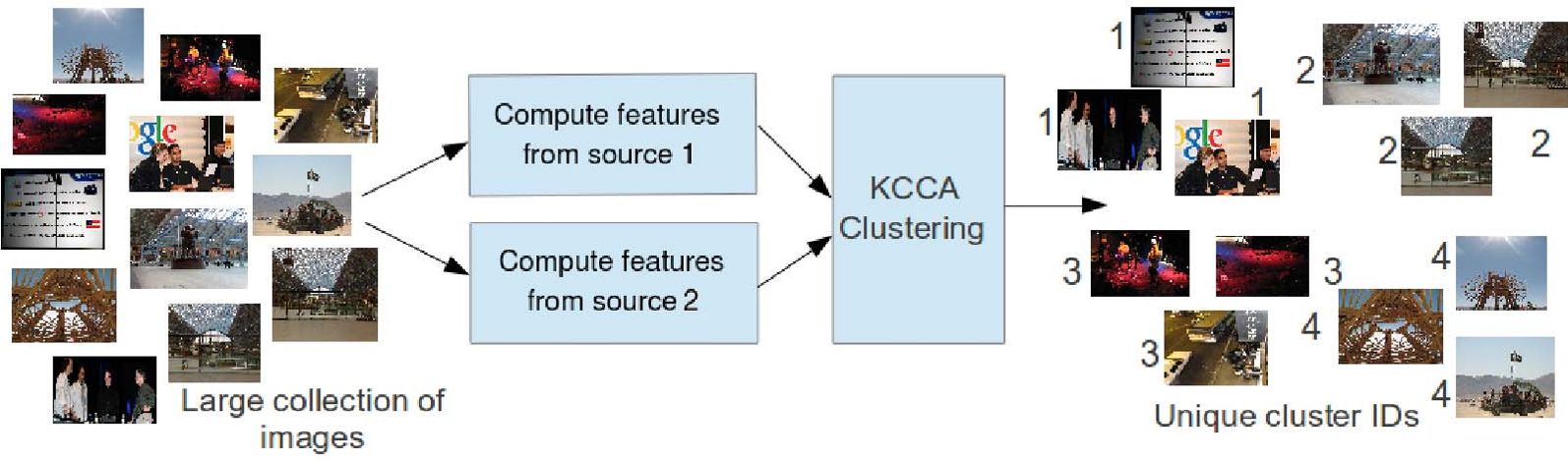 Figure 1: Overview of the KCCA-based aggregation approach.
To handle the computational cost of kernel matrices on 100,000 images, the authors utilize Incomplete Cholesky Decomposition (ICD), a smart way to approximate large matrices without losing significant precision.
Experiments & Results: Metadata is King
The authors tested various combinations of features on the MediaEval 2013 Social Event Detection dataset.
Key Findings:
- The Power of Usernames: Surprisingly, combining usernames and tags yielded the best performance (NMI: 0.9166). This suggests that social patterns (who follows whom/what) are incredibly strong indicators of event boundaries.
- Visual Limitations: Visual features alone are insufficient for "unique event" detection. However, when paired with usernames, they achieve a high NMI of 0.8933.
- Heuristic Search: Through empirical testing, the authors found that the top 12-22 canonical variates are sufficient to represent the underlying event structure.
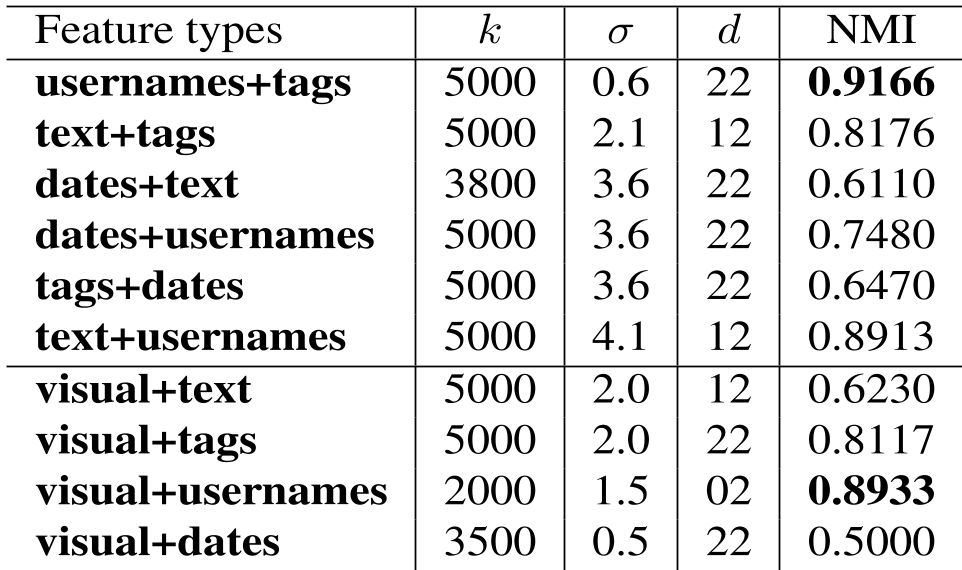 Table 1: NMI scores across different feature combinations and parameters.
Critical Analysis & Conclusion
Takeaway
The paper successfully demonstrates that semantic representations for social events are best learned by looking at the interaction between modalities. KCCA provides a mathematically grounded way to perform this fusion without a supervised signal.
Limitations
- Scalability: While ICD helps, KCCA still struggles with the sheer volume of "millions" of images in real-time social streams.
- Human-in-the-loop: The number of clusters () still needs to be estimated or searched, which is difficult in dynamic, real-world settings where the number of daily events is unknown.
Future Outlook
The authors propose moving toward incremental clustering algorithms to handle social streaming data. In today's context, replacing SIFT with deep embeddings (like CLIP or ResNet) within this KCCA framework could likely push these results even closer to perfect NMI scores.