
CNN-Based Stress and Emotion Recognition: Transforming Biosignals into Visual Intelligence
CNN-based stress and emotion recognition in ambulatory settings
The paper proposes a multi-modal framework for unobtrusive stress and emotion recognition in ambulatory settings, utilizing a custom CNN architecture to analyze 2D ECG spectrograms and facial expressions. By integrating physiological signals (ECG, EDA), body posture (Kinect), and facial features, the system achieves a state-of-the-art accuracy of 97.64% on the SWELL-KW dataset.
TL;DR
This research presents a sophisticated framework for monitoring workplace stress and negative emotions using unobtrusive sensors. By converting 1D heart rate signals into 2D spectrograms and leveraging mobile-optimized CNNs for facial analysis, the authors achieved an impressive 97.64% accuracy in stress detection and established a real-time pipeline for emotion recognition on Android devices.
Problem & Motivation: The Challenge of Unobtrusive Monitoring
Monitoring mental health and stress in a "wild" or ambulatory setting—like a busy office—is notoriously difficult. Previous methods often fall into two traps:
- Obtrusiveness: Requiring medical-grade equipment that interferes with work tasks.
- Lack of Robustness: Relying on a single modality (like heart rate alone) which can be easily confused by physical movement or environmental changes.
The authors' insight was to treat physiological data not just as a series of numbers, but as frequency patterns. By visualizing signal changes over time using spectrograms, they could utilize the power of Deep Learning (CNNs) originally designed for image recognition to identify the "signature" of stress.
Methodology: The Fusion of Vitals and Vision
The framework is split into two distinct yet complementary modules:
1. The Stress Detection Module
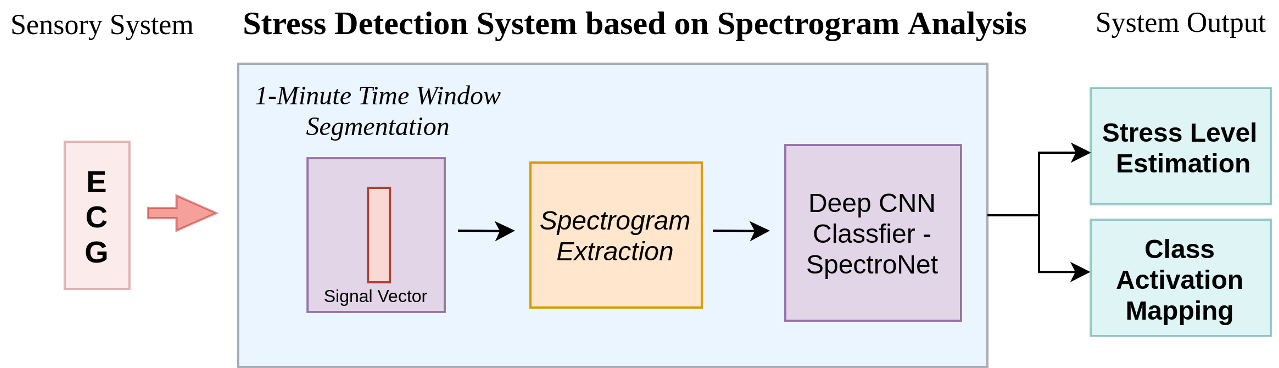
The authors explored two paths here. First, a traditional Machine Learning path using 171 statistical features from ECG, EDA, and body posture. Second—and more innovatively—a 2D CNN path.
- Spectrogram Analysis: Raw ECG signals are transformed into spectrograms. This captures how the frequency content of the heart rate changes.
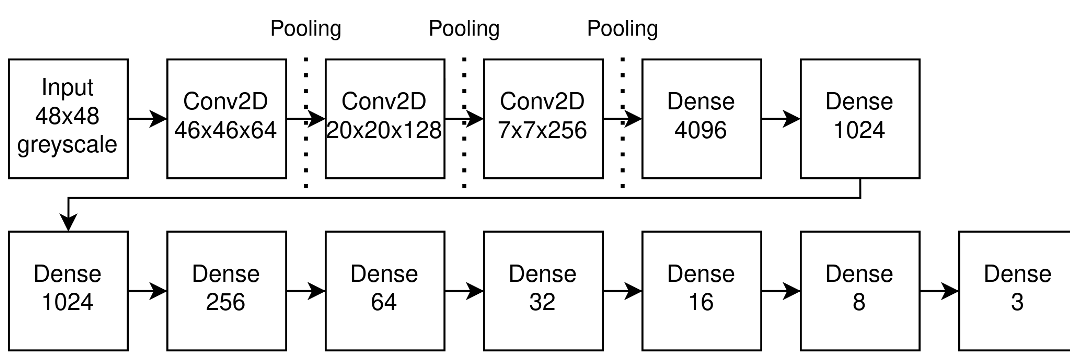
- Architecture: A VGG-like backbone with Batch Normalization and Leaky ReLU, optimized for mobile (only ~700K parameters).
- Class Activation Mapping (CAM): This allows the researchers to see where in the frequency spectrum the model is looking to decide if someone is stressed.
2. Emotion Recognition on the Edge
To complement physiological data, the team built an Android-based module that processes facial expressions via the smartphone camera.
- Real-time Processing: Using TensorFlow Lite and a modified FER2013 architecture, the app achieves inference in ~1.5 seconds.
- Robustness: It uses "Batch Voting," evaluating 10 frames at once to ensure a single blurry frame doesn't trigger a false emotion detection.
Experiments & Results: Setting New Benchmarks
The study utilized two major datasets: SWELL-KW (office work) and WESAD (physiological laboratory data).
Key Performance Metrics:
- Fusion Superiority: While individual sensors performed well (Posture: 90.38%), the Decision-Level Fusion (Majority Voting) achieved the highest performance of 97.64% accuracy.
- SOTA Comparison: Compared to the original SWELL study by Koldijk et al. (89.3%), this methodology provides nearly a 10% absolute improvement in accuracy.
- The Power of 2D: The CNN-based spectrogram analysis alone achieved 96.79% accuracy on WESAD, proving that "seeing" the signal is often better than simply calculating its mean or variance.
Comparison with Prior Work:
| Modality | Prior Work (Koldijk) | This Study (Ours) |
|---|---|---|
| Physiology | 64.1% | 80.71% |
| Body Posture | 83.4% | 90.38% |
| Combined (Fusion) | 89.3% | 97.64% |
Critical Insight & Future Outlook
The most profound takeaway is the effectiveness of 2D representation of 1D biosignals. By using Class Activation Mapping, the authors proved that stress isn't just a "faster heart rate"—it is a specific temporal pattern in the frequency domain.
Limitations: The study flags the subject-dependent nature of these signals. What looks like stress for one person might be a normal baseline for another.
Future Work: The team plans to create an "ECG-guided" system. To save battery and privacy, the system will only trigger the camera for emotion recognition when the low-power wearable ECG detects a stress threshold has been crossed. This "hierarchical sensing" could be the key to making mHealth applications practical for 24/7 use.