
Empowering the Next Generation: Co-Designing ML Apps with Primary School Children
Co-Designing Machine Learning Apps in K–12 With Primary School Children
This paper presents a study on Co-Designing Machine Learning (ML) applications with primary school children using Google Teachable Machine (GTM). The research demonstrates that GTM, a CNN-powered web tool, successfully enables 12-year-olds to create functional image, sound, and pose recognition models for mobile deployment.
TL;DR
Is Artificial Intelligence too complex for a 12-year-old? This study proves otherwise. Using Google Teachable Machine (GTM), researchers in Finland engaged 6th graders to co-design, train, and deploy their own ML-powered mobile apps. The results reveal that while children can easily grasp the training workflow, the real challenge lies in the "data hunger" and accuracy of the models they create.
Context & Motivation
AI is no longer just a subject for PhDs; it is a fundamental literacy requirement. Historically, AI in schools was a "black box" — kids used it but didn't build it. The authors of this paper shift the paradigm from AI for Learning (tutors) to Learning AI (construction). The goal was to see if modern web-based tools like GTM could bridge the gap between abstract computational thinking and concrete application development.
Methodology: From Idea to Interaction
The researchers followed a three-day workshop structure centered on Co-Design:
- Exploration: Students learned the basics of Convolutional Neural Networks (CNNs) through simple visual tools.
- Training: Groups used GTM to collect data and train models for three categories: Images, Poses, and Sounds.
- Realization: Researchers took the students' trained models and UI drafts to build nine functional web apps, ranging from mushroom identifiers to cheerleader practice aids.
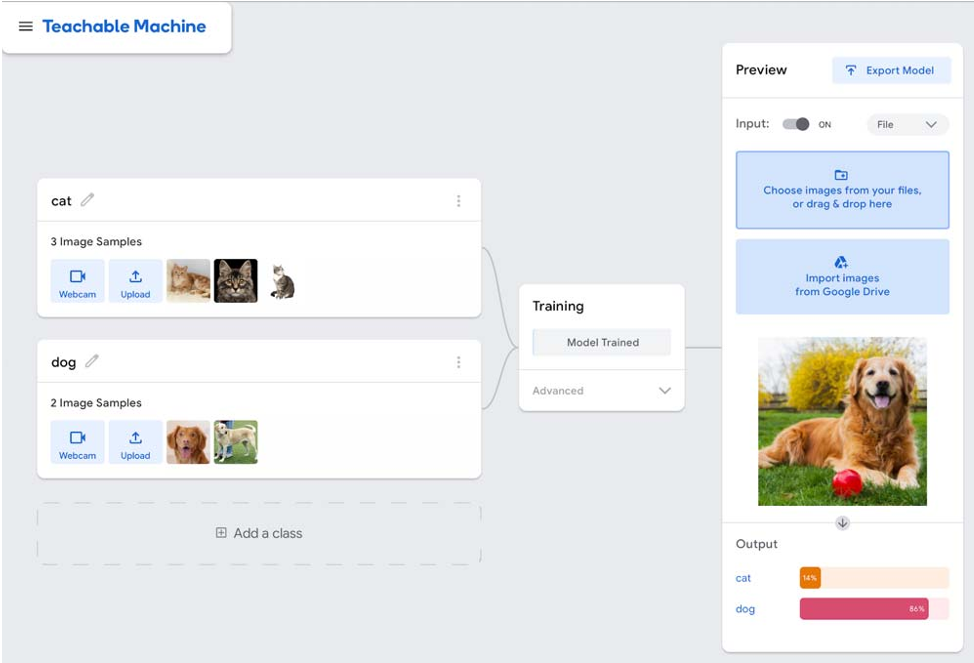 Figure 1: The GTM interface used by students to train CNN models locally in the browser.
Technical Performance: Efficiency vs. Accuracy
One of the most significant findings was the technical feasibility of these "kid-made" models:
- Lightweight Execution: The models integrated via
Tensorflow.jswere exceptionally efficient. They ran on low-end mobile devices with minimal latency, making them accessible to students regardless of their hardware's price point. - The Accuracy Gap: While the image-based models (e.g., berry detection) performed well, the sound recognition apps struggled. Students discovered that real-world background noise was a "distractor" the models hadn't been trained to ignore.
Critical Insight: The Data Realization
The pedagogy here moves beyond "coding." The students experienced the Empirical Loop of ML:
- Collect data.
- Train.
- Test and see it fail.
- Realize the need for better and more data.
This shift in understanding — that an AI's "intelligence" is strictly bounded by the diversity of its training set — is perhaps the most valuable meta-cognitive lesson for K-12 students.
Conclusion & Future Outlook
The study concludes that GTM is a "mature and feasible" tool for primary education. However, the authors note a crucial limitation: Time. To achieve professional-grade accuracy, students need more time to collect rich, diverse datasets. Future work should look at how to simplify the "app development" phase further, perhaps through block-based coding (like Scratch or Snap!) so that children can move from model training to app deployment without researcher intervention.
By positioning children as "meaning-makers" rather than passive users, this research provides a blueprint for an inclusive, multidisciplinary AI curriculum that aligns with modern global education standards.