
Decoupling Reality from Perception: How Our Phone Logs Predict Our Friendships
Co-evolution of two networks representing different social relations in NetSense
2016-11-30
Summary
Problem
Method
Results
Takeaways
Abstract
This paper investigates the co-evolution of "Cognitive" (subjective survey nominations) and "Behavioral" (objective mobile logs) social networks using the NetSense dataset. Leveraging longitudinal data from college students, it characterizes how communication patterns predict friendship formation and how cognitive dissolution signals future behavioral decay.
## TL;DR
Does talking to someone make them your friend, or do you talk to them *because* they are your friend? By analyzing the **NetSense** dataset—a unique combination of 4 semesters of smartphone logs and survey data from Notre Dame students—this study reveals that behavior (calls/texts) builds the bridge to friendship, but cognitive changes (feelings) are what ultimately burn that bridge down.
## The Research Intuition: Behavior vs. Cognition
The link between what we *do* and what we *think* is a cornerstone of social network analysis. This paper positions itself at the intersection of two networks:
1. **The Behavioral Network**: Objective, high-frequency data from mobile call and text logs.
2. **The Cognitive Network**: Subjective, low-frequency nominations from surveys ("Who are your most important contacts?").
The authors argue that these networks don't just coexist; they **co-evolve** in a feedback loop. Using these dual layers, they tackle the "chicken and egg" problem of social ties.
## Methodology: Tracking the Pulse of Social Ties
The study tracks ~200 freshmen over two years. By mapping phone numbers to survey nominations, they create a coupled temporal model.
### 1. The Growth Phase (Behavioral Precedence)
The data shows that a massive spike in communication acts as a leading indicator. Students who are "to-be-nominated" as friends in a future survey already show 7-8x higher call and text volumes than non-friends.
### 2. The Maintenance Phase (Cognitive Stability)
Once a cognitive link is established, communication frequency stabilizes. Interestingly, "older" friendships (existing for >1 semester) show slightly more stability than brand-new ones, suggesting a "maturation" of the social edge.

## The Anatomy of Dissolution: Why Friendships End
One of the most profound insights of this paper is how friendships die. It starts in the mind.
* **Cognitive Lead**: When a student stops nominating someone as a "friend" in the survey, their actual communication (calls/texts) begins to plummet shortly after.
* **Recency Score (RS)**: By applying a weighting system that favors recent interactions, the authors proved that communication in "dissolving" edges happens mostly at the beginning of a semester and dries up by the end.
## The Curse of Asymmetry
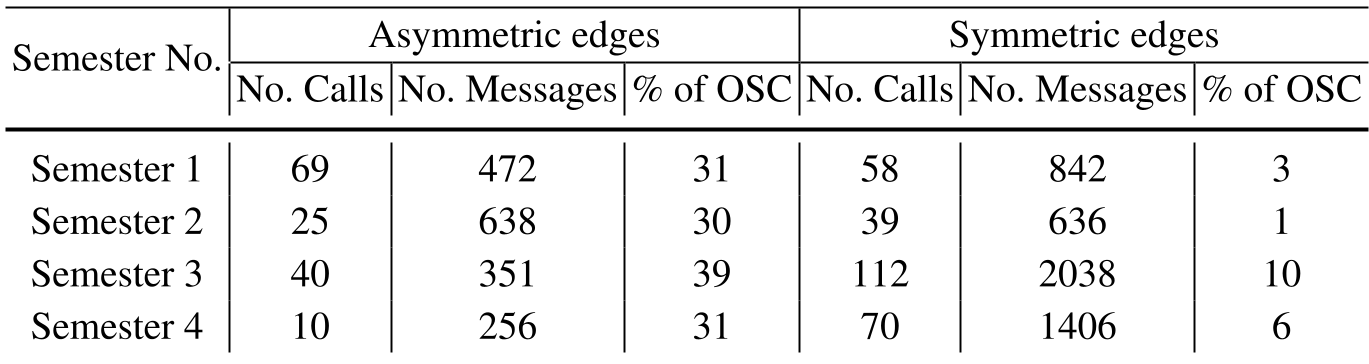
Not all friendships are mutual. The study finds that **Asymmetric Cognitive Edges** (where Person A nominates B, but B does not nominate A) are inherently unstable:
* **Higher Turnover**: Asymmetric edges have a dissolution probability of up to 90% in early semesters, compared to much lower rates for mutual friends.
* **Communication Imbalance**: These edges are 10x more likely to have imbalanced communication flows, where one person "chases" the other with messages that are rarely reciprocated.
## Critical Insight & Conclusion
This research confirms that while we need interaction to "discover" a friend, the **cognitive nomination** acts as the glue that maintains the behavior. Once the cognitive salience fades, the behavior follows.
**Takeaway for the Future**: For technologists and sociologists, this implies that "meaningful" interactions in social apps cannot be measured by volume alone. The **reciprocity and perceived value** (the cognitive layer) are the true predictors of long-term user retention and network stability.
**Limitations**: The study is limited to a college freshman demographic, which is known for highly volatile social transitions. Future work should explore if these "behavior-before-cognition" patterns hold in more stable, adult professional networks.