
Co-Evolutionary Networks: Decoding the Hidden Pulse of Social Interaction
A Co-Evolutionary Model for Inferring Online Social Network User Behaviors
This paper introduces a Co-Evolutionary Model for inferring user behaviors on Online Social Networks (OSNs) by modeling the dynamic mutual influence between users and behavior types. It achieves state-of-the-art performance, notably reaching an MAE of 0.024 hours for time inference and significantly outperforming baseline linear and logic models.
TL;DR
Predicting what a user will do next on social media—and exactly when they will do it—is a multi-faceted challenge involving time, identity, and action. This paper proposes a Co-Evolutionary Model that moves beyond static distributions. By treating users and behaviors as two parts of a bipartite graph that update each other's latent features in real-time, the model achieves a 7x improvement in timing accuracy compared to traditional linear and logic-based baselines.
Problem & Motivation: The Static Trap
Prior work in social network mining typically treats user behavior as a one-way street. Researchers either extracted static features (personality traits, past text) or fitted data to predefined probability distributions.
The Insight: Real social networks are dynamic ecosystems. A "leader" user might post frequently, influencing the "post" behavior's global state. Conversely, a holiday or a viral challenge (the "behavior") might temporarily transform a passive user into an active participant. This mutual influence—the Co-Evolution—is what current models miss.
Methodology: The Latent Feedback Loop
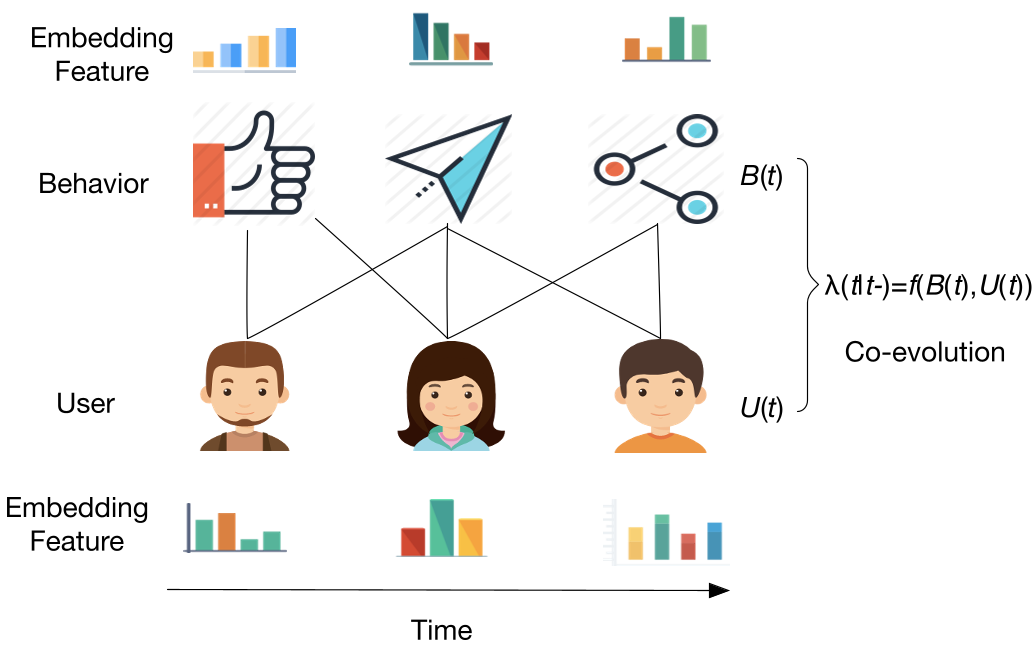
The core of the paper is a dual-update mathematical framework that refreshes user and behavior embeddings every time an event occurs.
1. The User-Behavior Bipartite Update
The model maintains two sets of latent vectors:
- (User Embedding): Updated based on temporal drift, self-evolution, the behavior they just performed, and—crucially—the influence of their followees.
- (Behavior Embedding): Updated based on the global trend and the types of users currently engaging with that behavior.
2. The Intensity Function
To answer "When will the next event happen?", the authors define an intensity function using a Gaussian kernel. This measures the "pressure" for an event to occur. Following a Rayleigh distribution, the expected time for the next event is inversely proportional to the current intensity.
Experiments & Results: Crushing the Baselines
The authors validated their model using a dataset of ~700,000 Twitter events (posts, favors, link shares).
- Time Inference: The Mean Absolute Error (MAE) was reduced to just 0.024 hours, a staggering 7.19x improvement over Linear Regression and Logic models.
- User/Behavior Inference: Accuracy for predicting "Who" and "What" improved by 12% to 14%.
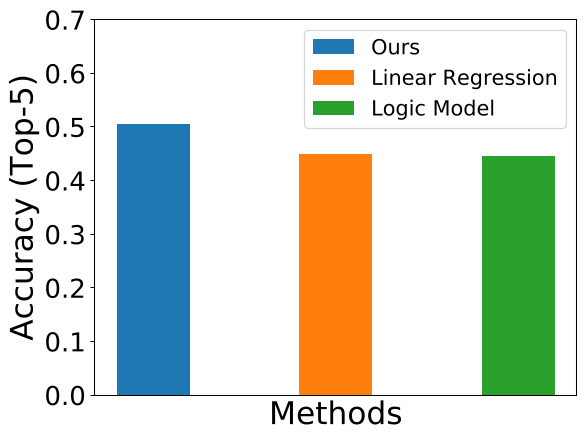 Fig: (a) Time Inference MAE (lower is better), (b) User Inference Accuracy.
Training Dynamics
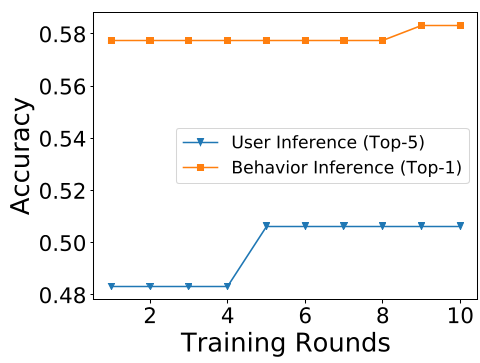
The model exhibits excellent convergence, with the time inference error dropping sharply and stabilizing after only about 8 training epochs.
Critical Analysis & Conclusion
Takeaway
The success of this model lies in its Inductive Bias: the realization that social behaviors are not just individual choices but are linked to global trends. By incorporating a "Followee Influence" term into the user update equation, the authors bridge the gap between individual modeling and network-wide graph theory.
Limitations & Future Work
While the time inference is revolutionary, the User and Behavior prediction accuracy (around 50-60%) leaves room for growth. The authors acknowledge that their current loss function is optimized primarily for time. Future iterations aim to implement Multi-Objective Optimization to simultaneously maximize accuracy across all three dimensions (When, Who, What).
This work sets a new benchmark for how we model the "Pulse" of the internet, with direct applications in hot topic prediction, recommendation systems, and digital assistant technologies.