
Co-Following: Decoding the Hidden Social Fabric of Twitter
Co-following on twier
The paper introduces "Co-following," a second-order similarity measure on Twitter that identifies relationships between users based on the overlap of the accounts their followers follow. By applying this methodology to 18 commercial and political rivalries, the authors achieve high-performance user classification (mean AUC 0.81) and reveal deep cultural insights without relying on language-dependent content.
TL;DR
This study demonstrates that who you follow reveals more about you than what you say. By analyzing "second-order co-following"—the friends of your followers—researchers can predict your political leanings and brand preferences with high accuracy (AUC ~0.81). This language-agnostic approach bypasses the "homophily ghetto" and uncovers invisible connections between seemingly unrelated entities like Apple and Puma.
Context: Beyond the "Follow" Button
In the Twitter ecosystem, a direct follow is a strong signal of interest. However, most research stops at these direct links. This paper argues that the true "signal" lies in the aggregated lifestyle of an audience. Even if two people never interact, if their followers share a distinct set of interests (e.g., both follow the same niche news outlets or musicians), those two people are functionally similar.
Methodology: The Power of Second-Order Connections
The core innovation is the Global Summary Vector.
- Data Sampling: For rivals like @CocaCola and @Pepsi, the authors sampled 2,000 followers.
- Feature Extraction: They looked at all the accounts those 2,000 followers followed (their "friends").
- IDF Weighting: To ensure that following a "super-celebrity" (like Justin Bieber) doesn't drown out specific interests, they applied Inverse Document Frequency (IDF) to weight rare, more informative follows more heavily.
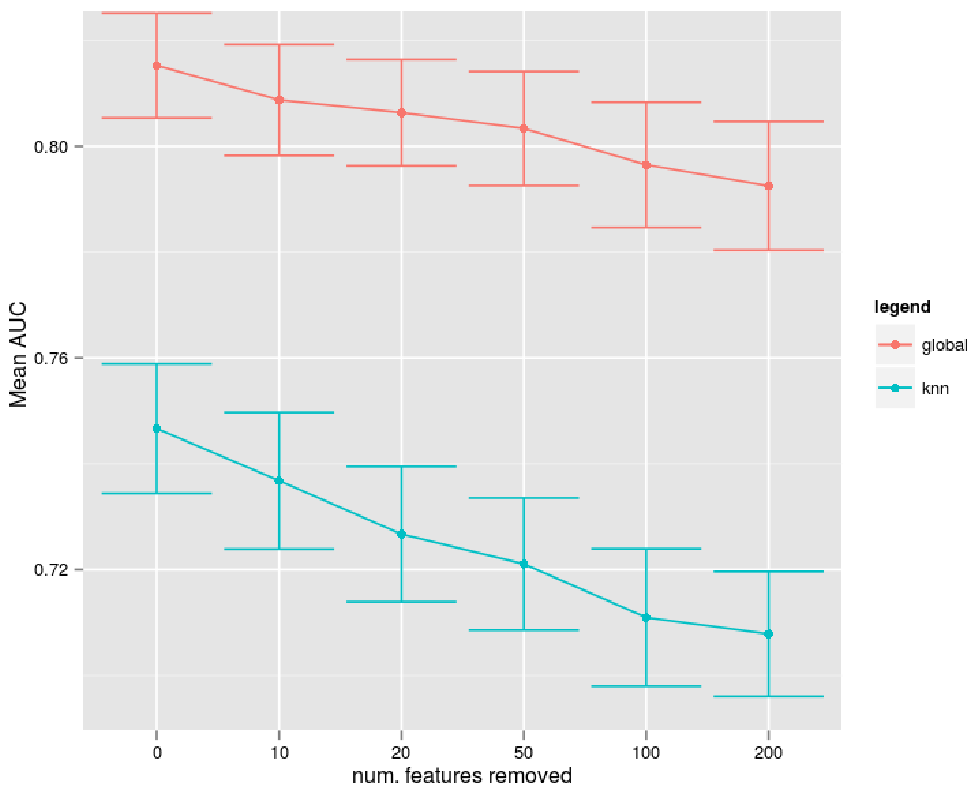 The study found that a "Global" vector aggregating the long-tail of followers works significantly better than "Local" k-NN approaches.
Key Insights: Lifestyle Politics & Marketing
The paper moves beyond math into the realm of Computational Social Science. By analyzing feature ranks, the authors validated several "lifestyle" stereotypes:
- Politics: @TheDemocrats followers are more likely to follow @nytimes and @ladygaga, while @GOP followers lean toward @WSJ and @kennychesney.
- Brand Affinity: @SnoopDogg followers surprisingly prefer @Pepsi over @CocaCola.
- Cross-Selling: The study revealed a striking similarity between @PUMA and @TheAppleInc audiences, suggesting both brands successfully target the "metropolitan sports-lifestyle" demographic.
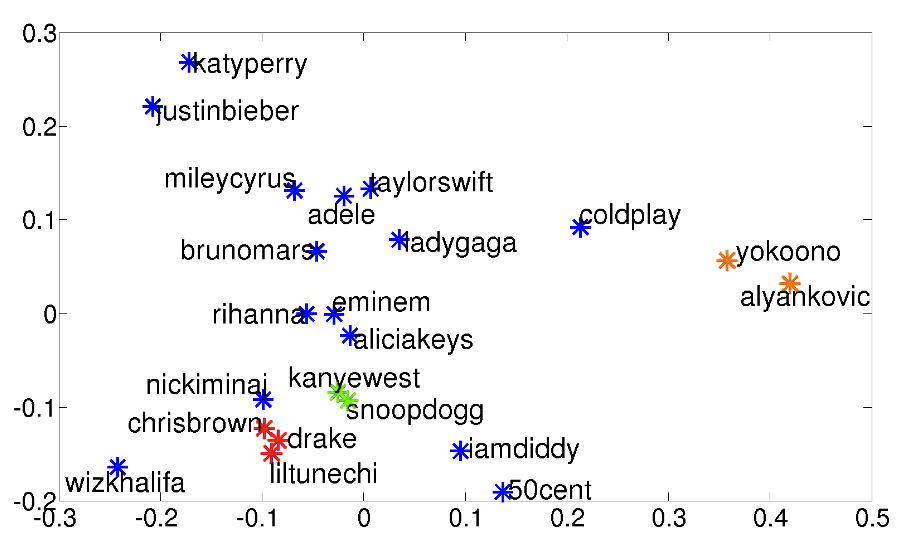 Figure: A 2D MDS map showing the relative positions of rivals. Notice the proximity of @MillerCoors to @GOP, confirming political-beverage correlations.
Robustness: Surviving the "Obvious"
A common critique of such models is that they rely on "obvious" features (e.g., following @BarackObama makes you a Democrat). The authors performed an ablation study by removing the top 200 most discriminative features. Remarkably, the classification remained robust. This suggests that "weak interests"—the subtle, aggregated patterns of many niche follows—contain almost as much information as the marquee connections.
Critical Analysis & Future Outlook
Takeaway: Co-following provides a "language-agnostic" way to understand users. This is vital for global platforms where NLP tools might fail across different dialects or slang.
Limitations: The study relies on 2014-era Twitter API access and focuses on U.S.-based users to avoid market penetration bias. The computational cost of fetching "friends of followers" is high, which may limit real-time scalability.
Future Work: As social media shifts toward algorithmic feeds (like TikTok), the "follow" signal might change. Future research should investigate if "co-engagement" (liking the same posts) provides a similar second-order signal to "co-following."
Conclusion
This work proves that our digital shadows—the networks of people our followers choose to associate with—map out our cultural and political identity with startling precision. For marketers and social scientists, "Co-following" is a map of the hidden boundaries of the "Twittersphere."