
Elevating Healthcare Collaboration: Decoding User Satisfaction in Virtual Communities of Practice
The co-learning process in healthcare professionals: Assessing user satisfaction in virtual communities of practice
This study investigates the determinants of user satisfaction within Virtual Communities of Practice (VCoPs) in the Spanish healthcare sector. Using a logistic regression analysis on 130 professionals, it identifies that perceived effectiveness and individual involvement levels are the primary drivers of satisfaction, ultimately fostering collaborative learning and knowledge sharing.
TL;DR
Knowledge sharing in healthcare is no longer bound by hospital walls. This research identifies that perceived effectiveness and specialized knowledge are the "secret sauce" behind healthcare professional satisfaction in Virtual Communities of Practice (VCoP). By analyzing 130 Spanish clinicians, the study reveals that feeling "efficient" in collaborative diagnosis is far more important for long-term engagement than just having frequent access to digital tools.
Background: From Physical Cloisters to Digital Commons
In the traditional healthcare landscape, clinicians often work in silos. Whether it’s a primary care doctor in a rural setting or a specialized nurse in a bustling urban hospital, the risk of "Professional Isolation" is a significant barrier to evidence-based medicine. The advent of VCoPs—online environments where professionals share tacit knowledge—promises to bridge this gap. However, the transition from physical interaction to digital collaboration isn't always seamless.
The "Why": Motivation and Pain Points
Previous research focused heavily on what VCoPs do (cost reduction, faster management) but often ignored why some users find them satisfying while others don't. The authors identified a gap: the intersection of human professional profiles and technological perceptions. They posited that satisfaction isn't just about the technology itself, but how that technology aligns with a doctor's specific workplace needs and their ability to navigate the digital space.
Methodology: The Interaction Model
The researchers developed a model that tests 10 hypotheses, spanning from sociodemographic traits (gender, specialization) to technological habits.

Using Binary Logistic Regression, the team analyzed data from 130 practitioners. Unlike simple correlations, this method allowed them to hold multiple factors constant to see which ones truly drove the "Satisfaction" outcome. They measured variables like:
- Perceived Usefulness: Does it help me treat patients better?
- Perceived Efficiency: Does it save me time compared to traditional consults?
- Involvement Level: Am I a "Leader" or a "Lurker"?
Key Insights: Effectiveness Over Frequency
The results yielded several fascinating technical takeaways:
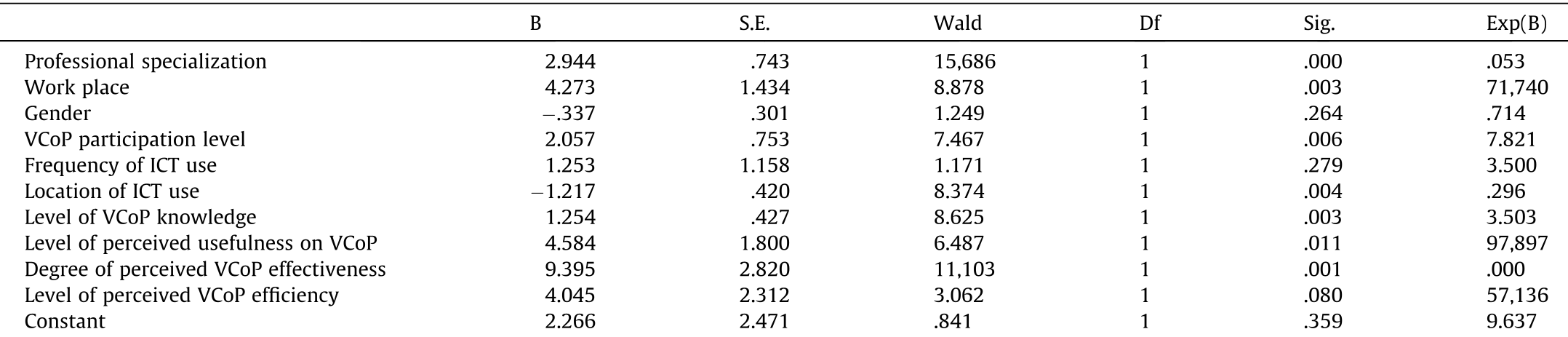
- Effectiveness is King: The highest statistical significance (p < 0.001) was found in the relationship between perceived effectiveness and satisfaction. If a doctor feels they can accurately solve a diagnostic dilemma via the VCoP, their satisfaction skyrockets.
- Gender Neutrality: Interestingly, gender had no significant impact (p = 0.264). This suggests that in professional medical communities, clinical utility transcends gender-based technology adoption differences seen in general social media.
- The Persistence of the "Lurker": The study categorized users into Core Leaders, Active Members, and Peripheral Lurkers. Those in the "Core" group showed significantly higher satisfaction, likely due to the Social Capital and trust built through high-frequency interaction.
Deep Dive: Critical Analysis
The most profound takeaway is the rejection of H6 (Frequency of Use). Simply using the platform every day does not make a professional more satisfied. This is a critical finding for VCoP designers: Quality of interaction triumphs over quantity. High-frequency noise can lead to information overload, which the authors explicitly cite as a limitation of modern digital tools.
Limitations to Consider
- Sample Size: 130 professionals is a solid start, but the findings may be culturally specific to the Spanish healthcare system.
- Exploratory Nature: The study relies on self-reported data through questionnaires, which can introduce subjective bias.
Strategic Recommendations for the Future
For healthcare IT managers and strategic leads, the roadmap is clear:
- Promote Utility, Not Just Access: Marketing a VCoP as "fast and easy" is less effective than showing "Success Stories" where the community solved a complex case.
- Tiered Engagement: Design features that encourage "Peripheral" members (Lurkers) to transition into "Active" members by lowering the barrier to knowledge contribution.
- Focused Sub-networks: Managers should identify the "Leaders" and empower them to moderate sub-specialty clinics within the VCoP.
In conclusion, VCoPs are not just technological platforms; they are organic social systems. Their success depends on the synergy between the professional's clinical environment and the digital tool's ability to provide efficient, reliable solutions to real-world medical problems.