
COATL: Scaling Real-Time AI Assistance from Zero to SOTA in Environmental Monitoring
COATL - a learning architecture for online real-time detection and classification assistance for environmental data
COATL is a staged online learning architecture designed for real-time detection and classification assistance in environmental data, specifically for deep-sea imagery. It transitions through KNN, SVM, H2SOL, and CNN models as the number of user-provided labels grows, achieving a top-3 accuracy of 0.97 and significantly reducing manual annotation effort.
TL;DR
COATL (Computational Online Assistance for Transect Labeling) is a web-based system that helps scientists label deep-sea images in real-time. By using a staged approach—switching between KNN, SVM, H2SOL, and CNNs as more labels become available—it bridges the gap between having no data and having a deep learning ready dataset. It achieves a 97% top-3 accuracy while keeping user interaction latency under the critical 1-second threshold.
The Cold-Start Problem in Environmental Science
In fields like deep-sea ecology, researchers face a "catch-22": they have millions of images but no labeled data to train an AI. Unlike facial recognition, where we have millions of pre-labeled "eyes" and "noses," deep-sea morphotypes are often unknown or unique.
Existing tools typically fail in two ways:
- The Latency Trap: Sophisticated models like CNNs take too long to retrain every time a scientist adds a single label.
- The Scarcity Trap: Simple models like KNN are fast but plateau in accuracy very quickly as the diversity of species grows.
COATL solves this by emphasizing dynamic adaptability—the system evolves its brain as the scientist provides more information.
Methodology: The Staged Learning Pipeline
The core innovation of COATL is its staged architecture. It doesn't use a single model; it uses an adaptive ensemble that switches based on the size of the training set .
- KNN ( labels): High speed, low data requirement.
- SVM ( labels): Improved accuracy using a Radial Basis Function (RBF) kernel, optimized via a one-vs-one scheme for speed.
- H2SOL ( labels): The authors' custom contribution—Hierarchical Hyperbolic Self Organizing Linear maps. It uses vector quantization in hyperbolic space to handle the hierarchical nature of biological taxonomies.
- CNN ( labels): A deep inception-based network for maximum performance once the dataset is mature.
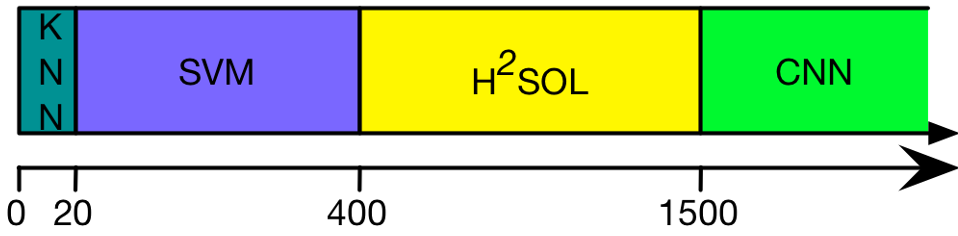 Figure 1: The staged learning approach where different learners take over as the label count grows.
Breaking Down H2SOL
Why H2SOL? As labels grow, SVM training time grows quadratically. H2SOL uses a "divide and conquer" approach by organizing data into a hierarchical grid. Each node in this grid learns a local linear classification function, allowing it to scale with the number of prototypes rather than the number of raw data points.
This formula represents how the system finds the nearest "prototype" node () and applies a local linear correction.
Real-Time Detection and Visualization
Finding objects in a high-res image is as hard as classifying them. COATL uses Local Shannon Entropy to generate saliency maps. This highlights areas with high "information content"—effectively "weird-looking" things on the sea floor—and presents them as Points of Interest (POIs).
To manage the user interface, they use Identicons. Since the species names are unknown beforehand, the system generates unique visual icons based on the MD5 hash of the class name, helping the scientist visually track consistent morphotypes.
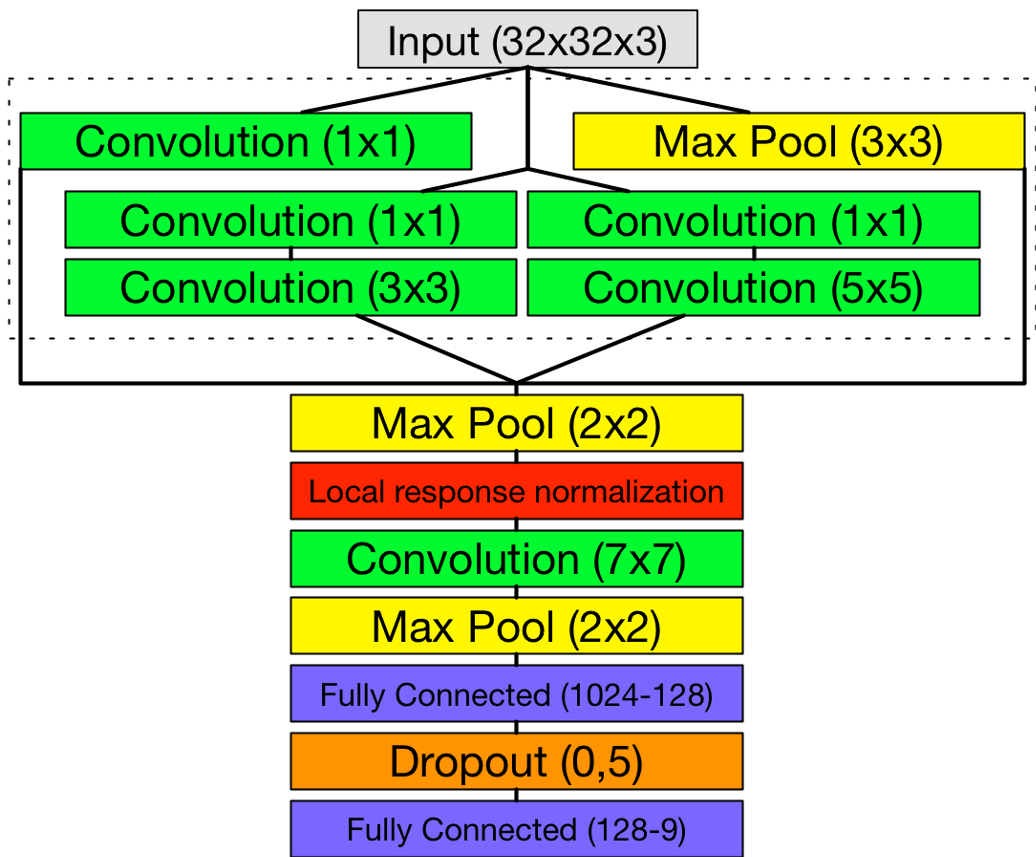 Figure 2: The deep learning stage utilizes an Inception module followed by fully connected layers.
Experiments & Results
The system was tested on the "HAUSGARTEN" dataset (Arctic deep-sea imagery).
- Accuracy: Reached 87% (top-1) and 97% (top-3).
- Latency: Training for SVM explodes after 400 labels, whereas H2SOL remains nearly flat, staying well under the 1-second "human frustration" limit.
- Efficiency: The assistance reduces a complex task (multiple clicks and typing) to just one or two confirmatory clicks.
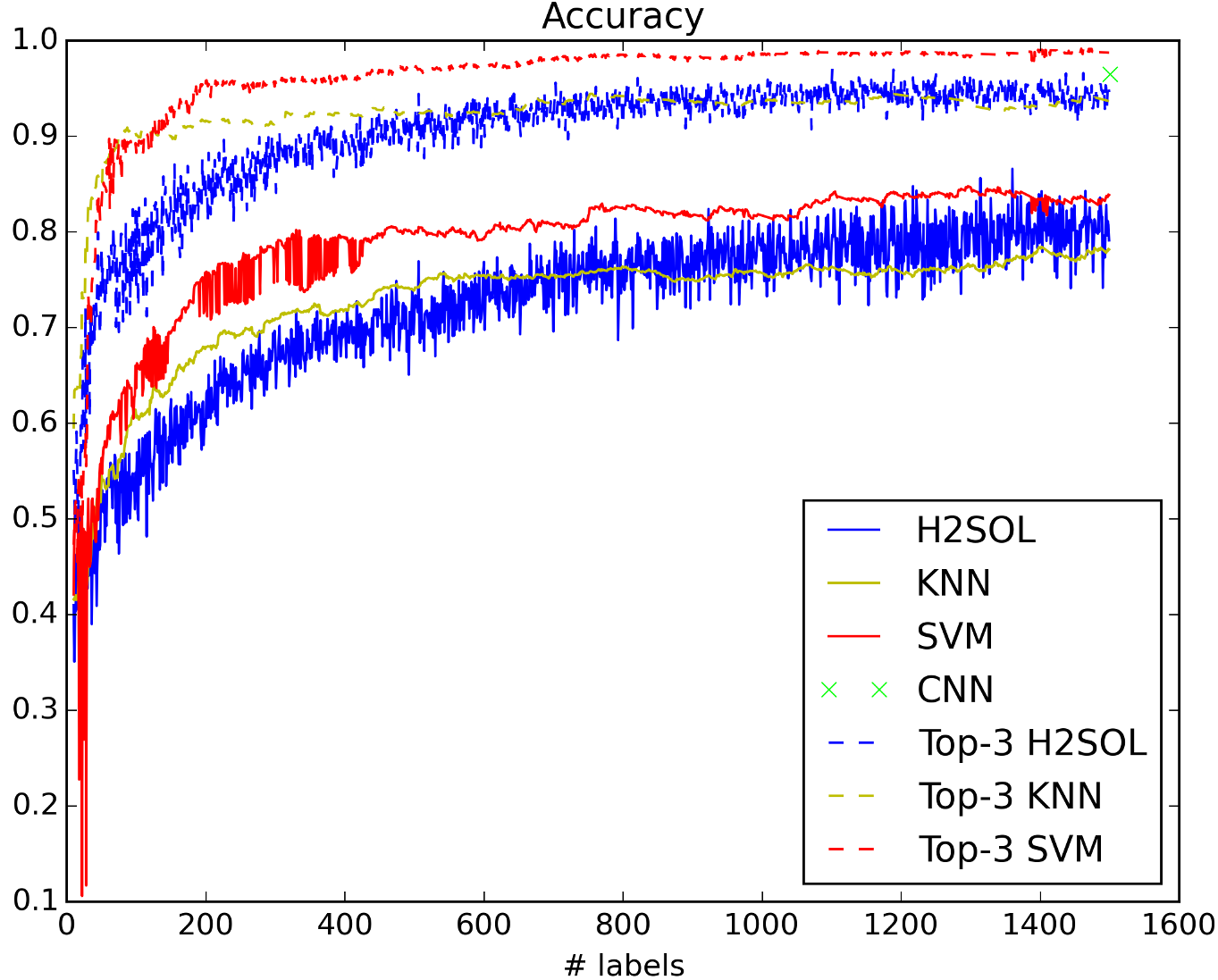 Figure 3: Accuracy performance across different models. Note the CNN (marked with 'x') achieving peak performance at the 1500 label mark.
Critical Analysis & Conclusion
Takeaway: COATL proves that "The Best Model" is a moving target. For interactive AI, the infrastructure for transitioning between models is as important as the models themselves.
Limitations:
- The entropy-based detection works best on homogeneous backgrounds (like sand). In complex environments (like coral reefs), it might over-trigger.
- The CNN still requires manual triggering or batch retraining (taking ~10 mins), which breaks the "real-time" flow at high label counts.
Future Outlook: Integrating self-supervised pre-training (like Masked Autoencoders) could potentially replace the MPEG7 features used in the early stages, giving the KNN and SVM stages even higher starting accuracy.