
Code Defenders: Weaponizing Gamification to Outperform Automated Testing Tools
Code Defenders: Crowdsourcing Effective Tests and Subtle Mutants with a Mutation Testing Game
This paper introduces Code Defenders, a gamified crowdsourcing platform where teams of "Attackers" and "Defenders" compete to generate high-quality mutants and unit tests for Java programs. The approach outperforms state-of-the-art automated tools like EvoSuite and Randoop in both code coverage and mutation scores.
TL;DR
Testing is often the "ugly duckling" of software development. While mutation testing (seeding bugs to check test quality) is powerful, it is plagued by redundant mutants and equivalent code. Code Defenders turns this struggle into a game. By pitting "Attackers" (who create subtle bugs) against "Defenders" (who write tests), the platform produces test suites and mutants that consistently outperform industry-standard automated tools like EvoSuite and Randoop.
Academic Positioning: This work sits at the intersection of Crowdsourcing and Software Engineering (Search-Based Software Testing). It challenges the purely automated status quo by proving that human competitive intuition still holds a significant "Intelligence Gap" over current algorithms.
The Problem: The Automation Wall
Software testing automation faces two major roadblocks:
- The Oracle Problem: Automated tools can generate inputs to cover lines of code, but they struggle to write meaningful assertions (the oracles) that catch subtle logic errors.
- The Equivalent Mutant Problem: Mutation tools generate thousands of artificial bugs. Many are "equivalent"—meaning the program’s behavior doesn't actually change. Identifying these is a massive manual drain on developers.
The authors’ core insight is that competition breeds creativity. If you make it a game to "break" someone else's code, humans will find the edge cases that a random or genetic algorithm might miss for hours.
Methodology: Attack, Defend, and Duel
Code Defenders operates on a multi-player web interface with a sophisticated scoring system designed to balance the "Meta-game."
1. The Roles
- Attackers: Using a code editor, they manually modify the class under test to create "subtle" mutants. They gain points based on how many tests their mutant "survives."
- Defenders: They view the source code and the locations of live mutants. Their goal is to write Junit-style tests that "kill" these mutants.
2. The Equivalence Duel
When a Defender finds a mutant they believe is impossible to kill (equivalent), they can trigger a Duel. The Attacker must then prove it is not equivalent by writing a killing test themselves. If they fail, the mutant is flagged as equivalent and the Attacker loses points.
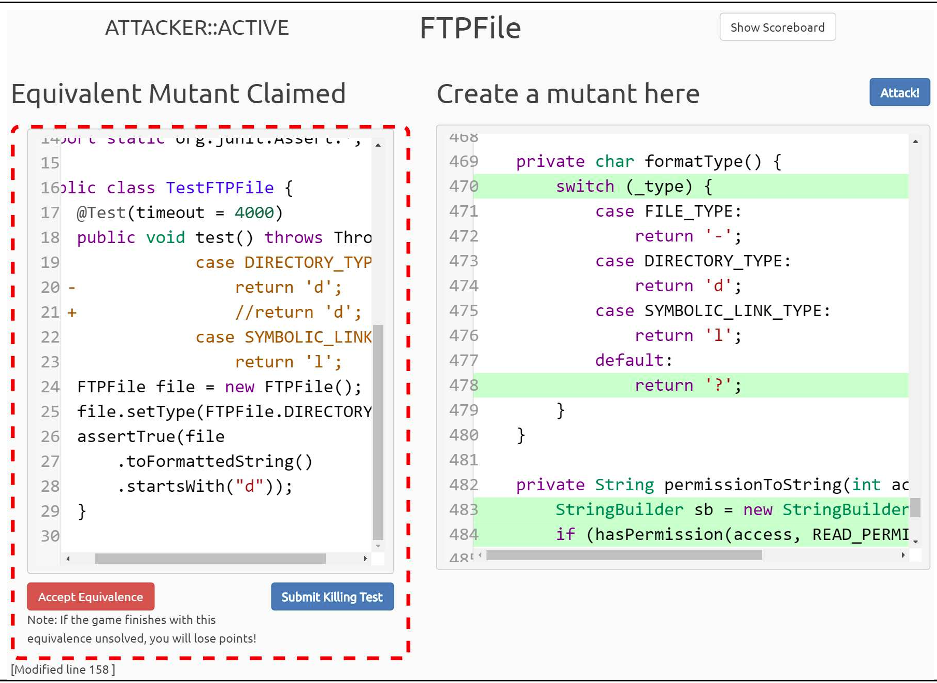 Figure 1: The Attacker's interface, showing code coverage and existing mutants.
Experiments: Humans vs. Machines
The researchers tested Code Defenders against EvoSuite (Search-based) and Randoop (Random-based) across 20 open-source classes from the SF110 and Apache Commons libraries.
Key Findings:
- Higher Coverage: The crowdsourced test suites hit 89.03% branch coverage, outperforming EvoSuite (80.39%).
- Superior Fault Detection: The "Mutation Score"—a proxy for how many real bugs a test suite would catch—was nearly 25% higher in Code Defenders compared to the automated tools.
- "Hard" Mutants: The mutants created by human attackers required far more random tests to "kill" than those generated by the
Majormutation tool, signifying that humans are better at finding "stubborn" faults.
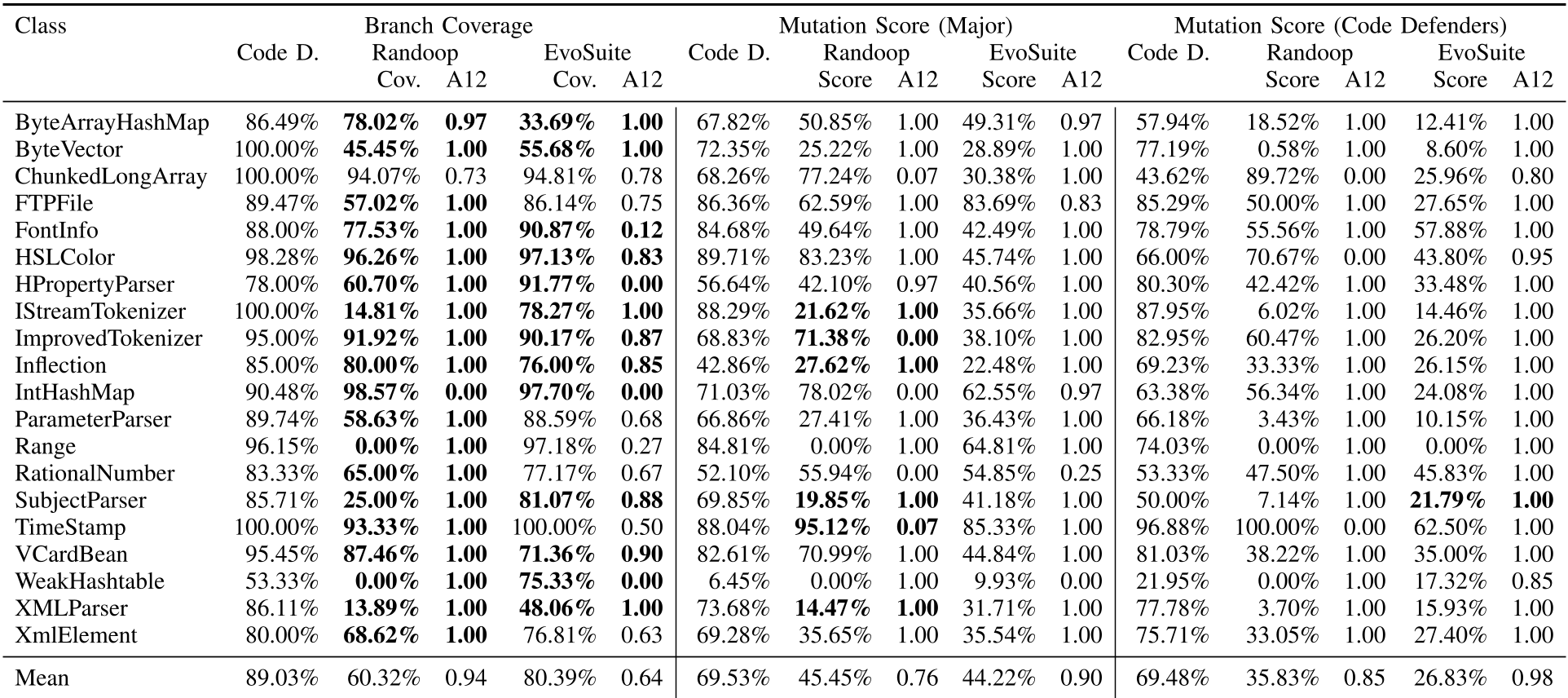 Figure 2: Comprehensive results showing Code Defenders (Code D.) leading in almost every metric.
Critical Insight: Why is it Effective?
The success of Code Defenders lies in Inductive Bias. Automated tools optimize for a metric (like branch coverage). Humans, however, look for meaning.
For example, a human attacker might change a hexadecimal constant from 0x7FFFFFFF to 0x7EFFFFFF. An automated tool might never guess this specific bit-flip, but a human understands that this "magic number" represents a boundary that a lazy test might miss.
Limitations
- Stagnation: In some games, if a player submits a "perfect" test suite early, it can discourage others from joining (the "Winner Takes All" effect).
- Complexity Scale: While 100-300 lines of code work well for a 24-hour game, applying this to a million-line enterprise codebase remains a massive architectural challenge in terms of dependencies and isolation.
Conclusion & Future Outlook
Code Defenders proves that software testing doesn't have to be a chore—it can be a sport. As we move into the era of AI-assisted coding, the "human-as-a-verifier" remains the gold standard.
The future of this work likely involves Hybrid Intelligence: using tools like EvoSuite to handle the "boring" boilerplate coverage and using games like Code Defenders to harvest human creativity for the 10% of bugs that cause 90% of the failures.