
Contect: Bridging the Gap Between Heavyweight Deep Learning and Mobile Healthcare
Code Offloading Solutions for Audio Processing in Mobile Healthcare Applications: A Case Study
The paper introduces "Contect," a mobile healthcare application that uses a multi-layered Residual Neural Network (ResNet) to analyze speech for neurological abnormalities. It proposes a hybrid approach combining local Deep Neural Network (DNN) optimization (quantization and partitioning) with the MobiCOP code offloading framework to ensure functionality across both high-end and low-end mobile devices.
TL;DR
Deploying medical-grade Deep Neural Networks (DNNs) on smartphones is a notorious engineering challenge due to memory limits and battery drain. This paper presents a case study on Contect, an Android app that detects brain injuries via audio analysis. By combining 8-bit quantization, a novel model partitioning strategy, and transparent code offloading via the MobiCOP framework, the authors achieved a 3.6x speedup and 80% energy savings while maintaining offline viability.
Problem & Motivation: The Heavy Model Paradox
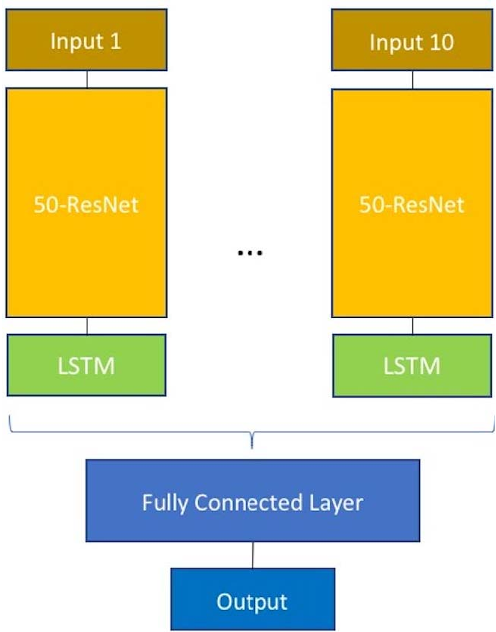
Modern healthcare requires high-precision AI, which usually translates to massive Deep Neural Networks. For instance, the Contect app uses 10 parallel 50-layer ResNets with LSTM layers—a structure requiring roughly 7GB of RAM in a mobile environment.
This creates a paradox:
- The Performance Gap: Most mobile devices (especially older ones) lack the RAM to load such models, causing immediate OS-level crashes.
- The Connectivity Trap: While cloud APIs (like Google Speech) exist, healthcare tools cannot rely solely on the cloud. They must work offline in remote areas or emergency situations.
- Hardware Constraints: Even on high-end phones, running these models locally drains the battery rapidly and induces high latency.
Methodology: Optimization Meet Offloading
The authors propose a dual-layer strategy: making the model "lean enough" to run locally while using the cloud as an "accelerator."
1. Model Optimization (The "How")
To shrink the 7GB footprint, the team employed three techniques:
- Constant Folding & Node Stripping: Removing training-only nodes and merging weights into the architecture file.
- 8-bit Quantization: Mapping 32-bit floating-point weights to 8-bit integers. Since DNNs are naturally noise-resistant, this 75% reduction in size came with negligible accuracy loss.
- Model Partitioning: This is the paper's key insight. Instead of loading the whole 1.3GB optimized model, they split it into 11 subgraphs (one for each ResNet and one for the fully connected layers). Each subset is run sequentially, and memory is recycled between iterations.
2. MobiCOP: Transparent Code Offloading
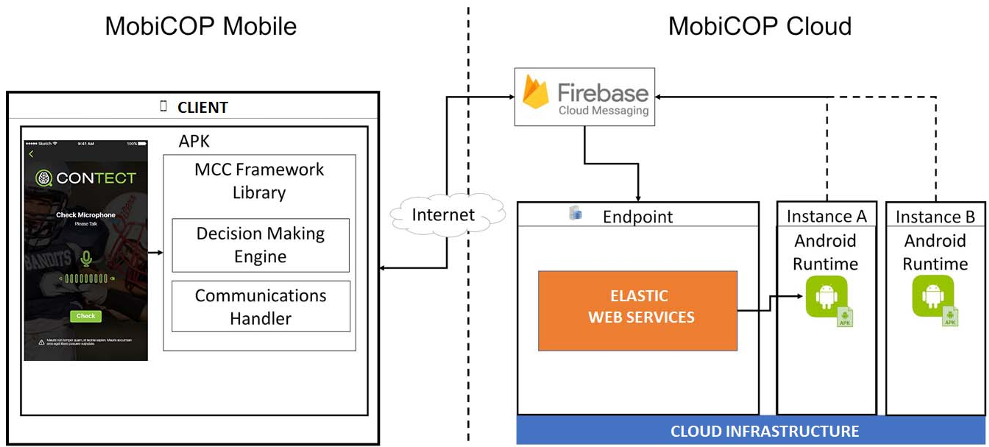
When a network (Wi-Fi/3G) is detected, the app uses MobiCOP. This framework replicates the application logic on a cloud server (AWS). A decision engine determines whether to execute locally or send the spectrogram to the cloud based on network quality.
Experiments & Results: Quantitative Breakthroughs
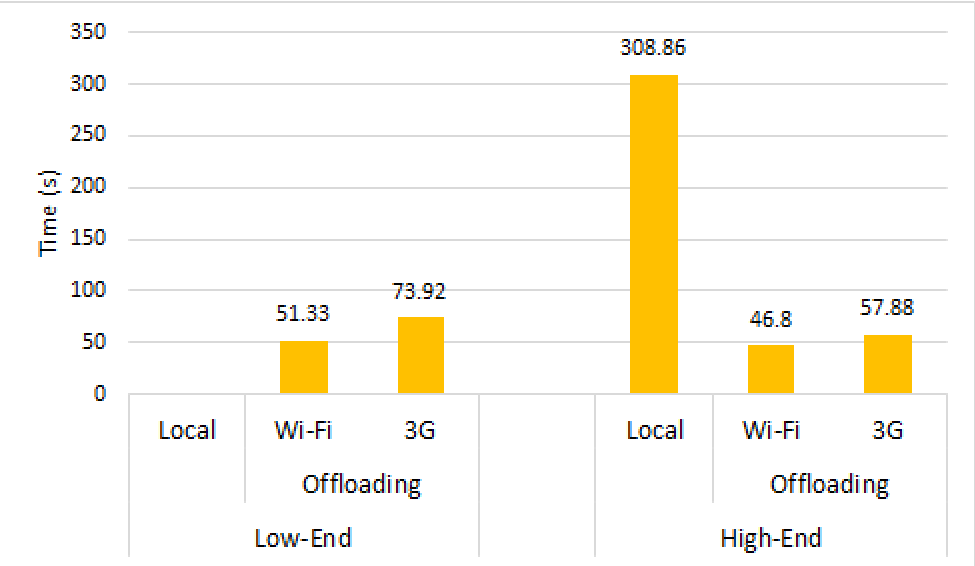
The effectiveness was tested on a low-end device (Lenovo A319, 512MB RAM) and a high-end device (Samsung S5, 2GB RAM).
- Enabling the Impossible: Without offloading and partitioning, the low-end device could not run the app at all. With this system, it could perform the diagnosis via the cloud.
- The 3.6x Speedup: On high-end hardware, offloading processed audio 3.6x faster than local execution.
- Energy Efficiency: Offloading tasks reduced battery consumption by up to 80% (5x savings).
Critical Analysis & Conclusion
The value of this work lies in its pragmatism. Rather than waiting for mobile hardware to catch up to server-side AI, the authors show that aggressive software-level memory management (partitioning) can bridge the gap.
Takeaway: For mission-critical apps, "Offline-First" doesn't mean "Offline-Only." By treating the cloud as an opportunistic accelerator rather than a dependency, developers can support a wider range of hardware (Inclusivity) while providing a premium experience on high-end devices (Efficiency).
Limitations: The reliance on Tensorflow Mobile (rather than Lite) due to kernel compatibility suggests that as mobile AI frameworks mature, we might see even higher performance. Future work on Edge Computing/Cloudlets could further reduce the latency observed in 3G/Wi-Fi offloading.