
Beyond Echo Chambers: The Mathematical Coevolution of What We Think and What We Do
A Coevolutionary Model for Actions and Opinions in Social Networks
This paper introduces a novel coevolutionary model that couples binary decision-making (actions) with continuous opinion formation in social networks. By integrating evolutionary game theory with the Friedkin–Johnsen opinion framework, it establishes a mathematical basis for how private beliefs and observed social coordination mutually reinforce or conflict with each other.
TL;DR
Human behavior is rarely a simple one-way street. We act because of our opinions, but we also shape our opinions based on how we see others act. This paper introduces a unified mathematical model that couples Discrete Action Selection (Evolutionary Game Theory) with Continuous Opinion Dynamics (Friedkin–Johnsen model). It explains why society sometimes gets stuck in "unpopular norms"—where everyone does something that almost no one actually likes.
The Missing Link: Why Traditional Models Fail
For decades, social scientists and control engineers studied opinions and actions in silos:
- Opinion Dynamics: Models like DeGroot focus on how we reach consensus through weighted averaging of beliefs.
- Evolutionary Game Theory: Focuses on "payoffs"—we choose actions (like adopting a new technology) because our neighbors do.
The Problem: In reality, these are a feedback loop. Your private "commitment" to an opinion acts as a psychological anchor for your decisions, while seeing a neighbor take an action provides "social proof" that shifts your internal belief. Previous models lacked this intertwined coupling, failing to explain why social norms can be incredibly stable even when they are unpopular.
Methodology: The Logic of Coupled Dynamics
The authors propose a model where each individual has an action and an opinion .
1. The Action Update (The "Why")
Instead of just following the crowd, an individual's payoff is influenced by their internal opinion and a commitment parameter . This creates a state-dependent threshold. You only switch actions if the social pressure outweighs your internal conviction.
2. The Opinion Update (The "How")
Opinions evolve by averaging neighbors' opinions and observing their actions. Here, represents susceptibility to actions. If is high, you are a "conformist" whose internal beliefs shift just by seeing others act, even if they don't speak.
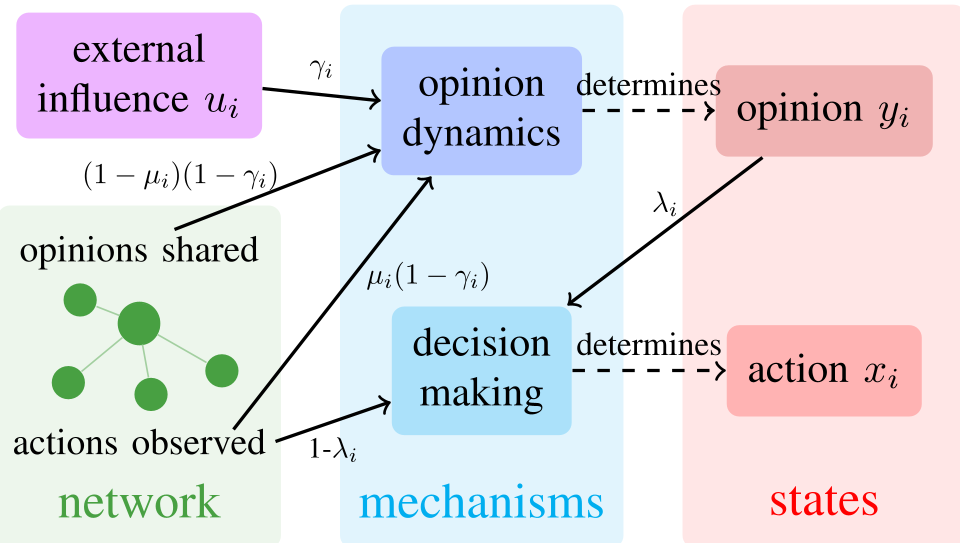 Fig 1: The schematic shows how actions (discrete) and opinions (continuous) provide mutual feedback.
Key Results: Resilience of Social Norms
The paper provides a rigorous mathematical proof of convergence using Potential Functions. By viewing the system as a "Potential Game," they show that under certain conditions, the system will always settle into a steady state rather than oscillating forever.
The "Unpopular Norm" Threshold
One of the most striking findings is the "Pure Configuration" analysis. The authors prove that a crowd can stay locked in a negative action () even if most people have a positive opinion ().
- The Magic Number: If everyone's commitment to their opinion is less than 1/3, the social network can maintain an action that the majority privately rejects.
- Evolutionary Advantage: If one action has a slight "evolutionary advantage" (), it becomes much harder for people to switch away from it, effectively acting as a "social trap."
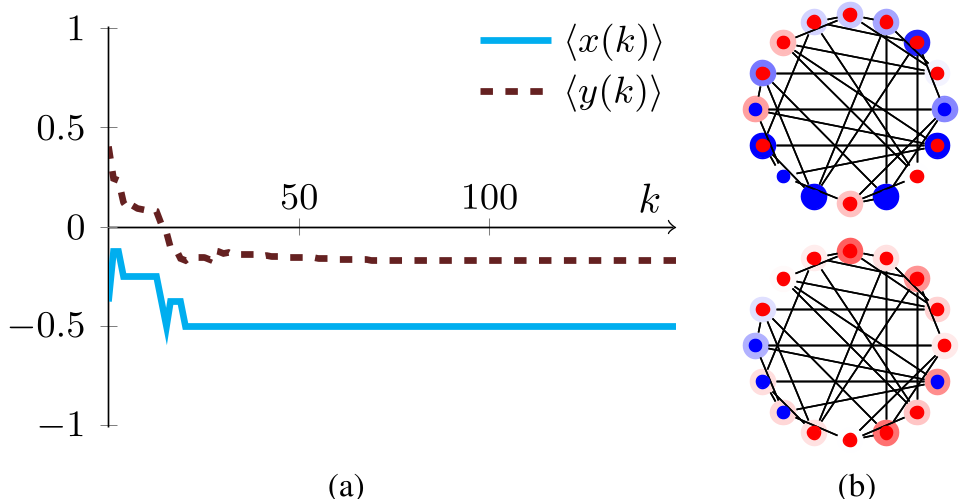 Fig 2: Simulations demonstrating how different parameters lead to either full consensus or the persistence of minority actions regardless of opinions.
Academic Insight: The Friction of Change
The beauty of this model lies in its ability to explain social inertia. In a standard game, people switch as soon as a better option appears. Here, the opinion acts as a "buffer."
When we try to change a society's behavior (e.g., public health mandates or green energy adoption), this model suggests that targeting opinions (via , external influence) is not enough if the action coordination is too strong. Conversely, forcing an action change can eventually drag the opinions along, provided the susceptibility is non-zero.
Critical Analysis & Conclusion
This paper is a significant theoretical step in merging cognitive psychology with control theory. However, it assumes an undirected network (symmetric influence). Real-world social media often features directed, asymmetric influence (influencers vs. followers), which might break the Potential Game structure and lead to limit cycles or chaos.
Future Outlook: The next frontier is "Stackelberg Games"—analyzing how a strategic actor (like a government or a marketing firm) could optimally seed opinions or actions to "flip" a network from an unpopular norm to a desirable one.