
CCAF: Beyond Discrete Logic — Building Agents with Continuous Behavioral Flexibility
Cognition, Sociability, and Constraints
This paper introduces the Constraint-Centered Architectural Framework (CCAF), a generic agent architecture designed to enable continuous behavioral flexibility. Unlike standard architectures that switch between discrete modes, CCAF treats flexibility as an emergent property resulting from an agent's ongoing management of local and global constraints across both cognitive and social dimensions.
TL;DR
The inherent limitation of modern AI agents often lies in their "digital" nature—they are designed to be either reactive or pro-active, isolated or social. This paper argues that true intelligence requires a continuous behavior space. The proposed Constraint-Centered Architectural Framework (CCAF) moves away from hard-coded behavioral modes, instead viewing flexibility as an emergent property of a centralized constraint-handling engine.
Background & Motivation: The "Discrete Isle" Problem
Most classic agent architectures—such as TouringMachines or INTERRAP—rely on separate layers or modules to handle different types of behavior. For example, one layer handles immediate reactions, while another handles long-term planning.
The author points out a critical flaw: these architectures induce a discrete behavior space. In the real world, the boundary between "reacting to a change" and "pursuing a goal" is often blurry. Standard models treat these as "behavioral isles" with no bridge between them, leading to rigid systems that cannot degrade gracefully when resources (time, cost, or data) become scarce.
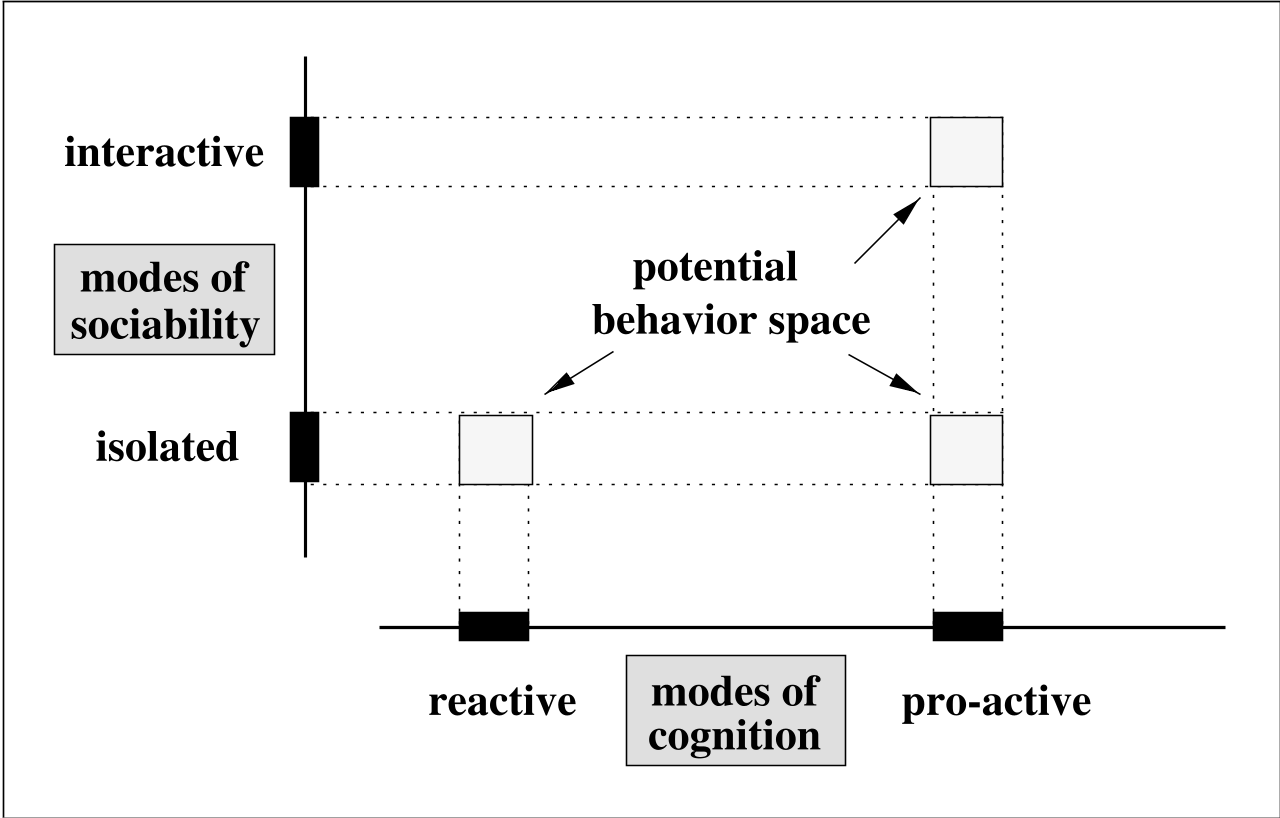 Above: Figure 5 & 6 contrast the standard discrete repertoire view with the proposed continuous view across the axes of Cognition and Sociability.
Methodology: The Constraint-Centered View
The core insight of the paper is that constraints (time bounds, budgets, quality requirements) shouldn't just be "checked"—they should drive the architecture. The author proposes four fundamental conditions to achieve this:
- Tight Intertwining: Every internal process (planning, sensing, communicating) must be able to modify the constraint set and, in turn, be restricted by it.
- Constraint-Induced Cooperation: Coordination shouldn't be a separate "mode." Instead, agents should communicate only if and when constraints (e.g., a local task is too complex or time-sensitive) force them to.
- Quantitative Meta-Reasoning: Agents must assign numerical values to the importance and risk of constraints. This allows for graceful degradation—the ability to intentionally violate a low-priority constraint to satisfy a high-priority one.
- Centralized Constraint Management: To avoid internal conflicts, an agent's reasoning about its own constraints must be centralized.
Architecture Overveiw
The CCAF structure consists of five management modules: Coordination, Adaptation, Script, Execution, and the heart of the system—Constraints.
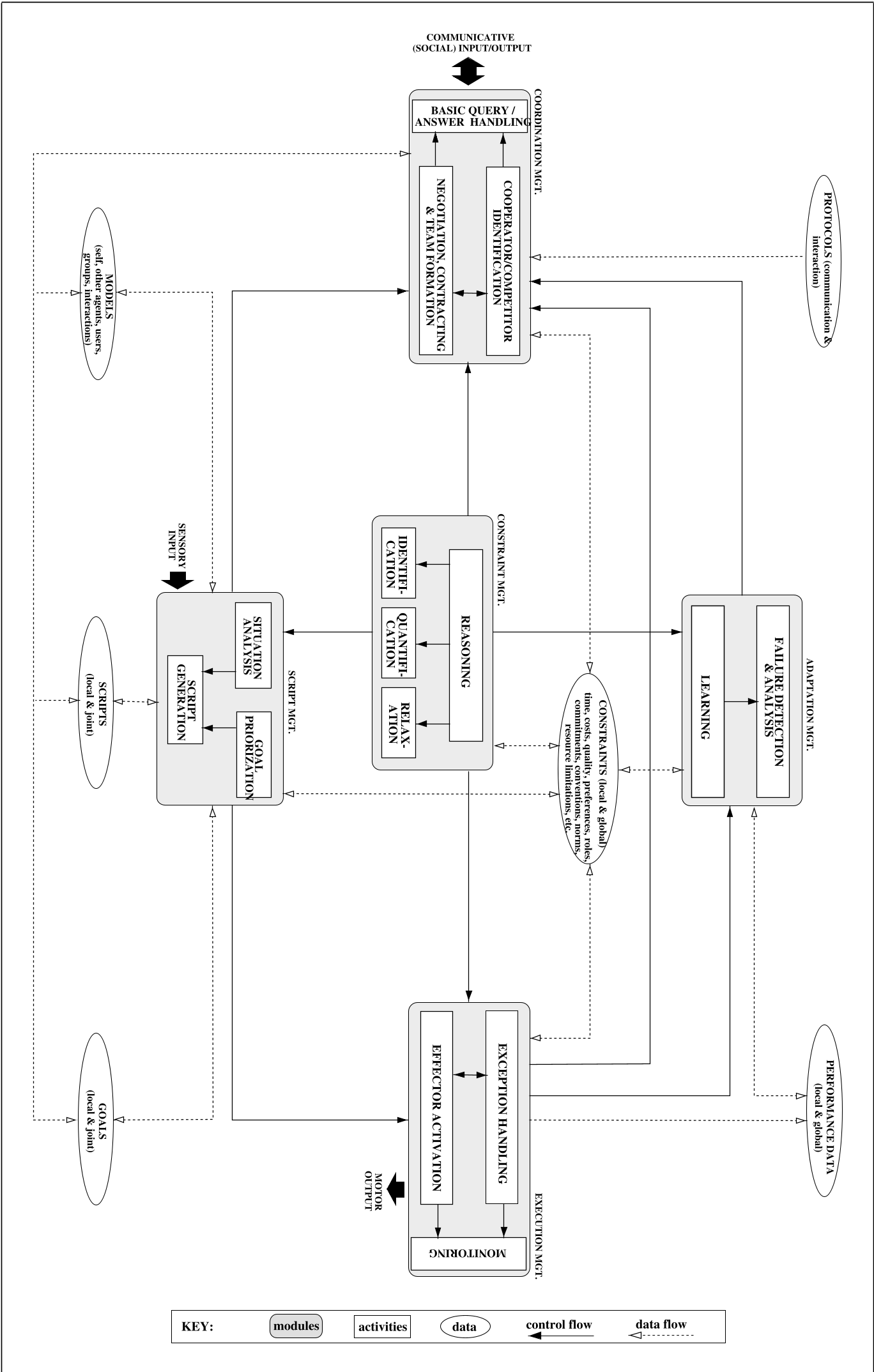 Figure 7: The CCAF model where the Constraint module maintains bidirectional links with all other functional units.
Critical Insight: Flexibility as Emergence
In CCAF, you don't program a "social mode." Instead, when the Constraint module realizes that a goal cannot be met locally within the allotted time, it triggers the Coordination module. The resulting "sociability" is an emergent response to environmental pressure.
This shift is profound. It moves the focus of AI development from "state machines" to "optimization engines" that navigate a continuous space of possibilities.
Limitations and Future Outlook
While the framework is theoretically robust, the author identifies several "Grand Challenges":
- Infinite Meta-Reasoning: If reasoning about constraints takes time, do we need a second-order process to manage the time spent reasoning?
- Global Metrics: How do heterogeneous agents agree on the "value" of a constraint when they come from different manufacturers?
- Any-X Algorithms: To truly work, every algorithm in the agent's repertoire needs to be "Any-time, Any-cost, and Any-quality," meaning they can provide a partial result at any point of interruption.
Conclusion
This paper serves as a roadmap for the next generation of "really flexible" agents. By integrating cognition and sociability into a single constraint-driven framework, CCAF offers a more biologically plausible and technically resilient path toward autonomous systems that can survive and thrive in open, dynamic environments.