
Cognitive Analysis in Social Networks: Winning Viral Marketing via CMAB and Graph DBs
16191_Cognitive Analysis in Social Networks for Viral Marketing.
The paper introduces a cognitive analysis framework for viral marketing that models Online Social Networks (OSNs) as heterogeneous graph databases. It utilizes Regular Path Queries (RPQs) to extract "influential paths" and employs a Combinatorial Multi-Armed Bandit (CMAB) strategy to solve the Influence Maximization (IM) problem without requiring prior knowledge of propagation probabilities.
TL;DR
Modern viral marketing is often hamstrung by a lack of data on how much one user actually influences another. This paper addresses this by treating the social network as a heterogeneous graph database and solving the Influence Maximization (IM) problem using Combinatorial Multi-Armed Bandits (CMAB). Instead of guessing influence probabilities, the system learns them on the fly.
The "Probability" Bottleneck in Viral Marketing
Influence Maximization (IM) is the task of finding a small set of "seed" users who can trigger the largest "word-of-mouth" cascade. Historically, researchers assumed we knew the probability of User A influencing User B. In reality, we don’t. Most state-of-the-art (SOTA) algorithms like TIM+ or IMM perform excellently if the probabilities are known, but fail or rely on poor heuristics when they are not.
The authors' insight is twofold:
- Heterogeneity matters: Influence isn't just about "friendship." It's about shared experiences (e.g., two people reviewing the same restaurant with the same sentiment).
- Learning while doing: If we don't know the probabilities, we should use Online Learning to estimate them while simulating or running the campaign.
Methodology: From Heterogeneous Graphs to Influential Paths
The framework operates in three distinct phases:
1. The OSN Graph Database
Unlike a simple adjacency matrix, the authors model the network (using Neo4j) as a feature-rich graph.
- Nodes: Users and Business Objects (e.g., Yelp restaurants).
- Edges: Friendships and Reviews.
- Attributes: Timestamps and Sentiment scores (extracted via NLP tagging).
2. Extracting Influential Paths with RPQs
The authors use Regular Path Queries (RPQ) to find specific behavioral patterns. For example, a "Social Path" might be:
User A reviews Business X User B (who is a friend of A) reviews Business X with the same mood within 50 days.
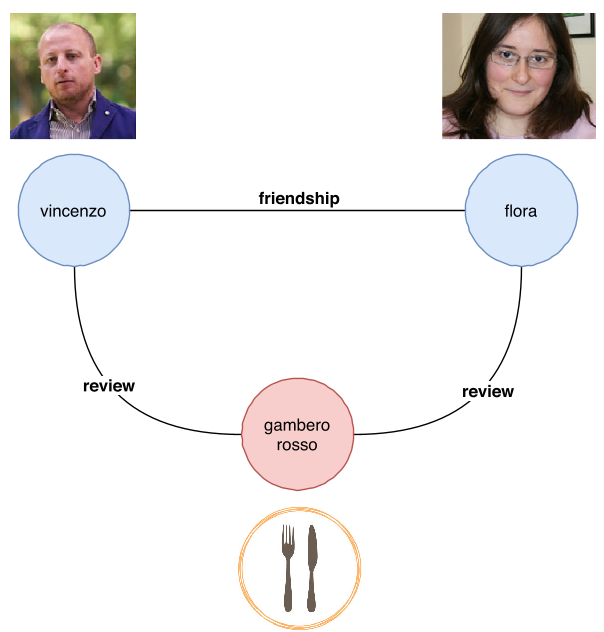 Figure: Abstracting a complex heterogeneous network into a simplified influence graph using path queries.
3. The CMAB Strategy
To solve the IM problem without initial probabilities, the authors map IM to the Combinatorial Multi-Armed Bandit problem:
- Arms: Edges in the influence graph.
- Superarm: A set of outgoing edges from the chosen seed nodes.
- Reward: The total "spread" (number of newly activated users).
By using an -greedy strategy, the algorithm balances Exploration (trying new nodes to see if they are influential) and Exploitation (using nodes known to have high influence).
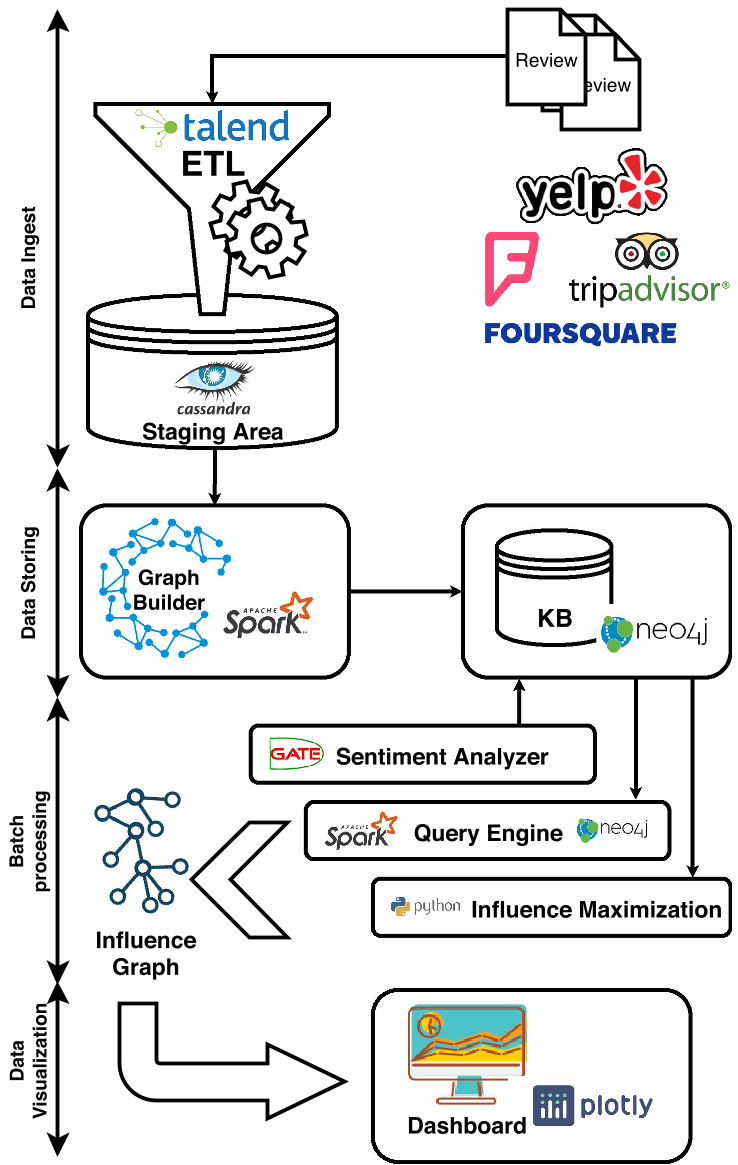 Figure: Step-by-step activation of the graph using the CMAB superarm mechanism.
Experimental Battleground: The Yelp Dataset
The authors tested their prototype on the massive Yelp Challenge dataset. They compared three CMAB variants (Pure Exploration, Pure Exploitation, and -greedy) against the SOTA TIM+ algorithm.
Key Findings:
- Near-Optimal Spread: After roughly 300 iterations, the CMAB approach achieved a spread nearly identical to TIM+, which had the "unfair" advantage of knowing the true probabilities.
- Efficiency: The CMAB approach showed superior scalability. For extremely large graphs, its execution time remained linear and lower than many greedy SOTA heuristics.
 Table: Mapping of CMAB terminology to Influence Maximization concepts.
Critical Insight & Future Outlook
The brilliance of this work lies in its agnosticism. It doesn't care how you define influence; as long as you can write an RPQ to find the path, the CMAB engine will handle the math of finding the best seeds.
Limitations: The 50-day window for the Yelp study was chosen for computational feasibility; however, real-world influence might be much faster or much slower depending on the industry.
The Takeaway for Tech Leaders: Don't wait for perfect data to start a viral campaign. By implementing a bandit-based reinforcement learning layer on your graph data, your marketing engine can "learn" your most influential customers through trial and error, often outperforming static models that rely on shaky assumptions.