
Modeling the "Meme": How Cognitive Biases Drive Behavioral Adoption
Cognitive modeling of socially transmitted affordances: a computational model of behavioral adoption tested against archival data from the Stanford Prison Experiment
This paper presents a cognitive model for the social transmission of affordances, implemented within the PMFServ agent-based architecture. It integrates Social Cognitive Theory and Information Theory to simulate how new behaviors spread through "unintentional" observational learning, successfully validated against archival data from the 1971 Stanford Prison Experiment (SPE).
TL;DR
Why do some people adopt a new behavior—ranging from a TikTok dance to a specific strategy in an insurgency—while others remain indifferent? This research moves beyond simple "contagion" models by building a high-fidelity cognitive simulation. By implementing a "double-competition" for attention and motivation, the model successfully replicated the complex social dynamics of the infamous Stanford Prison Experiment (SPE), proving that who we learn from is as important as what we learn.
The Gap: Why Network Graphs Aren't Enough
For decades, researchers modeled "behavioral spread" like a virus: if you are connected to an infected node, you might get infected. But humans aren't nodes; we are cognitive filters.
Existing models had two major flaws:
- The "Phone Booth" Fallacy: They assumed learning only happens via directed communication (Agent A tells Agent B). In reality, we learn by "ambient" observation—watching others and realizing a new action is possible.
- The Agency Void: Network models lack individual differences. They can't explain why, in the same room, one person becomes a rebel and another a "model prisoner."
Methodology: The Architecture of Attention
To solve this, Dr. Benjamin Nye extended the PMFServ architecture. The core insight is that learning a new action is the discovery of a Hidden Affordance.
1. The Double-Compete Process
The model treats behavioral adoption as a two-stage filter:
- Attention Competition: We are bombarded with stimuli. We only learn what we notice. This is governed by Central Cues (is the action novel? does it look rewarding?) and Peripheral Cues (is the person a leader? are they like me?).
- Motivation Competition: Once learned, we only perform the action if it aligns with our internal "GSP" (Goals, Standards, and Preferences) tree.
2. The Integrated Model
The paper synthesizes Information Theory (the channel/noise) with Social Cognitive Theory (attention, retention, motivation, production).
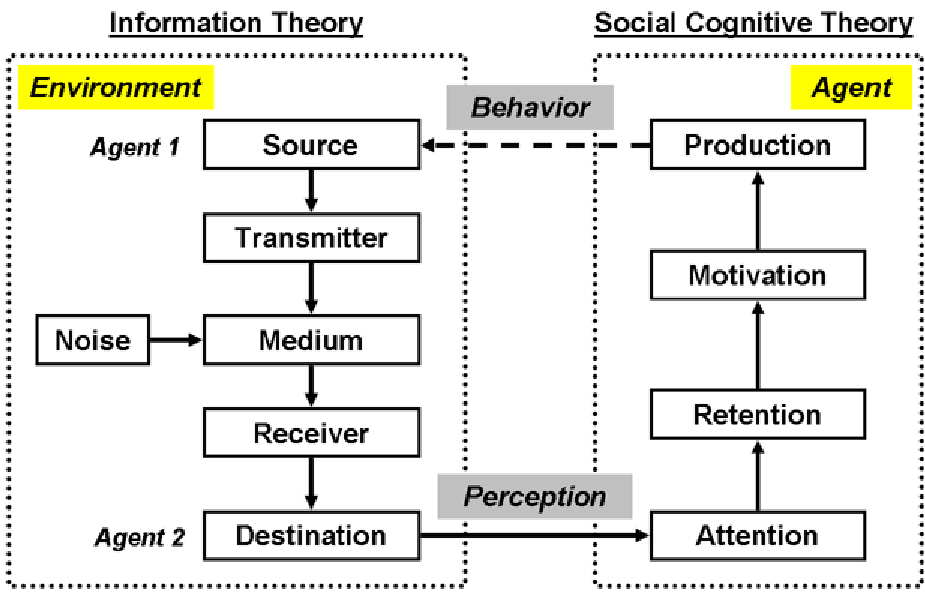 Figure 1: The synthesis of Shannon's Information Theory and Bandura's Social Learning.
Re-Simulating the Stanford Prison Experiment
The authors didn't just test this on toy data; they went to the archives of the 1971 Stanford Prison Experiment. They modeled 19 unique participants (9 prisoners, 10 guards) using their actual pre-experiment personality scores (Comrey Personality Inventory, F-Scale).
Experimental Conditions:
- Full Knowledge: Everyone knows how to be cruel/resist from the start.
- Authority: A leader "primes" the behavior.
- Meme Hypothesis: A few "innovators" (like the infamous guard "John Wayne") start a behavior, and it spreads organically.
Results & Validation
The "Meme Hypothesis" was the most accurate in predicting the order of adoption. For example, the use of "The Hole" (solitary confinement) didn't happen until the "John Wayne" agent arrived and demonstrated it.
Table: The simulation's predictive accuracy for action "first-expression" was significantly higher than random chance (p < 0.05).
Key findings included:
- Emotional Delta: The simulation replicated the "misery gap"—prisoners were consistently 3x more distressed than guards, matching the archival Mood Adjective Checklists.
- The "S-Curve" of Adoption: Some guards were "early adopters" of abuse, while "laggards" only joined in once the social pressure (conformity cue) became overwhelming.
Critical Analysis: KISS vs. KIDS
The paper tackles a fundamental debate in AI modeling: KISS (Keep It Simple, Stupid) vs. KIDS (Keep It Descriptive, Stupid).
- Dr. Nye argues for a middle ground: "as simple as possible, but no simpler."
- By including 12 distinct cues (Authority, Similarity, Novelty, etc.), the model avoids the bias of over-simplification without becoming an incoherent mess.
Limitations
The primary drawback is the interaction between cues. The model assumes factors like "Similarity" and "In-group bias" are linearly independent. In reality, they likely amplify each other. Furthermore, the model relies on "manual calibration" for action activations, which limits its plug-and-play capability for new domains.
Conclusion & Future Outlook
This work proves that social learning is a bottlenecked process. If you want to stop a harmful behavior (like IED design spread) or promote a good one (like health interventions), you must target the Attentional Cues. target the "Innovators" who share high "Similarity" with the target population, rather than just the most "Central" nodes in a network.
The future of AI agents lies in this "Socio-Cognitive" depth—creating agents that don't just process data, but react to the social "vibes" of their environment.