
COGVIEW & INTELNET: Simulating the Human Mind’s Cultural "Energy"
COGVIEW & INTELNET: Nuanced energy-based knowledge representation and integrated cognitive-conceptual framework for realistic culture, values, and concept-affected systems simulation
This paper introduces INTELNET, an "Energy-Based" Knowledge Representation (EBKR), and COGVIEW, an integrated cognitive-conceptual framework designed to simulate nuanced worldviews, culture, and values. By modeling semantics through energy flows and dual-layer processing (conscious/unconscious), the system achieves a state-of-the-art ability to simulate complex human behaviors like opinion formation and suicide terrorism motivation.
TL;DR
Human worldviews are messy, fractal, and deeply emotional—traits that traditional AI logic (like "Is-A" or "Has-A" relations) fails to capture. Daniel J. Olsher’s COGVIEW and INTELNET frameworks introduce an "Energy-Based" perspective on knowledge. By treating concepts as interconnected networks where "energy" carries emotional and semantic weight, the system can simulate how culture affects perception, why people adopt radical ideologies, and where moral conflicts arise.
Categorization: Cognitive Architecture / Social Simulation / SOTA Knowledge Representation
The "Nuance" Problem: Why Symbolic AI Fails Culture
Traditional symbolic AI is built on "bright-line" separations. A TABLE is FURNITURE. But what if a situation requires a TABLE to be SHELTER? Symbolic systems struggle to reconstrue concepts based on context.
When we deal with Cognitively Mediated Process Data (CMPD)—things like morality, values, and cultural taboos—the data is diffuse. Prior works in ontologies are often too "brittle" to handle the "shades of gray" that define human tragedy, persuasion, and social norms.
Methodology: INTELNET & The Energy-Based Paradigm
Instead of opaque symbols, INTELNET uses augmented graphs where everything is a network "all the way down."
1. Energy Flows and Quanta
In INTELNET, energy isn't just a number; it is a structured "quantum" containing:
- Magnitude & Polarity: How strong is the concept, and is it positive or negative?
- Approval & Legitimacy: Is this concept socially sanctioned?
- Focus: A measure of "recent reference" simulating short-term memory or priming.
2. The Dual-System Architecture
COGVIEW operates on two distinct levels:
- U-Level (Unconscious): Handles fast, parallel, and automatic energy spreading. It is where "priming" and "emotional colorization" happen.
- C-Level (Conscious): Handles slow, serial, and logical processing. It interfaces with the outside world and manages explicit goal selection.
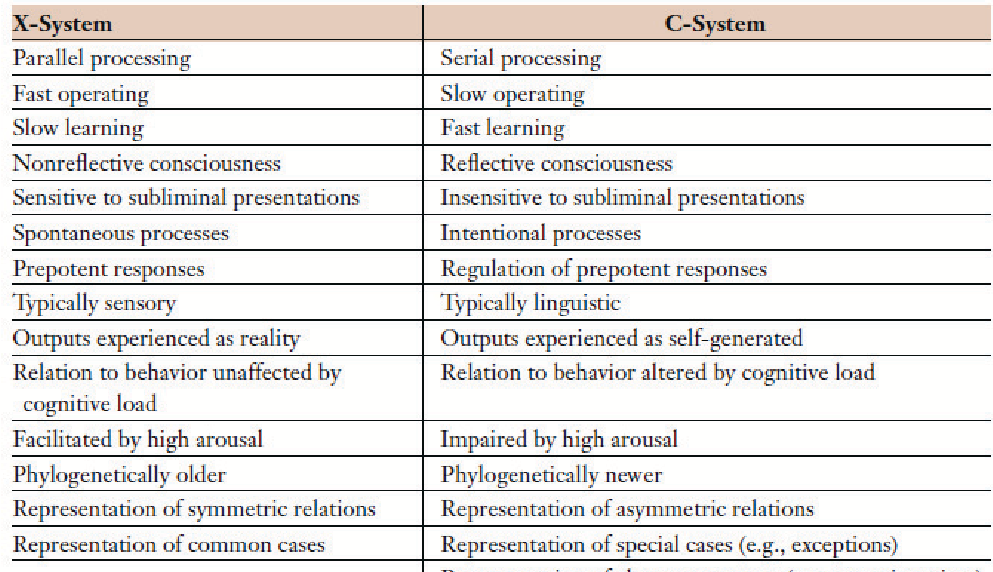 The X-System (Unconscious) vs. C-System (Conscious) processing characteristics.
The Core Insight: "Clashes" as Conclusion
One of the most profound contributions of this paper is the concept of a Clash. A clash occurs when opposing energies (e.g., positive vs. negative) meet at a specific node.
The author argues that these clash sites are exactly where humans feel moral tension. By identifying where energy "collides," the AI can effectively "discover" the moral dilemmas inherent in a culture without a human having to explicitly label them.
Case Study: Suicide Terrorism
The paper applies COGVIEW to the suicide terrorism domain to model how a "quest for personal significance" can override the "desire to preserve life."
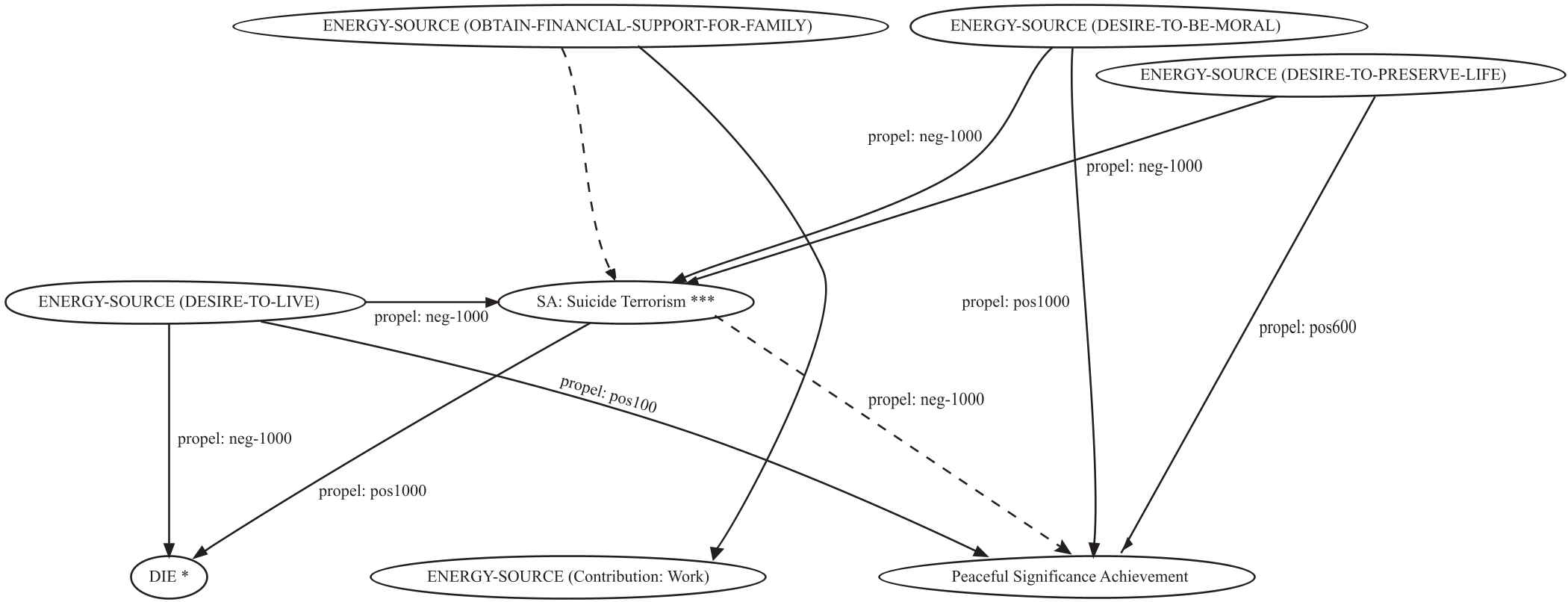 Visualizing the shift in beliefs: Solid lines (Pre-persuasion) vs. Dotted lines (Post-persuasion).
By tracing energy paths, the framework shows how radicalization isn't just about learning new "facts," but about re-routing energy flows from community-based significance to violent-based significance.
Experimental Validation
Instead of standard accuracy scores (which are often meaningless for cultural models), the authors validate the network through Path Lengths and Clash Site Correspondence.
- Does the model predict the same "moral controversies" as human experts?
- Can it sustain long logical paths that remain semantically coherent?
The results show that COGVIEW accurately identifies the inherent tension between suicide terrorism and the desire to be a "moral parent," a finding supported by psychological interviews with failed perpetrators.
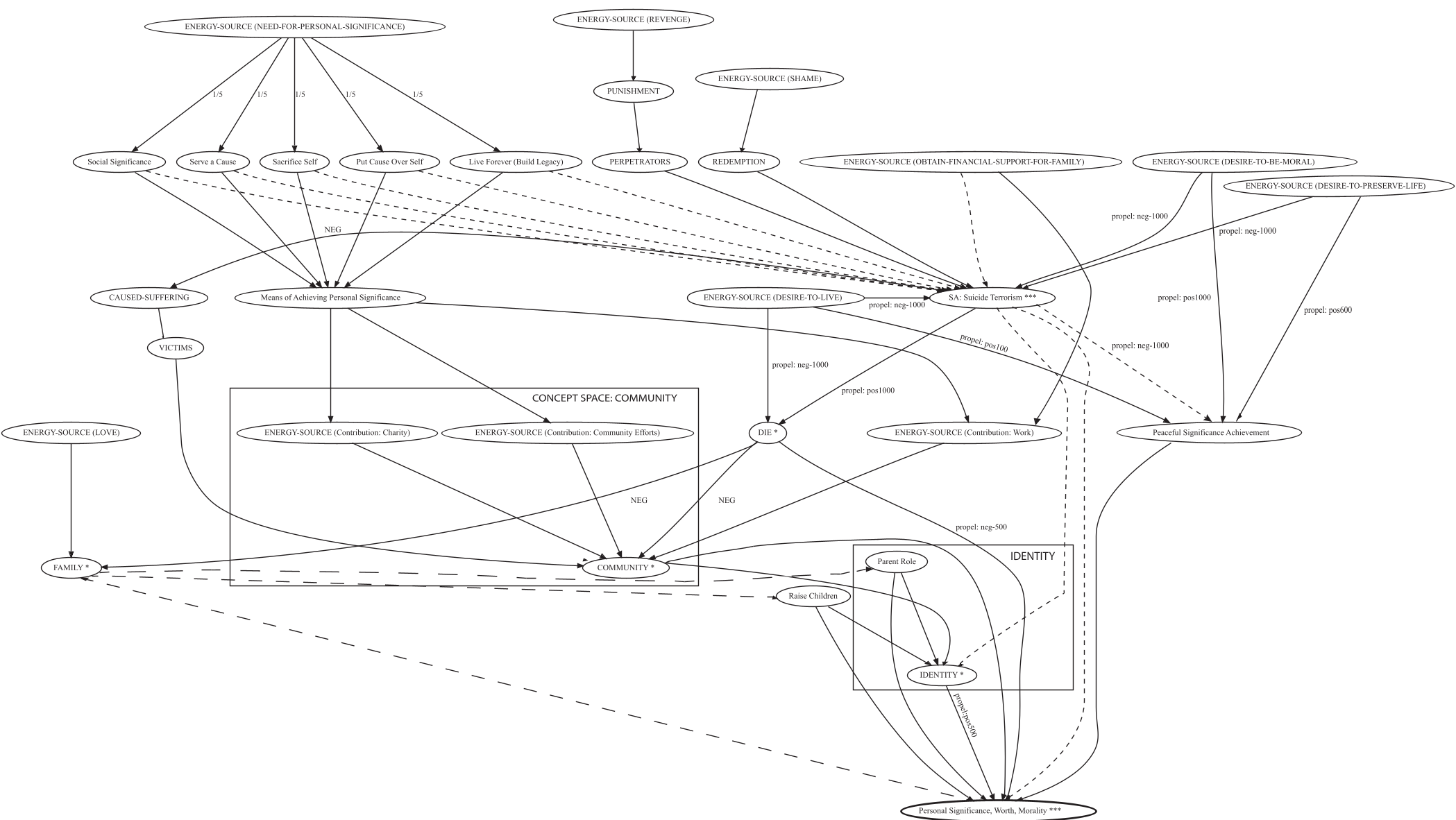 The comprehensive COGVIEW Worldview Network showing energy loops between Family, Community, and Identity.
Critical Insight & Conclusion
COGVIEW/INTELNET represents a departure from the "AI as a calculator" metaphor toward "AI as a cognitive mirror."
Takeaway: To build agents that truly understand humans, we must stop focusing on surface-level symbols and start modeling the underlying unconscious energy that binds concepts together.
Limitations:
- The design of Worldview Networks still requires significant domain expertise.
- Scaling this to "infinite nuance" while avoiding computational loops in energy flow remains a technical challenge.
Future Outlook: This framework provides a blueprint for "Norm Change" programs—using AI to find the most effective conceptual "levers" to reduce prejudice or prevent radicalization by shifting the energy balance within a cultural network.