
Deciphering Identity and Interaction: Finding Cohesive Subgroups in Nokia’s Friend View
Finding Cohesive Subgroups and Relevant Members in the Nokia Friend View Mobile Social Network
This paper investigates user social behavior in the Nokia Friend View mobile social network by identifying cohesive subgroups and relevant members. Utilizing the SCAN method, the study establishes that interaction patterns in mobile networks strongly mirror explicit friend relationships, effectively identifying influential users to enhance recommendation systems.
TL;DR
This research explores the intersection of explicit friendship and real-time interaction within the Nokia Friend View mobile social network. By applying the SCAN (Select and Collect) method, the authors prove that interaction networks are a mirror of social intent, where "cohesive subgroups" represent the true core of a network. These members are not just typical users—they are the most influential nodes, posting 27 times more comments than the average user.
The Problem: The Noise of Digital "Friendship"
In the early days of mobile social networking (circa 2008-2009), platforms struggled with a fundamental issue: Relevance. While users could easily add "friends," these connections often became "friend spam"—links with no shared interests or actual interaction. Popularity metrics like follower counts were (and are) easily gamed.
The research asks: How can we find the people who actually matter to a user's digital experience? The answer lies in identifying cohesive subgroups—groups where members interact with each other more intensely than with the world outside.
Methodology: The SCAN Approach
The paper utilizes the SCAN method to move beyond simple link counting to deep structure analysis.
1. The Select Step: Filtering for Influence
Before finding groups, we must find the "engines" of the network. The authors use three types of Centrality:
- Betweenness: Nodes that act as bridges.
- Degree: Nodes with the most direct connections.
- Closeness: Nodes that can reach everyone else quickly.
2. The Collect Step: Hierarchical Clustering
Once the high-influence nodes are selected, the system uses Weighted Average Hierarchical Clustering. Unlike rigid cliques, this creates a dendrogram (a tree-like structure) that reveals the natural nesting of social circles.
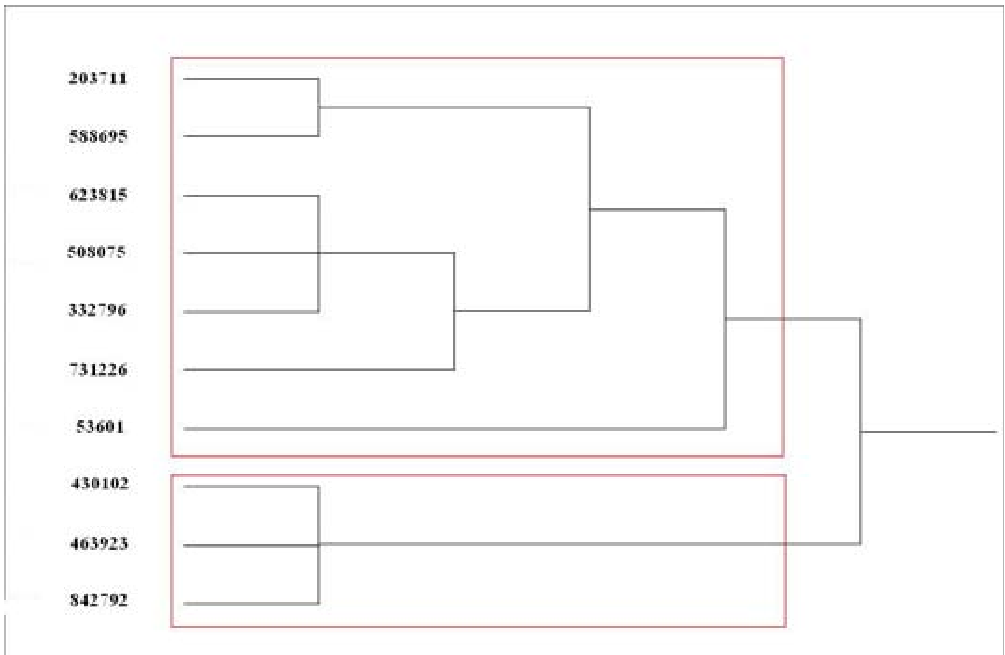 Fig. 3: Dendrogram of cohesive subgroups in the friend network, illustrating how individual nodes merge into distinct social clusters.
Experimental Insights: Friends vs. Talkers
The study analyzed two distinct networks:
- Friend Network: Based on accepted friend requests.
- Interaction Network: Based on actual comments and message replies.
The findings were striking. While the interaction network was smaller (1150 users vs 3374 in the friend network), the "Relevant Members" (Top 10) were remarkably consistent across both.
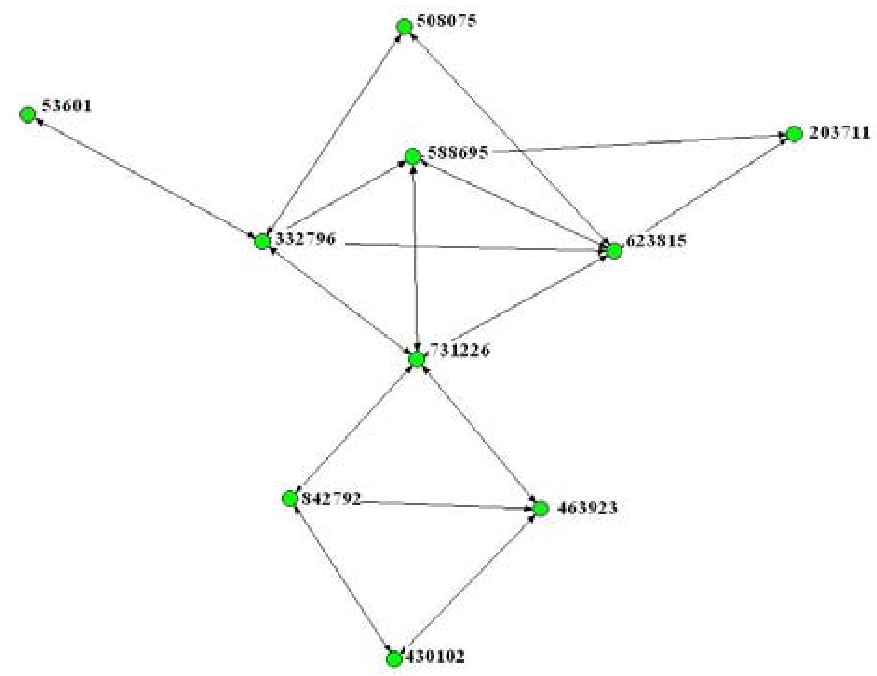 Fig. 2: Visualization of a cohesive subgroup. Large nodes represent the top 10 influencers who form the "spine" of the social network.
Key Quantitative Results:
- Engagement Gap: Subgroup members post 212.9 comments on average, while the general population posts only 7.7.
- Network Influence: High-relevance members have an average of 57.8 friends, compared to a network-wide average of just 3.0.
- Core Overlap: 90% of the top 10 users in the friend network were also active in the interaction network, validating that friends in name are often friends in deed.
Critical Analysis & Conclusion
The value of this study lies in its validation of Interaction-based Social Network Analysis (SNA). By showing that "who you talk to" is a high-fidelity proxy for "who you are friends with," it paves the way for better recommendation engines.
Limitations
- Static Data: The study only covers the first 80 days of the service. Social groups are dynamic; they evolve and dissolve over time.
- Content Neutrality: The SCAN method looks at structure but ignores semantics. 100 comments of "Spam" would look identical to 100 comments of "Quality Friendship" in this model.
Future Outlook
As we move into an era of massive, AI-driven social graphs, the principles of finding "cohesive subgroups" remain vital. Modern recommendation systems at companies like Meta or ByteDance still use these fundamental insights—ranking "interacted-with" connections higher than "passive" ones—to maintain user retention and combat the noise of digital clutter.