
From Fans to Community: Decoding the Mechanics of Facebook Pages
Cohesiveness and Sense of Community of Fan Club Members at Facebook Pages
This study investigates the structural determinants of member engagement within Facebook Pages (fan clubs), proposing a model where Brand Image and Web Quality drive Trust and Cohesiveness, ultimately fostering a "Sense of Community." The research notably argues for a reversed causal path where Cohesiveness precedes and enables the Sense of Community in virtual settings.
TL;DR
Social media marketing is no longer just about posting content; it's about engineering a digital "tribe." This research explores how Brand Image and Web Quality function as the bedrock for Trust and Cohesiveness, which then synthesize into a powerful Sense of Community (SOC). Key takeaway: Cohesiveness isn't just a result of a community—it is the force that builds it.
The "Why": Moving Beyond Likes
In the mid-2000s and early 2010s, Facebook Pages (then called "Fan Clubs") revolutionized how brands interacted with consumers. However, firms often treated these pages as simple broadcasting tools. The author, Dauw-Song Zhu, argues that the real value lies in the psychological stabilization of the community.
The core problem identified is that virtual communities lack the "face-to-face" interaction of physical ones, making trust fragile. To combat this, brands must leverage their existing image and the technical quality of their interface to create "Maintenance-based" cohesiveness—the glue that keeps members from leaving.
Methodology: The Architecture of Virtual Belonging
The study proposes a multi-layered model. It breaks down Sense of Community into four dimensions: membership, influence, integration, and shared emotional connection. But the innovation here is in the "Direction of Influence."
While traditional sociology often suggests that a "feeling of community" leads to people sticking together (cohesiveness), this paper flips the script. It suggests that in the digital realm, we must first establish Cohesiveness (the attraction to stay, driven by shared goals or liking) before an emotional Sense of Community can truly emerge.
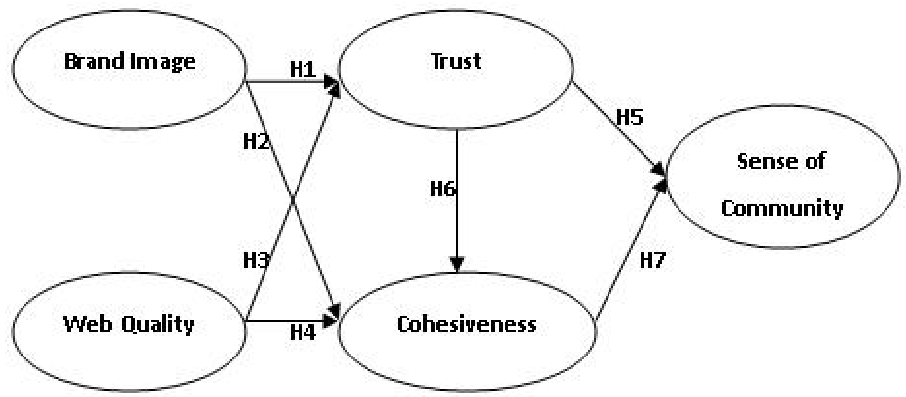 Figure 1: The proposed research framework illustrating the flow from external factors (Brand/Web) to internal states (Trust/Cohesion) and the final Sense of Community.
Key Drivers of Success
- Brand Image: Not just a logo, but a "symbolic fulfillment." If a brand (like Nike or Apple) aligns with a user's self-esteem, Trust follows automatically.
- Web Quality: This includes "System Design Quality" and "Playfulness." A clunky interface destroys trust; a seamless one fosters "Ease of Use," lowering the barrier for community entry.
- The Trust-Cohesion Link: Trust acts as a replacement for "subjective norms." In a community where members trust each other and the manager, the interaction becomes "vehement" and open, leading to higher retention.
Experimental Insight: The Path to Retention
The study highlights that Cohesiveness can be Task-based (e.g., joining a group to solve a problem or get a discount) or Maintenance-based (e.g., joining because you like the other members).
- Trust (H5, H6): Mitigates anxiety in risky online environments.
- Cohesiveness (H7): Directly feeds into the Sense of Community. Without cohesiveness, the group remains a mere "virtual settlement" rather than a true community.
Critical Analysis & Conclusion
This paper provides a vital roadmap for NPOs and businesses. The most profound insight is the realization that Sense of Community is a psychological "end-state." To get there, managers must focus on the "Means":
- Maintain high technical standards (Web Quality).
- Foster interpersonal bonds (Cohesiveness).
- Ensure transparency to build Trust.
Limitations: As a theoretical framework focused specifically on Facebook Pages during their peak era, the model may need adjustment for the "short-form video" age where community interaction is more ephemeral. However, the underlying psychological truths about belonging and attraction remain a cornerstone for any digital strategist.
Takeaway
If you want your fans to stay, don't just give them content—give them cohesion. Focus on shared goals and reliable technical experiences to transform a list of "followers" into a resilient "community."