
Unified Social Ontologies: Reducing the Overhead of our Digital Social Lives
Collaborate Social Network Services via Connectors
This paper introduces a novel social network aggregation approach that utilizes a middle server equipped with ontology merging and a Social Service Oriented Architecture (SSOA). The core method, implemented in an application called "LU," consolidates multiple independent social media accounts into a single unified instance to optimize data synchronization.
TL;DR
As our digital identities fragment across Facebook, Twitter, LinkedIn, and beyond, our devices struggle with the overhead of maintaining synchronized connections for each. This paper proposes a Middle Server Architecture that uses Ontology Merging and SSOA to consolidate multiple social feeds into a single "One Message" stream, significantly cutting down CPU usage and network congestion.
Contextual Background
In the current social media landscape, the burden of aggregation is typically placed on the user or a superficial UI "wrapper." While tools like Profilactic have existed, they often fail to address the underlying architectural inefficiency: the client device still maintains active, independent communication channels for every service. The authors argue that this is not just a UI problem, but an architectural one that impacts device longevity and network efficiency.
The Problem: The High Cost of Independence
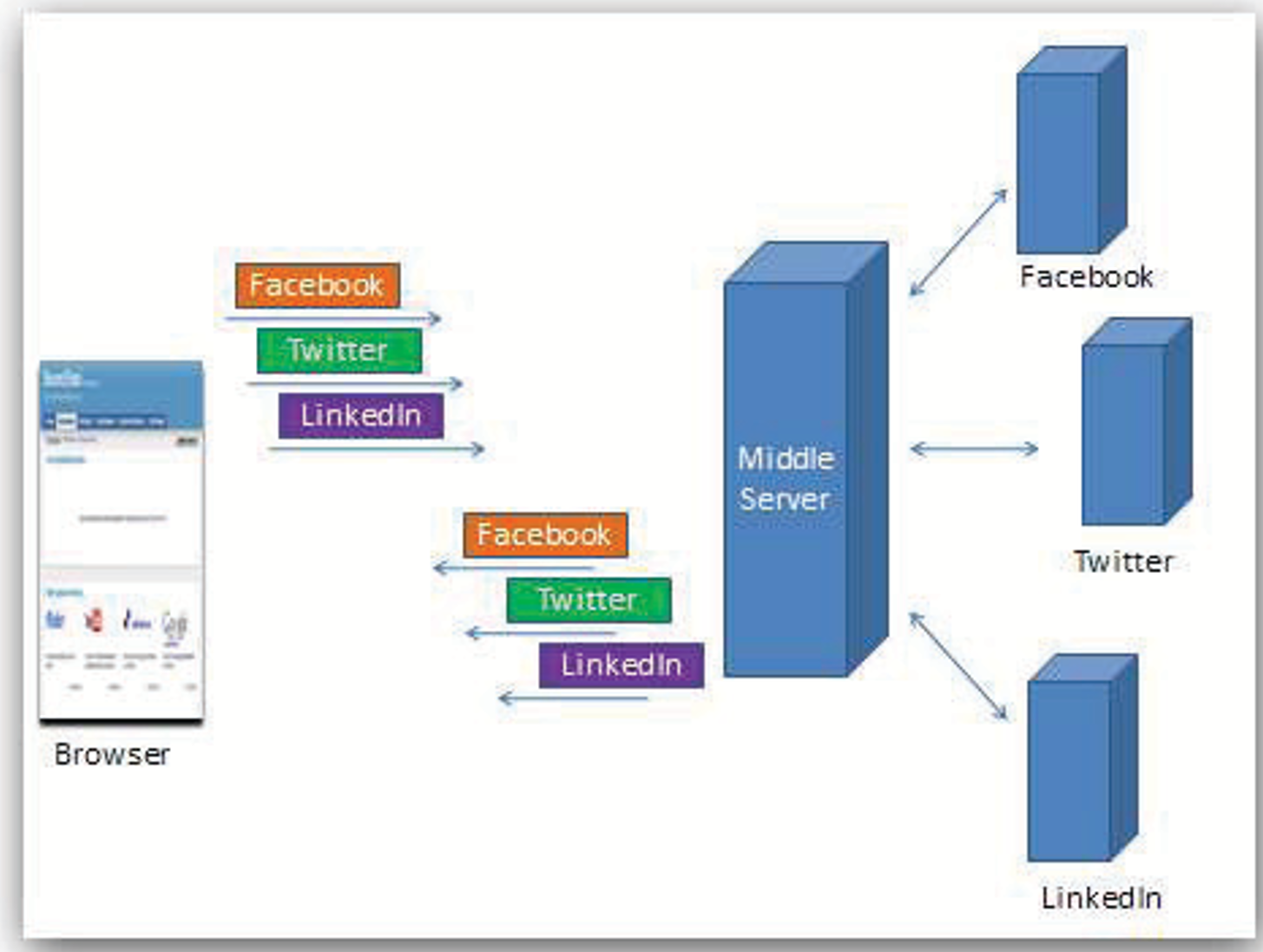
Every social media account acts as an independent silo. For a user with four accounts, a mobile device must send four distinct requests and process four distinct responses every update cycle. This Iterative Checking creates a "pollution" of communication and causes unnecessary spikes in CPU and memory usage, which is particularly taxing for mobile hardware.
Methodology: Middle Server & SSOA
The proposed solution moves the complexity away from the client and onto a sophisticated Middle Server.
1. Ontology Merging
Instead of simply forwarding data, the middle server utilizes Ontology Merging. It treats a client as a single class with multiple attributes (their various accounts). By mapping the traits of different services (profiles, friends, feeds) into a unified semantic model, the server can manage data more intelligently.
2. Social SOA (SSOA)
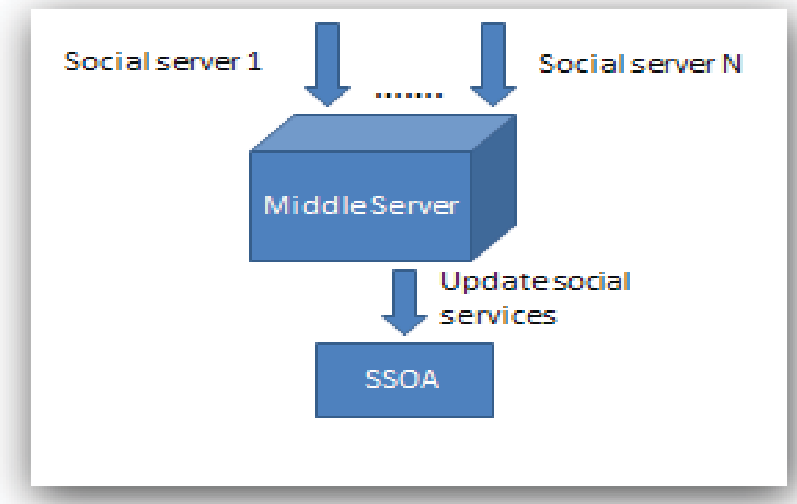
The authors introduce SSOA, a specialized version of Service Oriented Architecture tailored for social data. It acts as a service provider where the "combined social type" is the primary service. It uses a registry system to notify the client of updates across any linked platform through a unified metadata flag.
3. The "One Message" Principle
The most striking innovation is the communication protocol. Whether using a Push or Pull model, the middle server bundles all social updates into a single message packet.
Implementation & Results
The authors developed LU (Universal Linker), a Java-based application utilizing socket models and SSL for secure communication. By consolidating requests:
- Device Performance: CPU and memory requirements were significantly lowered because the app only handles one synchronized stream.
- Network Efficiency: Server-side work is reduced as the middle server acts as the primary observer, managing the heavy lifting of polling social providers like Facebook or Twitter.
Critical Analysis & Conclusion
Takeaway
The paper effectively demonstrates that the future of social networking isn't just about more platforms, but about better interoperability. By abstracting social data into a unified ontology, we can interact with our digital presence more efficiently.
Limitations
- Privacy & Trust: Moving all credentials and social data to a middle server creates a significant security "honeypot." While the authors mention SSL and CA certificates, the central storage of encrypted passwords remains a high-risk factor.
- API Constraints: The success of such a system relies heavily on the willingness of social giants (Facebook, etc.) to allow middle-server polling, which has historically been restricted by proprietary API limitations.
Future Outlook
The authors suggest expanding this ontological approach to all internet activities, not just social media—essentially creating a "Universal Client Agent" that acts as a digital twin, filtering and consolidating the noise of the internet into a clean, single stream of information.