
TSSP-M & TSSP-S: Securing and Accelerating Mobile Crowdsensing via Social Networks
SPECIAL SECTION ON COLLABORATION FOR INTERNET OF THINGS
2018-01-01
Summary
Problem
Method
Results
Takeaways
Abstract
This paper proposes two novel incentive mechanisms, TSSP-M and TSSP-S, designed for Mobile Crowdsensing (MCS) through social networks. By leveraging social diffusion and reverse auction models, the mechanisms achieve SOTA performance in participation recruitment while ensuring Sybil-proofness and time-sensitivity.
## TL;DR
Mobile Crowdsensing (MCS) often struggles with low participation. This paper introduces a "social diffusion" strategy where users are paid not only for sensing but for recruiting others. By designing two auction-based mechanisms—TSSP-M and TSSP-S—the researchers successfully accelerated task coverage by 82% while making the system immune to Sybil attacks (fake identities).
## The Participation Paradox in MCS
Most MCS systems assume a ready pool of participants. In reality, only a tiny fraction (often <6%) of users contribute real-time data. While social networks offer a massive recruitment pool, they introduce two lethal problems:
1. **Lethargy**: Without specific incentives, tasks diffuse too slowly for time-sensitive applications like traffic monitoring.
2. **Sybil Attacks**: In a social context, it is trivial to create fake accounts. If users are rewarded for recruiting, they might simply "recruit" themselves multiple times to harvest rewards.
## Methodology: Diffusion with a Ticking Clock
The paper models the interaction as a **Reverse Auction**. To solve the problems above, the authors designed a dual-reward structure:
* **Sensing Payment**: Compensation for the task cost (battery, data, privacy).
* **Recruitment Reward**: A bonus delivered to the person who shared the task.
To ensure **Time-Sensitivity**, the recruitment reward $r$ is a decreasing function of time. The faster the task reaches a winner, the more the recruiter earns.
### TSSP-M (Multi-Bid Model)
Designed for independent tasks. It utilizes a modified **Vickrey Auction** (Second-Price rule).
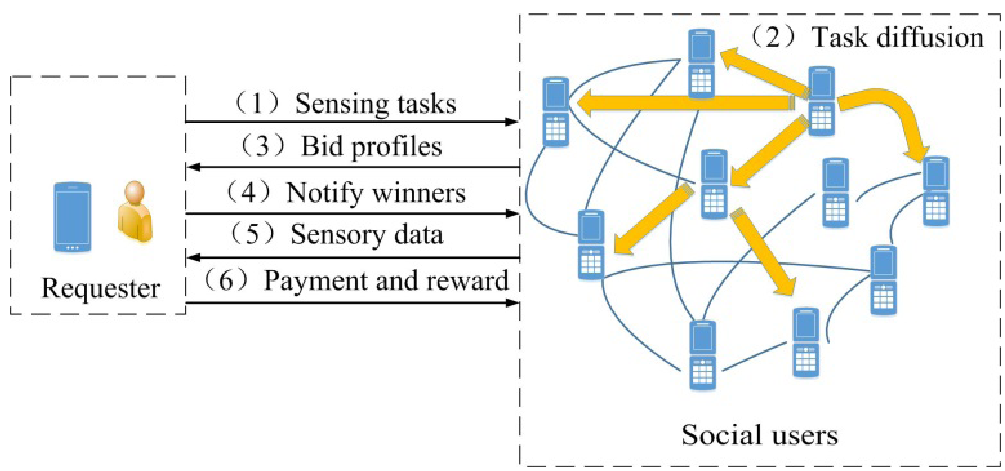
*Architecture: The requester diffuses tasks to social neighbors, who either bid or further diffuse the task.*
### TSSP-S (Single-Bid Model)
Designed for correlated tasks (e.g., sensing two nearby locations is cheaper than two far ones). It calculates payments based on the **marginal utility** of a user's task set compared to other bidders, ensuring that no user can game the system by splitting tasks across fake identities.
## Experimental Results
The mechanisms were tested against standard benchmarks like `MSensing` and `MMT`.
1. **Social Cost Optimization**: TSSP-M achieved the theoretical minimum social cost because it always selects the lowest-cost bidders from a larger, diffused pool.
2. **Superior Speed**: As shown in the coverage charts, TSSP-M/S reached near 100% task coverage significantly faster than time-insensitive versions.
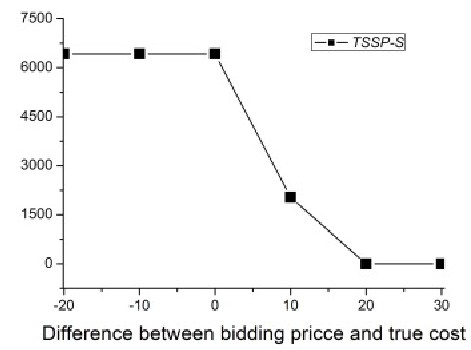
*Coverage Efficiency: Time-sensitive rewards lead to much higher task coverage rates ($ \alpha $) as the deadline ($ T_L $) approaches.*
## Critical Analysis: Why This Matters
The brilliance of this work lies in its **Sybil-proofness proof**. By ensuring the "disguised cost" (the friction of managing fake accounts) is always higher than the potential recruitment reward, the authors make fraud economically irrational.
**Limitations**: The TSSP-S model has exponential complexity ($O(n \cdot 2^{|0_i|})$) relative to the task set size. While manageable for small task sets per user, it may struggle with very high-density task environments.
## Conclusion
This research moves MCS from a "passive" recruitment model to an "active" social propagation model. By mathematically aligning the interests of the requester (speed and low cost) with the users (higher rewards for fast sharing), it provides a robust blueprint for urban-scale sensing applications.