
Beyond the Virtual Crowd: A New Taxonomy of Locality and Collaboration
Collaboration and Locality in Crowdsourcing
The paper proposes a new 2x2 taxonomy for crowdsourcing that integrates locality and collaboration. It classifies projects based on the type of search (Local vs. Remote) and the interaction mode (Tournament-based vs. Collaboration-based), addressing the rise of Location-Based Crowdsourcing (LBCS).
TL;DR
Crowdsourcing is often viewed as a "location-blind" digital phenomenon. This paper challenges that notion by introducing a taxonomy based on Locality of Search and Interaction Type. By analyzing platforms like Lego Ideas and WeGoLook, the authors demonstrate that the effectiveness of a crowd depends on whether you need a "local" or "remote" crowd and whether they should compete or collaborate.
Problem & Motivation: The Location Gap
In the early days of the Web, crowdsourcing was synonymous with "anywhere, anytime." However, as mobile technology advanced, a new problem emerged: Location-Dependency.
If you need someone to inspect a car in a specific city or verify a news story in a neighborhood, a global crowd of millions is useless if no one is there. Prior taxonomies focused on what the task was, but ignored where the participants were and how they interacted. The authors argue that as "Location-Based Crowdsourcing" (LBCS) grows, we need a rigorous way to categorize these projects to design better incentives and platforms.
Methodology: The 2x2 Matrix of Crowd Dynamics
The core of this work is the classification of crowdsourcing into four quadrants based on two dimensions:
- Interaction Dimension:
- Tournament-based: Crowdsourcees work independently; the best solution wins (e.g., Threadless design contests).
- Collaboration-based: The crowd must interact and combine efforts to achieve a result (e.g., Fold.it protein folding).
- Locality Dimension:
- Local Search: Seeking participants within a specific geographical proximity to the task or crowdsourcer.
- Remote Search: Seeking participants regardless of location, typically via the internet.
The Taxonomy in Action
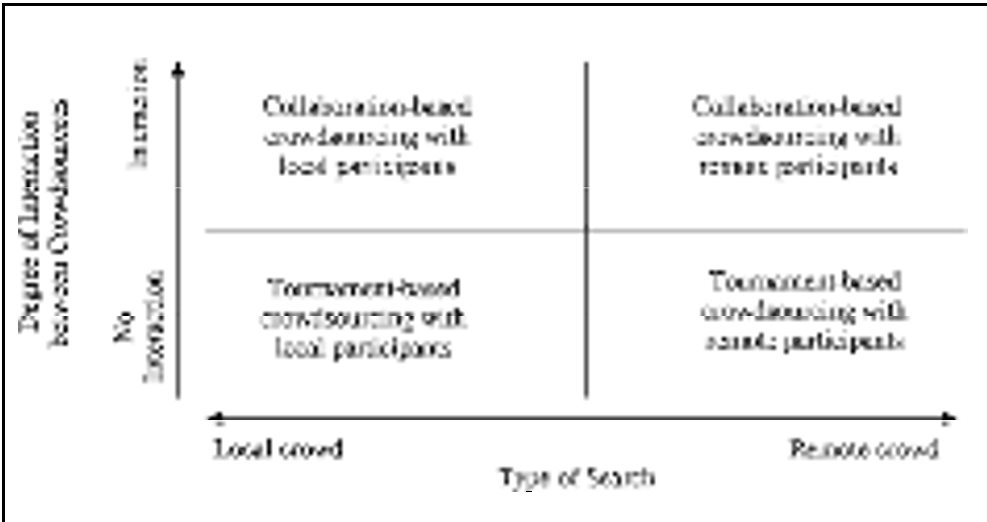
- Quadrant 1 (Remote/Tournament): The classic model like Amazon Mechanical Turk or iStockphoto. Global reach, individual tasks.
- Quadrant 2 (Remote/Collaborative): Platforms like Marblar, where a global community collaborates to find commercial uses for new technologies.
- Quadrant 3 (Local/Tournament): WeGoLook is a prime example. The platform searches for a local individual to perform a specific task (inspection) at a specific place. No collaboration is needed, but "being there" is mandatory.
- Quadrant 4 (Local/Collaborative): trnd.com uses local "connectors" to trigger viral marketing within specific neighborhoods, requiring local social interaction.
Experiments & Case Insights
The paper uses a qualitative case-study approach to analyze current market leaders:
- Lego Ideas: Shows how psychological rewards (seeing your design on shelves) drive participation in a global tournament.
- Fold.it: Demonstrates that while it is a remote search, the option for collaboration (team play) significantly impacts the quality of scientific outcomes.
- Incentive Variation: The authors note that in "Local" tasks, the convenience of location often acts as a lower barrier to entry, whereas "Remote" tasks require higher specialization or stronger extrinsic rewards.
Critical Analysis & Conclusion
Takeaway
The paper successfully reframes crowdsourcing as a spatial-social challenge. The real value for developers and researchers lies in the realization that proximity is an asset. Local crowdsourcing reduces "search costs" for physical tasks and can foster higher trust.
Limitations
- Security & Privacy: The paper briefly mentions this but doesn't deep-dive into the risks of LBCS, where revealing one's location is a prerequisite for work.
- Quantitative Validation: While the taxonomy is logically sound and backed by examples, it lacks empirical data on which quadrant yields the highest ROI for specific industries.
Future Outlook
The authors suggest that the next frontier is Automated Matching. Imagine an LBCS portal that doesn't wait for you to find a task but uses smartphone sensors to suggest a collaborative local task just as you walk into a relevant area. The future of crowdsourcing isn't just "in the cloud"—it's right around the corner.