
Beyond Expert Search: Re-Engineering Academic Collaboration Recommendations
Collaboration Recommendation on Academic Social Networks
This paper introduces an innovative recommendation framework for academic collaborations within Social Networks. By integrating "Global Cooperation" (co-authorship intensity) and "Global Correlation" (research area similarity via VSM), it provides a hybrid approach to recommend initiating or intensifying scientific partnerships.
TL;DR
This research addresses the "Information Overload" in academia by proposing a recommender system that doesn't just find experts, but analyzes the depth of existing relationships. By balancing co-authorship history (Global Cooperation) with research area alignment (Global Correlation), the system identifies where researchers should start new projects or deepen existing ones.
Contextual Positioning
In the landscape of Social Network Analysis (SNA), this work acts as a bridge between structural collaborative filtering and content-based semantic analysis. Moving beyond the "who knows whom" of early social graphs (like MySpace or early Facebook), it seeks to optimize professional productivity within Digital Libraries like DBLP.
The Problem: The Gap Between Potential and Practice
Most academic recommender systems suffer from a binary focus:
- Structural Bias: They recommend "friends of friends" without checking if their research areas actually overlap.
- Semantic Bias: They find people with similar keywords but ignore whether those people are already collaborating or have a history of conflict.
The authors argue that the real value lies in the discrepancy between cooperation and correlation. For example, if two researchers have high research alignment but zero co-authored papers, that is a prime "Recommend to Initiate" opportunity.
Methodology: The Dual-Metric Engine
1. Global Cooperation (Structural)
The system treats the co-authorship network as a directed graph. The weight of a relationship from researcher to is calculated as the ratio of their shared papers to the total papers of . This asymmetric approach (an adaptation of the Jaccard Coefficient) recognizes that a junior researcher's collaboration with a senior professor is more "significant" to the junior's profile than vice versa.
2. Global Correlation (Semantic)
To determine how much two researchers should be working together, the authors use a Vector Space Model (VSM). Using a specialized research area ontology (taxonomy), they map each author into an -dimensional space where each dimension is a research field (e.g., "Databases" or "Machine Learning").
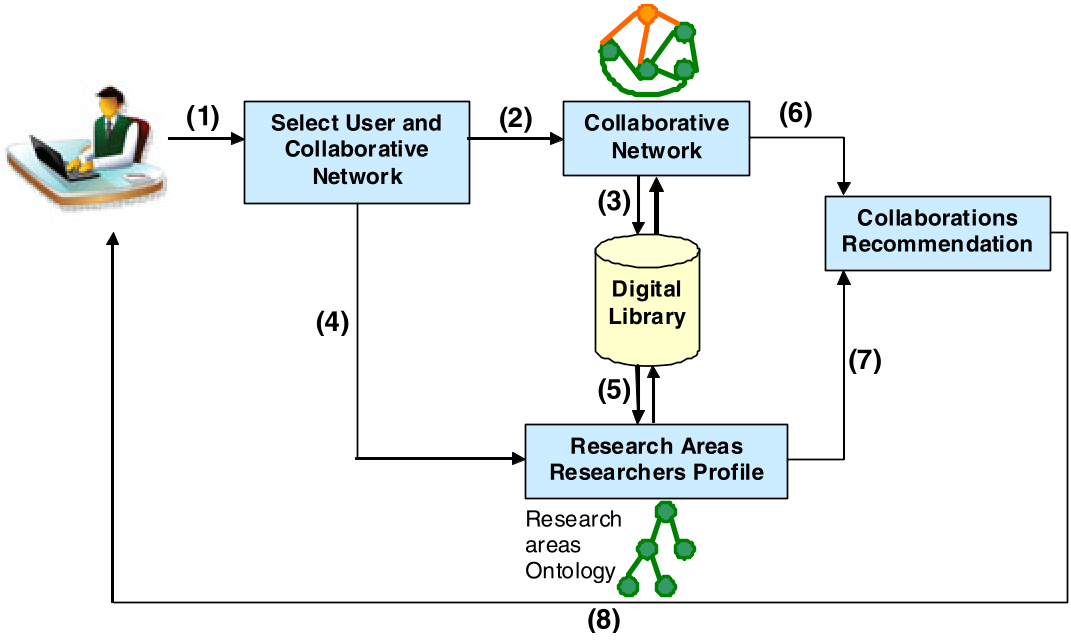 Figure 1: The system architecture illustrating the data flow from Digital Libraries to the Recommendation Engine.
The Strategic Logic
The most innovative part of the paper is the Decision Matrix. Instead of just a "similarity score," they categorize pairs into a 3x3 grid:
| Cooperation / Correlation | Low | Medium | High |
|---|---|---|---|
| Low | OK | Recommend | Recommend |
| Medium | Alert | OK | Alert |
| High | Alert | Alert | OK |
- Recommend: High potential, low activity.
- Alert: High activity, but research profiles have drifted apart (potential over-specialization or outdated partnership).
- OK: Cooperation is currently matched with topical interest.
Experiments & Case Study
The authors validated this on the InWeb (Brazilian National Institute of Science and Technology for the Web) dataset, extracting nearly 700k conference papers and 432k journal articles from DBLP.
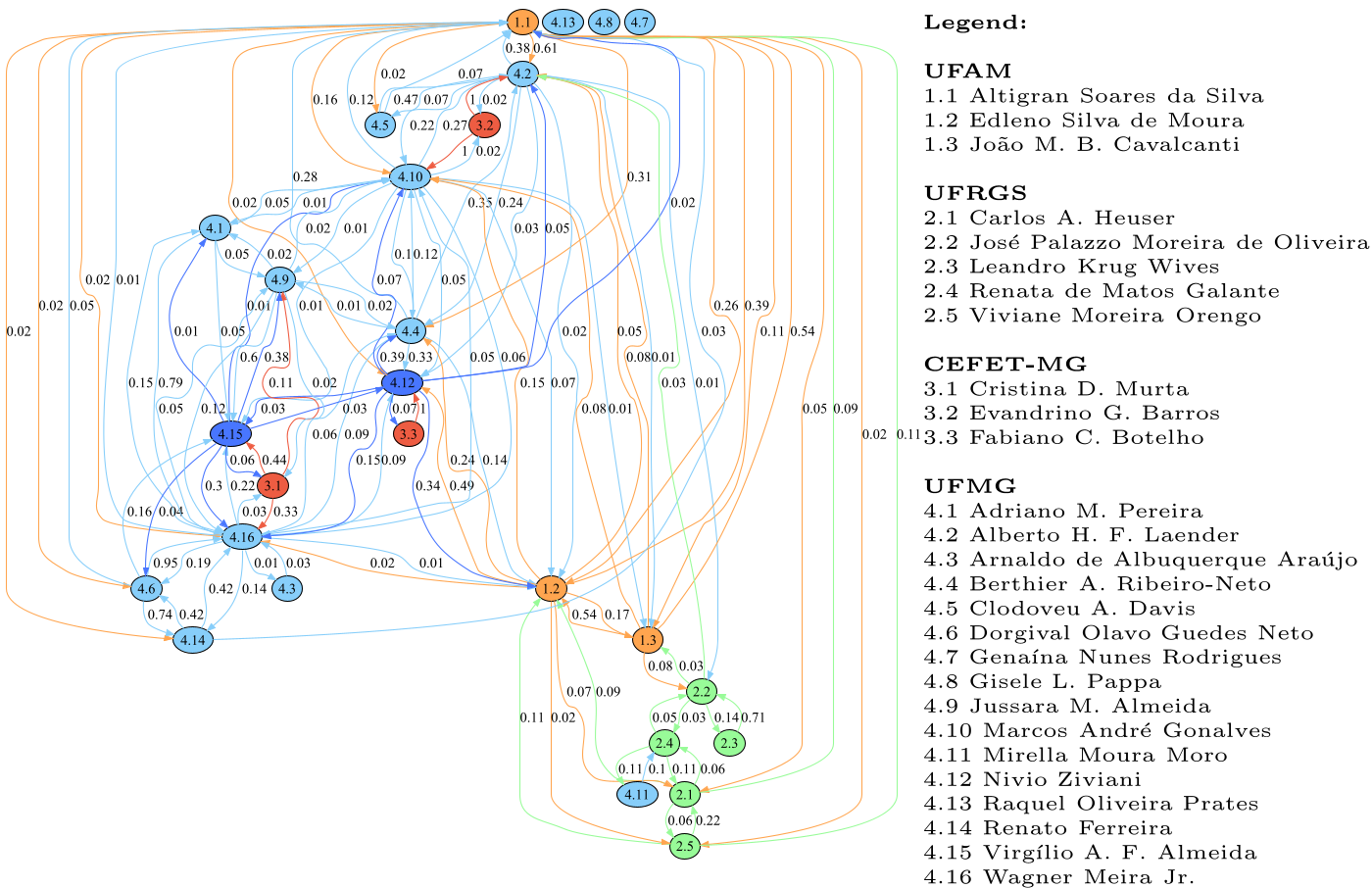 Figure 2: The generated Social Network for InWeb members based on DBLP metrics.
The results allowed for ranked recommendation lists. For "Initiate Collaboration," the list is ranked by Correlation; for "Intensify Cooperation," it is ranked by the ratio of Cooperation to Correlation, prioritizing those with the most "untapped" potential.
Critical Insight & Future Outlook
While the paper provides a solid foundation, its reliance on titles (ignoring full text or citations) might limit the "Global Correlation" accuracy. However, the introduction of the "Intensify" vs. "Initiate" logic is a significant step forward in making academic social networks more than just digital Rolodexes.
Future Research Directions:
- Implementing Spreading Activation Models to find indirect collaborators.
- Examine how temporal changes in research interests affect the "Alert" status in the decision matrix.
- Integration of Trust Metrics to ensure recommended partners are not just scientifically compatible, but also reliable.