
Beyond Thought Pieces: How Collaboration Networks Drive Evidence-Based Research in Terrorism Studies
The Influence of Collaboration on Research Quality - Social Network Analysis of Scientific Collaboration in Terrorism Studies Research Groups.
This study utilizes Social Network Analysis (SNA) and cluster analysis to investigate the relationship between research collaboration structures and the production of evidence-based studies in terrorism research. By analyzing 5,121 publications from 1992 to 2013, it identifies that heterogeneous and internationally diverse research groups significantly outperform homogeneous ones in generating data-driven policy insights.
TL;DR
Is terrorism research grounded in facts or just opinions? This study performs a deep-dive Social Network Analysis (SNA) on over 5,000 papers to prove that how researchers organize matters. The verdict: International, organizationally diverse, and highly interconnected research groups are far more likely to produce "evidence-based" research than isolated individual scholars.
The "Conceptual" Trap in Security Studies
For decades, the field of terrorism studies has faced a recurring criticism: it is "lite" on data. Previous evaluations suggested that as much as 80% of the literature consisted of literature reviews or subjective "thought pieces." This is a dangerous gap. When counter-terrorism policies cost billions of dollars and involve human lives, they cannot rely on mere intuition.
The authors of this paper argue that the transition from conceptual to evidence-based research isn't just a matter of individual will, but a matter of network structure.
Methodology: Mapping the Intellectual Web
The researchers treated the entire field of terrorism studies (1992–2013) as a living network. They used:
- Data Mining: Scouring the Web of Science for 5,121 publications.
- Girvan-Newman Clustering: An algorithm that mathematically "chops" a large network into distinct research communities by removing the busiest bridges (edges with high betweenness centrality).
- Regression Analysis: Testing if "Heterogeneity" (mixing countries/organizations) actually predicts "Quality" (evidence-based output).
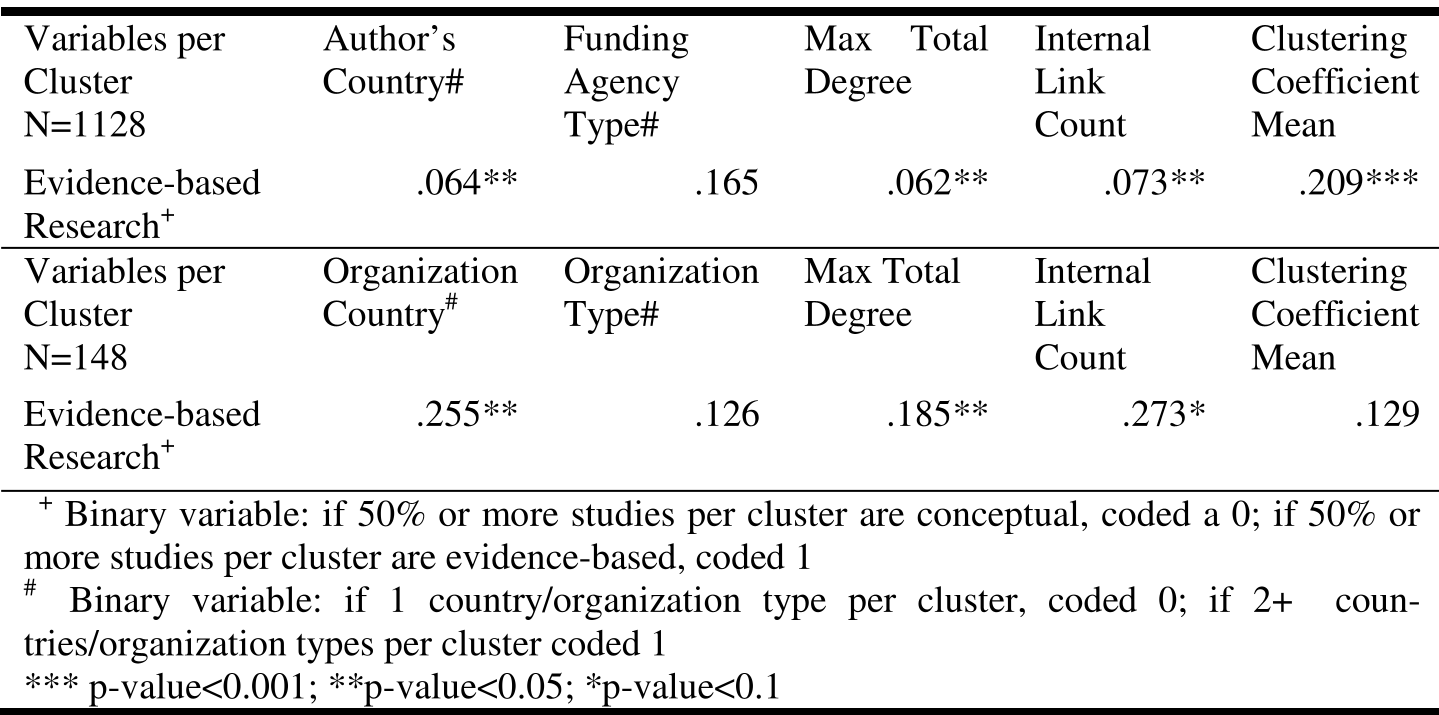 The table above highlights that clustering coefficients and multi-country participation are the strongest predictors of evidence-based research.
Key Insights: Why Diversity Wins
The study confirms several critical hypotheses regarding the "Mode 2" of knowledge production:
- The International Advantage: Research groups spanning multiple countries are significantly more likely to produce empirical data. Diversity acts as a "quality control" mechanism, forcing researchers to move beyond local biases.
- The Role of Opinion Leaders: High Total Degree Centrality (being a "hub" in the network) is a strong predictor of quality. Authors who are well-connected are likely more exposed to diverse methodologies and data sources.
- Density Matters: Higher clustering coefficients—where one's collaborators also collaborate with each other—create a "communalism" that supports the rigorous, labor-intensive work required for data-driven studies.
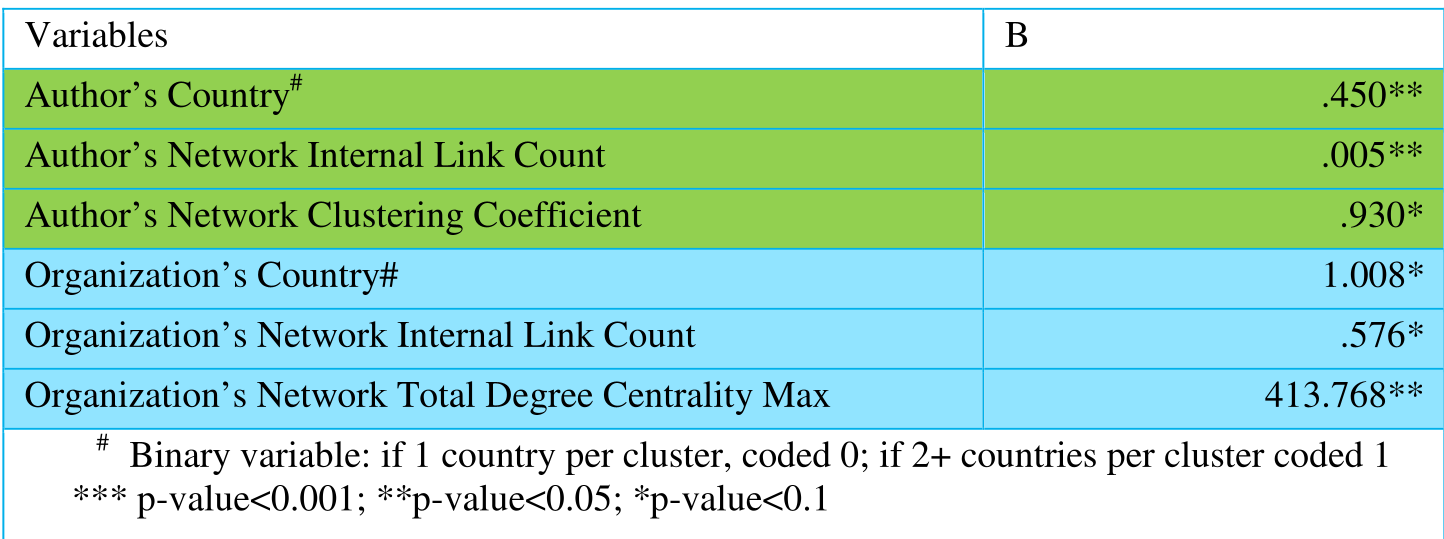 Logistic regression coefficients show that the organizational country count has a massive B-value of 1.008, underscoring its predictive power for research quality.
Critical Analysis & Conclusion
This paper provides a rare, quantitative look at the sociology of science within security studies. It moves the conversation from what we should study to how we should fund and organize the people studying it.
Takeaway for Policy Makers: If you want better policy advice, don't just fund a single expert. Fund a consortium. Promote international co-authorship and transdisciplinary clusters.
Limitations: The study relies on Web of Science data, which may under-represent non-English research. Furthermore, "evidence-based" is treated as a binary variable, which may mask nuances in the quality of the data analysis itself.
Future Outlook: As we move into an era of AI-driven research, the "human" network remains the gatekeeper of quality. Future studies should look at how digital collaboration platforms (e.g., GitHub, Slack) are further densifying these networks and accelerating the death of the "thought piece" in favor of the "data piece."