
Eventer: Bridging the Social and Physical Gap in Event Recommendations
A Collaborative and Content Based Event Recommendation System Integrated with Data Collection Scrapers and Services at a Social Networking Site
The paper introduces "Eventer," a hybrid event recommendation system integrated as a Facebook application. It combines content-based and collaborative filtering to suggest concerts by leveraging web scraping, API services (like Last.fm), and geographical proximity.
TL;DR
"Eventer" is a hybrid recommendation engine designed for the Facebook ecosystem. By merging Content-Based Filtering (what you like) with Collaborative Filtering (what similar people like), and grounding it in Geographical Location, it solves the problem of finding not just "what" to do, but "where" to go and "who" to go with.
Contextual Motivation: Why Event Discovery is Hard
Event recommendation is uniquely challenging compared to movie or book suggestions. An event is transient, locally bound, and inherently social. Prior works often failed because:
- Geographical Irrelevance: Recommending a concert in Turkey to a user in Calgary is useless.
- The "Solo" Problem: Most people won't attend an event if they don't have company.
- Data Fragmentation: Event info is scattered across various websites like Last.fm, Eventful, and Biletix.
The authors argue that a recommendation system must be SoLoMo (Social, Local, and Mobile/Web-integrated) to be truly effective.
Methodology: The Hybrid Engine
The system architecture relies on a robust data collection layer using Web Scrapers and RESTful API consumers.
1. Content-Based Similarity (The "What")
For music events, the system pulls artist similarities from the Last.fm API. If an event features multiple artists, the similarity is calculated as the maximum similarity between any performer at the event and the user's preferred artists.
2. Collaborative Filtering (The "Who")
The system calculates the Pearson correlation coefficient between users based on their shared ratings.
3. The Social Graph
Perhaps the most innovative part for its time is its integration with Facebook. When an event is recommended, the system explicitly shows which friends were also recommended that event, facilitating the "finding company" aspect of social life.
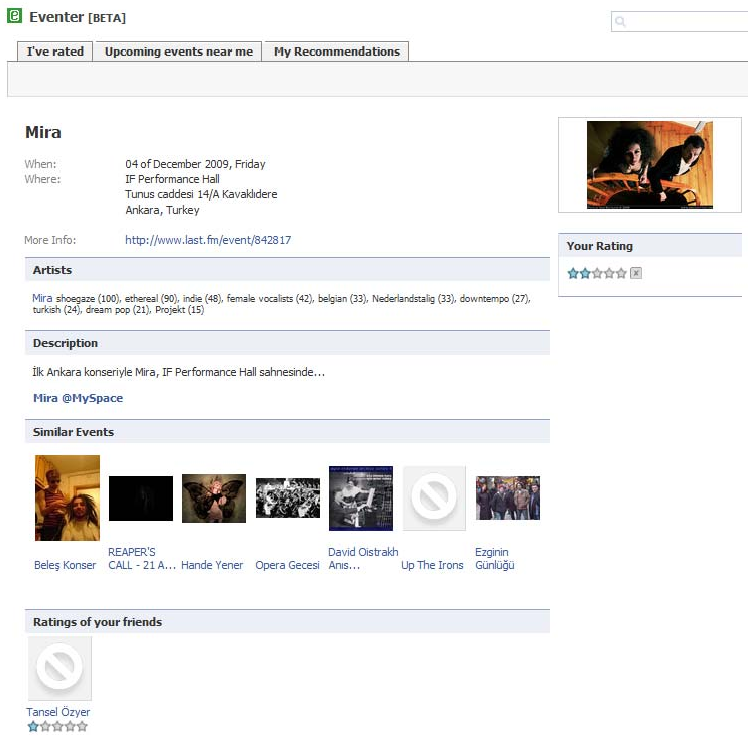 Figure: The Recommendation Tab showing shared interest among friends.
Experiments and Results
The authors tested the system on a group of university students and IT employees. As the number of events processed increased, the system's ability to rank items correctly improved significantly.
- Performance Convergence: Both Pearson Correlation and Kendall Tau rank correlation showed that as users rated more events (moving from 5 to 35 events), the "worst-case" accuracy improved and converged toward a high mean.
- Error Reduction: The rate of "False Opt-outs" (good events the system failed to recommend) plummeted to zero as the dataset grew.
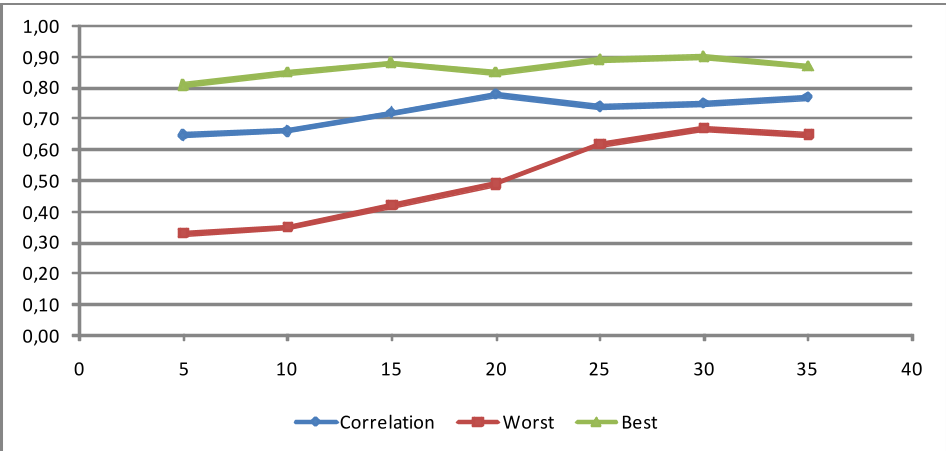 Figure: Correlation of user ratings over time, showing steady improvement in recommendation quality.
Critical Insight & Limitations
The beauty of this system lies in its data-agnostic collection. By using a modular approach to scrapers, it can unify "heterogeneous" data from different sources into a single user interface.
Limitations:
- Manual Weighting: The current similarity score is a simple sum of content and collaborative metrics. The authors admit that dynamic weighting would be more accurate.
- Sparsity: With only 10 active users in the trial, the collaborative filtering might suffer from the "sparsity problem" in a larger, more diverse population.
Conclusion
Eventer proves that for social activities, the "Interest" (Genre) is only half the battle. By adding "Identity" (Friends) and "Proximity" (Location), the system transforms a simple list of concerts into a viable social planner. Future work in this space likely involves moving from simple concerts to multi-category events like sports and theater.