
Beyond "Friends of Friends": Leveraging Interaction Intensity and Genetic Algorithms for Social Recommendations
A collaborative filtering framework for friends recommendation in social networks based on interaction intensity and adaptive user similarity
This paper introduces a Collaborative Filtering (CF) framework for friend recommendation in Social Networking Sites (SNSs) called EMDP-CFLW. It combines an Implicit Rating Model (IRM) based on user interaction intensity and profile similarity with a real-valued Genetic Algorithm (GA) to adaptively learn user-specific attribute weights, significantly improving recommendation accuracy in sparse social environments.
TL;DR
Researchers Vinti Agarwal and K. K. Bharadwaj proposed a collaborative filtering framework that moves beyond simple graph-based friend suggestions. By calculating implicit ratings through interaction intensity (with temporal decay) and using Genetic Algorithms to learn which profile attributes matter most to specific users, their system significantly boosts recommendation accuracy and coverage in highly sparse social networks.
Background Positioning
In the landscape of Social Recommender Systems (SRS), this work serves as a bridge between traditional Memory-based Collaborative Filtering and modern Evolutionary Computing. It addresses the lack of explicit "likes/dislikes" in social graphs by deriving a numerical affinity score between users, positioning itself as a more nuanced alternative to basic "Common Neighbor" or "Jaccard" link prediction methods.
The Problem: The Asymmetry of Friendship and the Curse of Sparsity
Most social platforms suggest friends based on mutual connections (2-hop neighbors). However, this ignores two fundamental truths:
- Asymmetry: Just because I visit your profile daily doesn't mean you do the same. Friendship strength is often directional.
- Sparsity: Most users are only connected to a tiny fraction of the network (often < 0.004%), making it nearly impossible for CF to find "similar" users based on overlapping friend lists alone.
Methodology: The Core Innovations
1. Implicit Rating Model (IRM) & Temporal Decay
The authors realized that interaction is the pulse of a relationship. They defined Interaction Intensity (II) by tracking six variables (private messages, wall posts, likes, etc.). Crucially, they introduced a decay function to ensure that an interaction from six months ago weighs less than one from yesterday.
This intensity is then combined with profile similarity using a harmonic mean to create a 1-5 implicit rating.
2. Adaptive Similarity via Genetic Algorithms (GA)
Not everyone values the same things in a friend. One user might care about "Hometown," while another prioritizes "Music" or "Career." The framework uses a real-valued GA to evolve a 16-element weight vector for every user.
- Chromosomes: Represent weights for attributes like Gender, SES, Religion, etc.
- Fitness: Minimized the difference between predicted and actual implicit ratings.
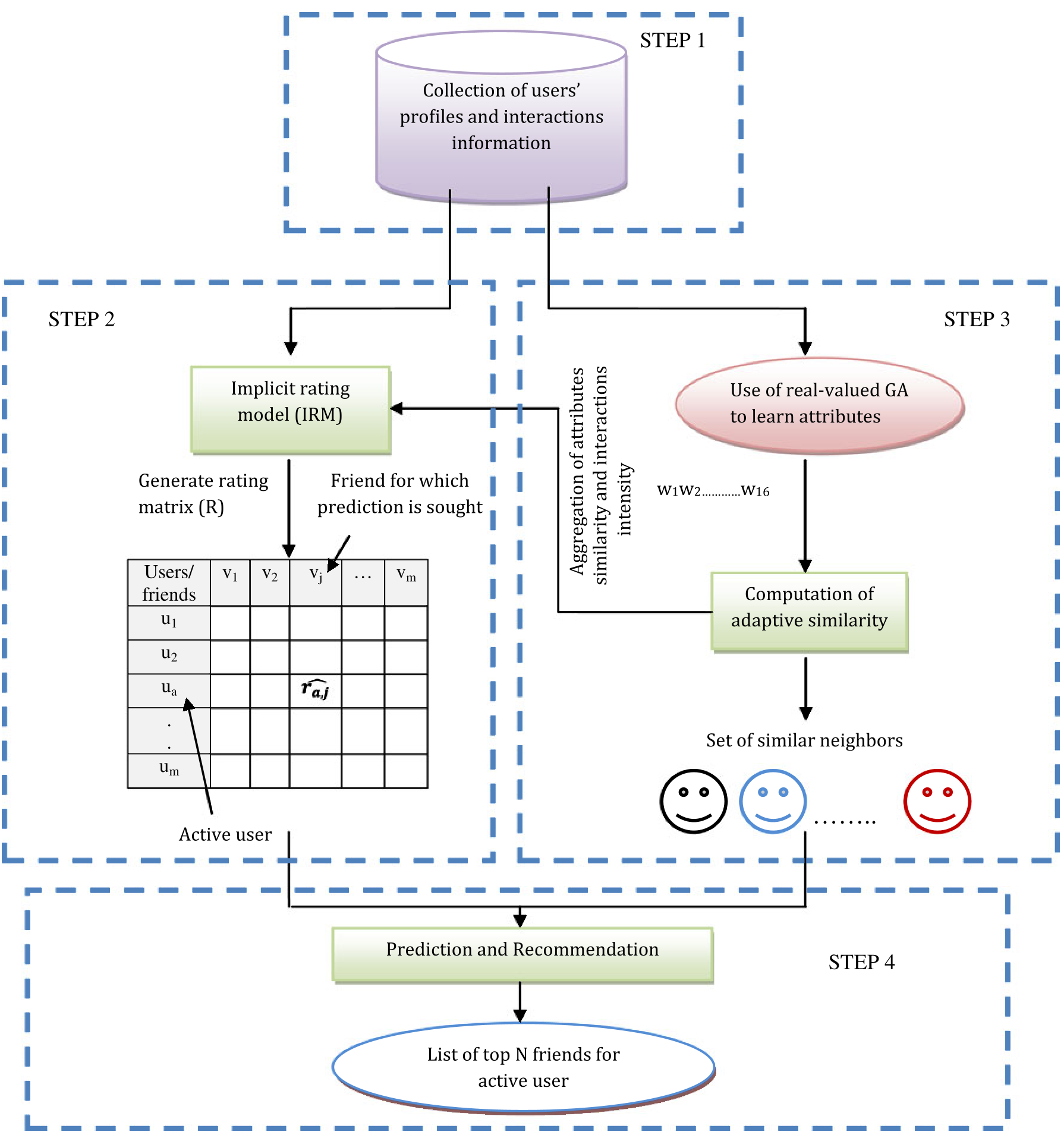 Figure 1: Schematic representation of the CF-based Friend Recommender System (FRS).
Experiments and Results
The authors compared three versions of their system:
- CFEW: Equal weights for all attributes.
- CFLW: Learned weights using GA.
- EMDP-CFLW: Learned weights plus the Missing Value Prediction algorithm.
Key Findings:
- Personalization Matters: The GA-evolved weights varied wildly between users, confirming that "one-size-fits-all" similarity measures are ineffective.
- Sparsity Solution: The EMDP algorithm allowed the system to provide recommendations even when the user-user rating matrix was 80% empty.
- Quantifiable Gain: CFLW-EMDP consistently achieved lower Mean Absolute Error (MAE) across 15 different dataset splits compared to existing hybrid baselines.
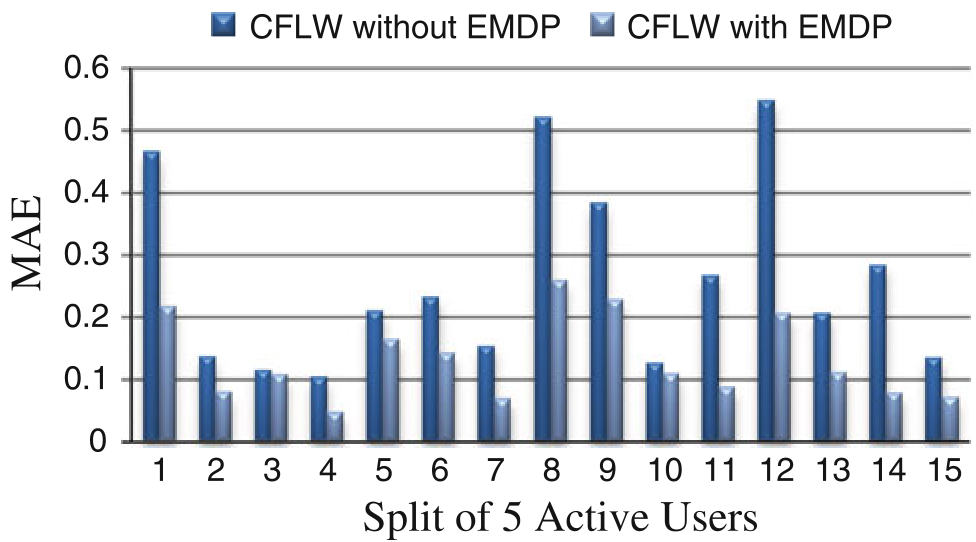 Figure 2: Performance comparison showing that EMDP-CFLW (Missing Data Prediction) significantly reduces error over standard CFLW.
Critical Analysis & Conclusion
The Takeaway: The "strength of ties" is not a static property but a dynamic one driven by interaction and personal preference. This paper provides a robust mathematical framework for transforming raw social behavioral data into actionable recommendations.
Limitations:
- Scalability: Running a GA for every user to learn weights is computationally expensive (though authors suggest this be an offline process).
- Synthetic Data: While the results are promising, the reliance on a synthetic dataset leaves questions about how these specific 16 attributes would perform in the noise of a real-world Facebook or LinkedIn dataset today.
Future Outlook: The next step for this line of research is the integration of Trust-Reputation measures and Multi-relational link prediction, where different types of social ties (professional vs. personal) are modeled separately to provide even more context-aware suggestions.