
Socially-Aware CF: Why Your Friends Predict Your Taste Better Than Strangers
Collaborative Filtering For Recommendation In Online Social Networks
This paper investigates the efficacy of conventional Collaborative Filtering (CF) within online social networks (OSNs) by leveraging explicit social graphs (Facebook API data). It compares standard CF against two socially-constrained variants, "FRIEND" and "Friends-of-Friends" (FoF), across multiple item types including links, videos, and check-ins.
TL;DR
Researchers at University College Dublin utilized Facebook's social graph to prove that traditional Collaborative Filtering (CF) is effectively "blind" to social context. By restricting recommendation sources to a user's explicit Friends or Friends-of-Friends (FoF), they achieved up to a 30% boost in accuracy. The study also reveals that user-based methods are far more robust than item-based ones in the "noisy" environment of social sharing.
Problem & Motivation: The Global Similarity Trap
For decades, the gold standard for recommendation has been finding "people like you." In traditional CF, "like you" is defined mathematically as having a similar rating history. However, this approach ignores a fundamental psychological truth: we often trust the opinions of our friends more than the calculated similarities of anonymous strangers.
With the rise of Open APIs from platforms like Facebook, we now have access to Explicit Social Graphs. The authors identified a massive opportunity: Can we improve recommendation by trading quantity (the global population) for quality (the social circle)?
Methodology: Constraining the Neighborhood
The authors tested three core algorithmic variations applied to both User-based and Item-based CF:
- Standard CF: The traditional approach using the entire database to find neighbors.
- FRIEND: Restricting neighbors only to direct social connections.
- FoF (Friends-of-Friends): Expanding the social circle slightly to second-degree connections.
They also explored Cross-Domain effects by profiling users across three distinct item types: Links, Videos, and Check-ins. This allowed them to test if your taste in music (Videos) could predict your destination (Check-ins).
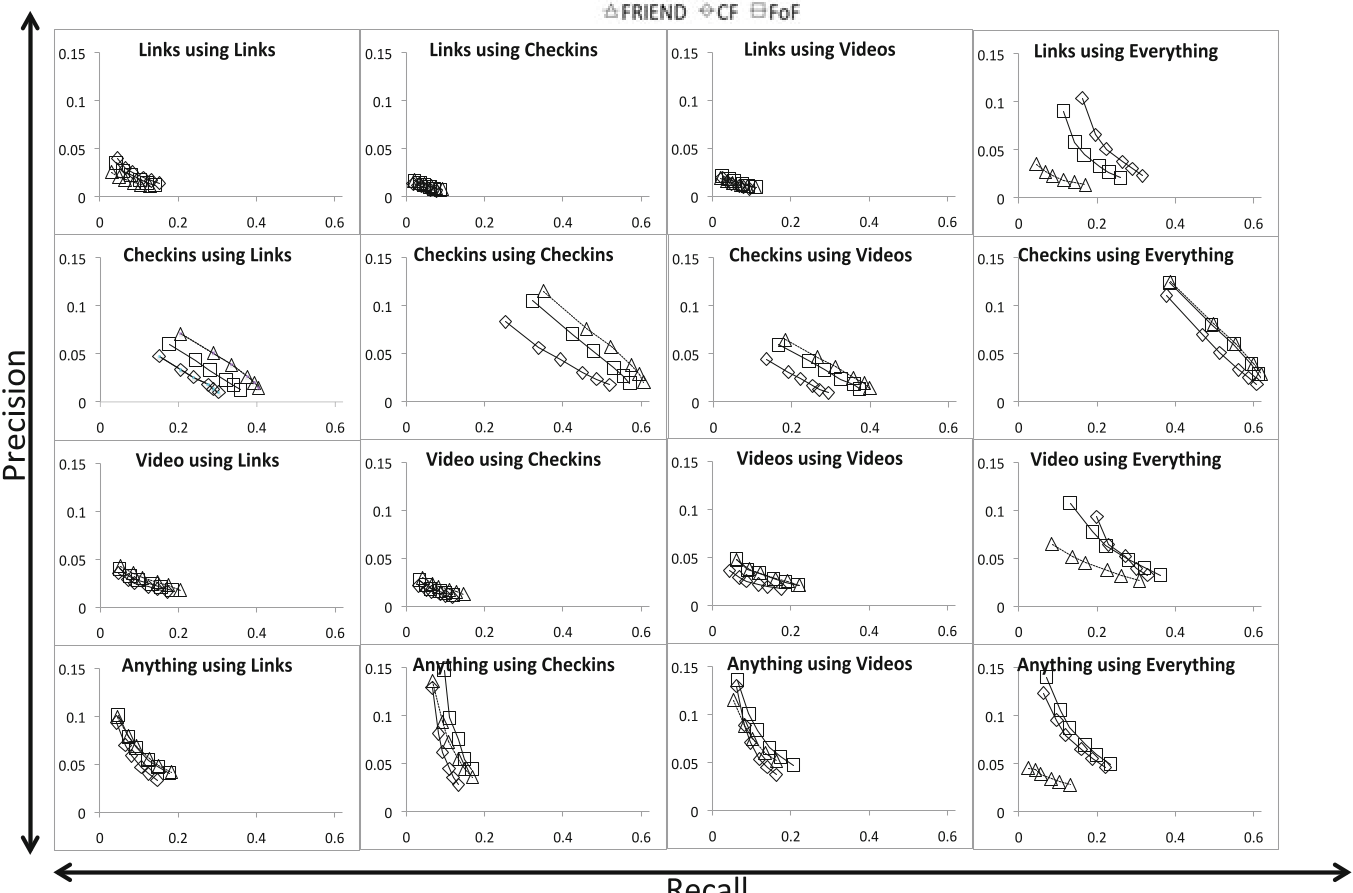 Table 1: The Facebook dataset statistics across Links, Videos, and Check-ins.
Experiments & Results: Quality Over Quantity
The results were striking across 16 different input/output combinations.
1. The Social Advantage
While standard CF had slightly higher coverage (because it had more users to pick from), its accuracy was consistently lower. The FRIEND and FoF variants provided far more relevant recommendations. In the "Everything" condition (using all data types), FoF outperformed standard CF by a significant 25% in F1 score.
2. User-Based vs. Item-Based
One of the paper's strongest findings is that User-based CF is vastly superior in social settings. Item-based CF struggled specifically with "Links" due to extreme sparsity (the likelihood of two different users sharing the exact same URL is very low). User-based methods, by contrast, could capture overlapping interests even when specific item matches were rare.
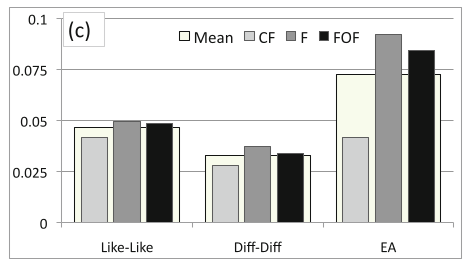 Fig 5: Summary of User-Based F1 results showing the dominance of FRIEND/FoF and the 'Everything' (E) profile.
3. The Power of Check-ins
Check-ins (locations) were the easiest items to recommend. The authors hypothesize that this is due to "physical realism"—friends are often physically together or share similar geographic constraints, making a friend's visit to a coffee shop a high-signal recommendation for you.
Critical Analysis & Conclusion
Takeaway
The core insight is that Social Filtering acts as a high-pass filter for relevance. By ignores the "noise" of millions of strangers and focusing on the social graph, models can overcome data sparsity and provide recommendations that reflect real-world trust.
Limitations
- Cold Start: The FRIEND/FoF methods rely heavily on the existence of a mature social graph. For new users with no friends, these methods fail completely.
- Unary Data: The study uses "shares" (positive feedback only). It does not account for items a user might dislike.
Future Outlook
The authors suggest that future research should focus on blending interests across item types. As we move toward a "Metaverse" or integrated social ecosystems, the ability to translate a social link into a content preference across domains will be the key to solving information overload.