
MR3++: Harmonizing Social Circles and Review Text for Superior Recommendations
Collaborative Filtering with Topic and Social Latent Factors Incorporating Implicit Feedback
The paper proposes MR3 and its extension MR3++, a novel collaborative filtering framework that fuses user-item ratings with social networks and item reviews. By aligning latent factors from Social Matrix Factorization (Social MF) and hidden topics from Topic MF, it achieves state-of-the-art performance in rating prediction.
TL;DR
The MR3++ framework represents a major step in recommendation accuracy by simultaneously modeling ratings, social relations, and item reviews. By aligning Social Matrix Factorization with Topic Modeling and adding an implicit feedback layer, it tackles the "sparsity" problem head-on, delivering significant RMSE reductions on major real-world datasets like Epinions and Ciao.
Problem & Motivation: The Data Sparsity Wall
Standard Collaborative Filtering (CF) relies on the user-item rating matrix. However, this matrix is often over 99% sparse. When a user has only rated one or two items, the model "guesses" their preferences poorly.
Previous researchers tried two patches:
- Social MF: "If my friends like it, I might too."
- Topic MF: "Reviews clarify why an item was rated high/low."
The authors observed that no model effectively combined all three while also mining implicit feedback (the mere fact that a user chose to rate an item, regardless of the score). MR3++ was born from the intuition that social influence and review content are complementary perspectives of the same user preference.
Methodology: The Core of Triple Fusion
The MR3++ model is built on two primary pillars:
1. Latent Factor Alignment
The model ensures that:
- Users have a dual identity: their position in the social network (Social MF) must be consistent with their rating behavior.
- Items are defined by both their rating patterns and the "topics" discussed in their reviews. A "Softmax Transformation" bridges the gap between real-valued rating vectors and probabilistic topic distributions.
2. Deep Mining via Implicit Feedback
The "++" in MR3++ signifies the integration of an extra implicit feature matrix . This matrix captures the a priori impact of items a user has interacted with, helping stabilize the latent preference vector even for users with very few explicit ratings.
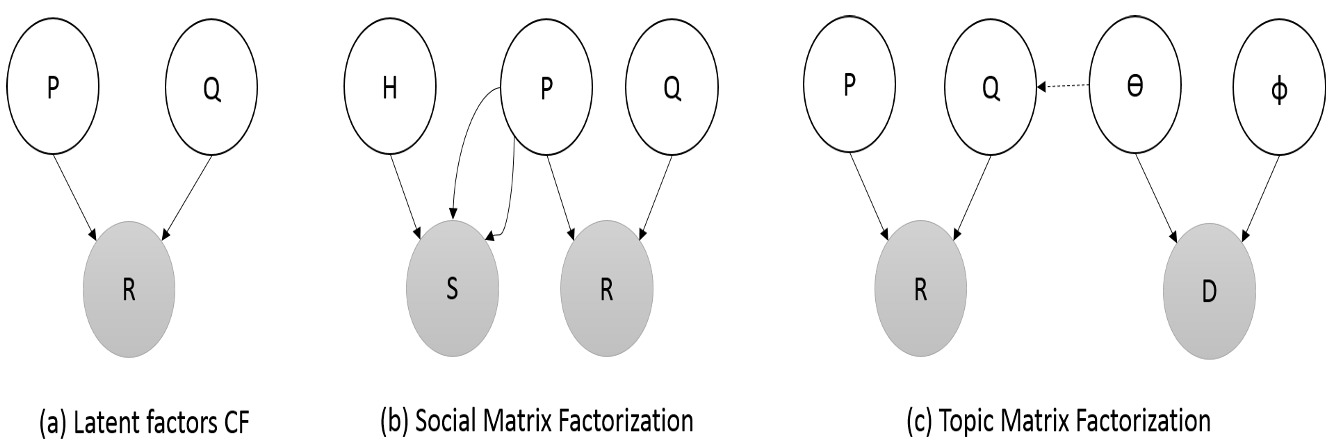 Figure: The interaction between Rating (R), Social (S), and Review (D) data matrices through shared latent spaces.
Experiments & Performance
The authors tested the model against heavyweights like PMF, HFT (Topic-based), and LOCABAL (Social-based).
Key Findings:
- Synergy Wins: MR3 (the base hybrid model) beat the best individual component by an average of 1.86% in RMSE.
- Implicit Growth: Adding implicit feedback (MR3++) provided an additional boost, particularly on the Ciao dataset where social and review data were "denser."
- Data Richness Matters: On Ciao, where reviews are 42x longer than Epinions, the review-based Topic MF component contributed significantly more than on sparser datasets.
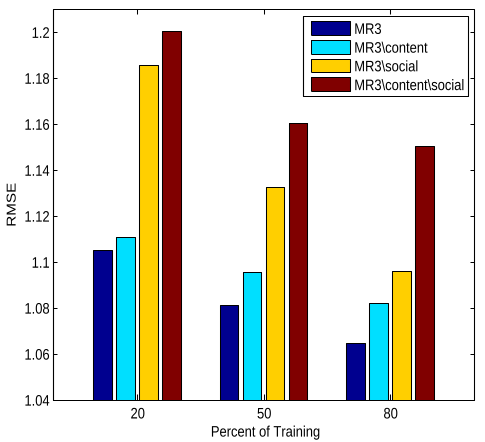 Figure: Performance comparison between the full MR3 model and its components (MR3\content, MR3\social).
Critical Analysis & Conclusion
Takeaway
MR3++ proves that alignment is better than stacking. Instead of just averaging the results of a social model and a content model, enforcing a shared latent representation across all three domains captures the nuanced relationships between how we talk (reviews), who we trust (social), and what we buy (ratings).
Limitations
A notable drawback is the computational cost. As shown in the Running Time analysis, MR3++ takes significantly longer per epoch (approx. 10x longer than MR3) due to the large-scale implicit feedback calculations. This makes it challenging for real-time updates in massive, hyper-dynamic systems without further optimization.
Future Work
The logical next step is moving beyond linear matrix factorization into Non-linear Fusion using Deep Neural Networks or Graph Convolutional Networks, which could potentially model the complex, "local social influence" via Trust values more naturally.