
Collaborative Privacy: Moving Multiple-User Access Control Beyond "The Union Rule"
Collaborative joint content sharing for online social networks
The paper introduces a collaborative access control scheme for Online Social Networks (OSNs) focusing on "joint content" (e.g., tagged photos). It utilizes Shamir’s Secret Sharing to ensure that access to shared information is only granted when a threshold of related users agrees to collaborate, achieving a decentralized privacy-preserving mechanism within existing OSN architectures.
TL;DR
Existing social networks handle "joint content"—like a photo featuring five friends—by simply merging everyone's friend lists. This creates a privacy nightmare. This paper proposes a Collaborative Sharing Scheme using Shamir’s Secret Sharing, where content only becomes visible if a specific number of tagged users "greenlight" the sharing. It is a cryptographic solution for a social problem, ensuring no single user can unilaterally leak shared data.
Problem & Motivation: The "Union" Trap
The status quo in Facebook or Google+ is the Union Rule: If Alice tags Bob in a photo, Alice's friends and Bob's friends can see it. Bob has no say in who among Alice's friends sees it, and Alice might inadvertently expose the photo to Bob's untrusted circles.
The authors identify that social privacy isn't just about confidentiality from the platform (encryption); it's about social translucence—the ability for multiple stakeholders to collaboratively decide the flow of information. Currently, research either focuses on encrypting everything for the publisher or building entirely new decentralized networks that no one uses. This paper seeks a middle ground: a cryptographic layer that works on top of existing OSNs.
Methodology: Social Gatekeeping via Secret Sharing
The core idea is to treat the decryption key as a "secret" that needs a threshold of approvals to be reconstructed.
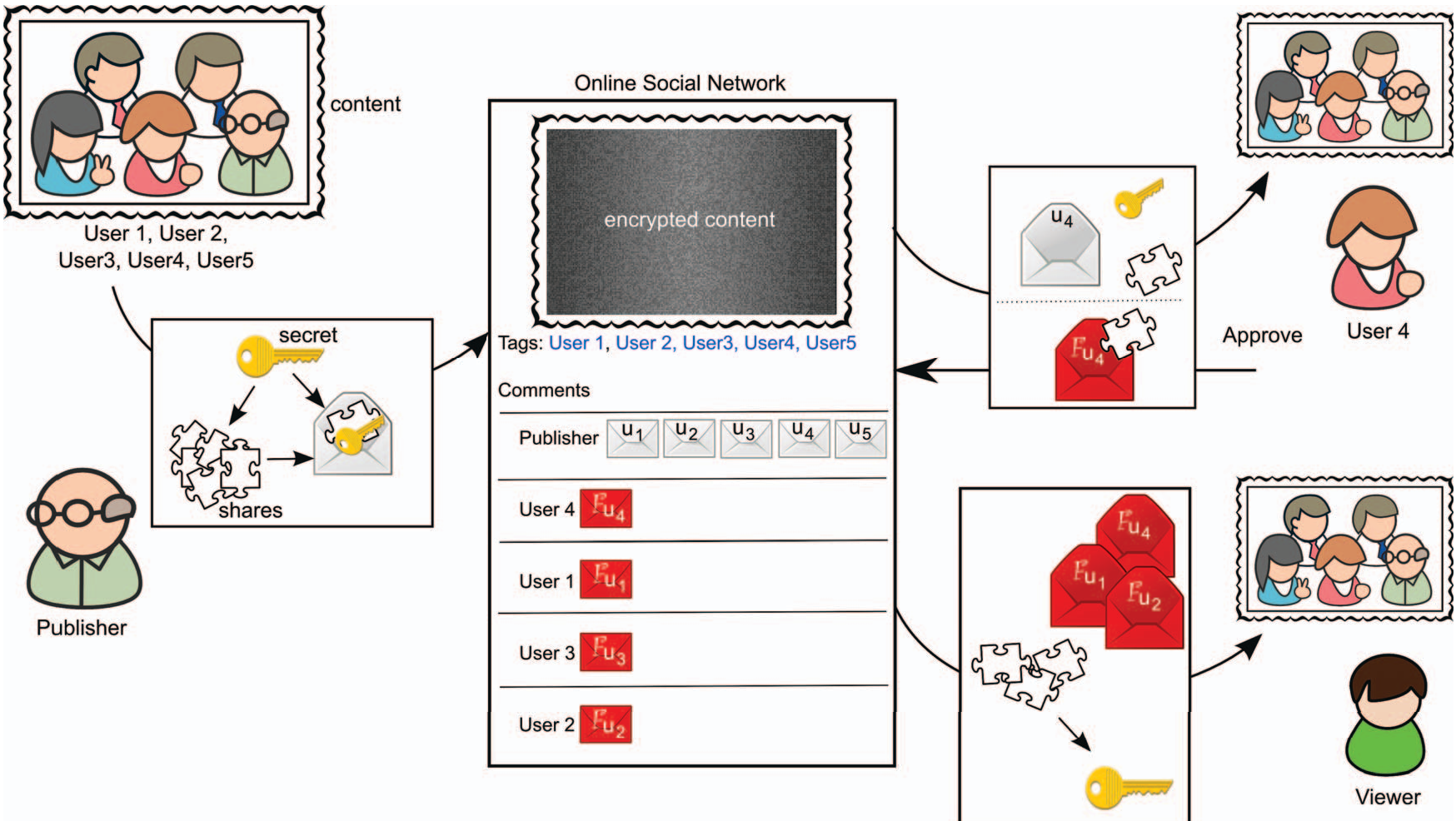
- Publishing: When a user publishes content involving friends in set , they encrypt with a random key . They then split into shares using a threshold scheme.
- Encrypted Distribution: Each share is encrypted specifically for the tagged user .
- Collaborative Approval: Each tagged user reviews the content. If they approve, they release their share encrypted under their own "collaborative key" , which is only visible to their own friends.
- Implicit Access: A viewer can only see the content if they are friends with at least people who have approved the share.
The Math Logic
The system uses the Lagrange property of polynomials. The secret is . To find , a viewer must solve:
eq i} \frac {j}{j - i}$$ This requires $t$ points (shares). Without $t$ shares, the content remains information-theoretically secure. ## Experimental Evaluation The authors demonstrate that this isn't just theoretical. Using **Curve25519** and **Authenticated Encryption (AES-CCM/AEGIS)**, they mapped out the computational costs: * **Publisher side**: Effort scales linearly with the number of tagged users $n$. * **Viewer side**: Effort is constant relative to the threshold $t$, making it highly efficient for mobile devices. * **Security**: Since it's IND-CCA secure, even the OSN provider cannot access the content if the users manage their collaboration keys outside the provider's direct view. 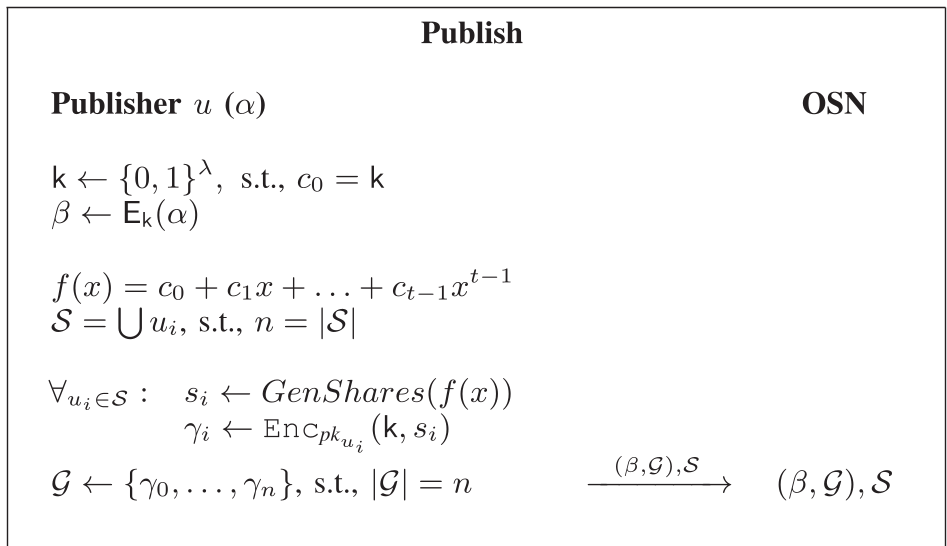 | Operation | Publish | Collaborate | Retrieve | | :--- | :--- | :--- | :--- | | EC Multiplication | $n+1$ | 1 | 0 | | Auth. En/Decryption | 1 | 2 | $t+1$ | ## Critical Analysis & Conclusion The brilliance of this approach is its **implicit access control**. There is no "master list" of allowed viewers. Instead, the allowed audience is a dynamic set formed by the intersection of the collaborators' social circles. **Limitations**: - **The Threshold Choice**: How do we decide $t$? Is it 2 out of 5? 5 out of 5? A high $t$ ensures privacy but might kill social engagement. - **Social Contract**: A authorized viewer can still download and re-post the image. No cryptographic scheme can stop the "analog loophole." **Future Work**: The authors suggest that future OSNs should integrate these "Trust Algorithms" into the UI, making the selection of threshold $t$ as intuitive as picking a "Friend List" today. This work paves the way for a more democratic and private social web.