
Towards Collaborative Machine Learning: Redefining Healthcare IoT Architecture
Towards Collaborative Machine Learning Driven Healthcare Internet of Things
The paper proposes a hierarchical, multi-layer architecture for Healthcare IoT (eHealth) called Collaborative Machine Learning. It distributes intelligence across IoT Devices, Edge (Fog) nodes, and Cloud servers, achieving a SOTA accuracy of 98% for arrhythmia detection using a combination of shallow ANN and deep CNN models.
TL;DR
This paper presents a paradigm shift from Cloud-centric healthcare to a Collaborative Machine Learning framework. By distributing intelligence across a three-tier architecture (Device-Edge-Cloud), the authors achieve real-time arrhythmia detection with up to 98% accuracy while maintaining the low-power requirements of medical wearables. This approach optimizes the tradeoff between latency, energy, and diagnostic precision.
Problem & Motivation: The Cloud Bottleneck
In the era of medical-grade wearables, the "Cloud-only" model is hitting a wall. Constant streaming of high-frequency data—such as ECG recordings—creates a "data tsunami" that overwhelms bandwidth and introduces unacceptable latency for life-critical alerts.
The authors argue that we must move toward a hierarchical ecosystem. The challenge, however, isn't just where to put the AI, but how to distribute it. Prior works often relied on static SVM models or ensemble methods that are either too computationally heavy for wearables or too simplistic for clinical-grade reliability.
Methodology: Tiered Collaborative Intelligence
The core innovation is a multi-layer strategy where different AI models "collaborate" based on the difficulty of the task and the confidence of the inference.
1. The Three-Tier Architecture
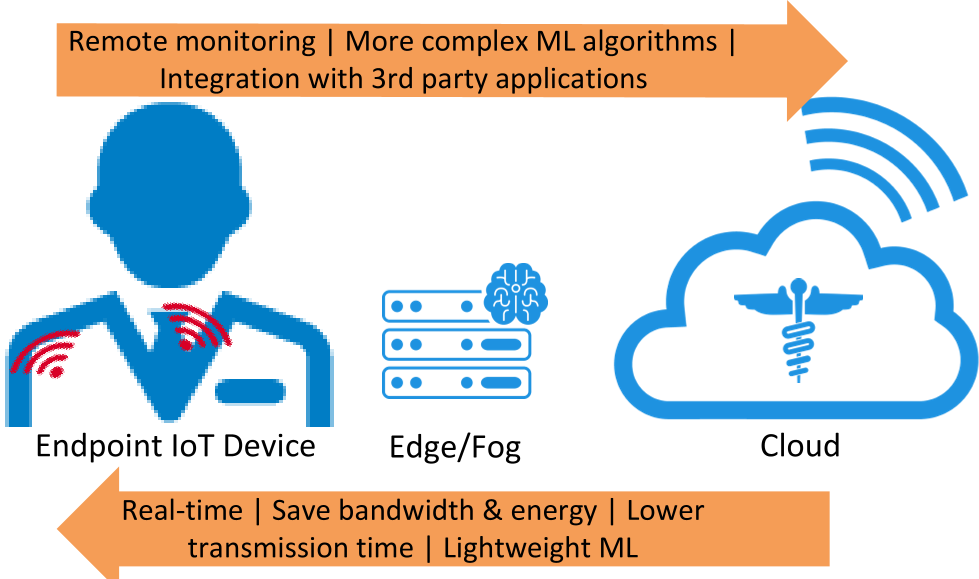
- IoT Device Layer: Uses "Machine Learning on-chip" (a shallow ANN) for low-power, always-on monitoring.
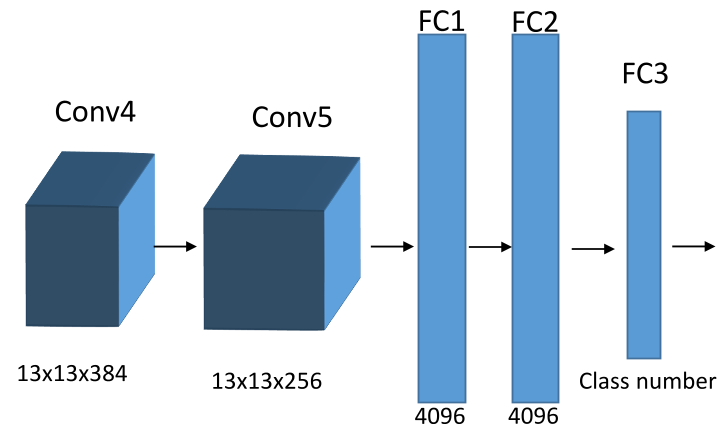
- Fog/Edge layer: Employs a sophisticated 2D-CNN (based on AlexNet) to process complex signals when the device layer is uncertain.
- Cloud Layer: Acts as the "Brain," handling big data storage and the heavy lifting of training/re-training models to provide personalized updates back to the local nodes.
2. The Decision Logic (When to Switch?)
The system utilizes a softmax confidence score . If the on-chip model's maximum confidence is below a threshold , it rejects the local opinion and asks the Edge node for a second opinion. This ensures that only "borderline" cases consume the energy and bandwidth required for Fog/Edge processing.
Case Study: ECG Arrhythmia Detection
To prove the concept, the authors targeted arrhythmia classification.
- On-Chip ANN: Features were meticulously engineered (RR-intervals and morphological descriptors) to allow a shallow network to run on low-end hardware.
- Edge CNN: The 1D ECG signal is transformed into a 2D image (227x227x3) to leverage the powerful spatial feature extraction capabilities of Convolutional Neural Networks.
Experiments & Results: Performance vs. Efficiency
Using the MIT-BIH database, the authors demonstrated that their collaborative approach outperforms traditional methods.
- Diagnostic Power: The Edge CNN achieved an impressive 98% accuracy, significantly higher than the 88%-94% range reported for previous SVM-ensemble methods.
- Efficiency: The 8-feature on-chip ANN model (Model No. 3) achieved 95% accuracy while minimizing the computational footprint, making it ideal for integration into medical grade SoC (System-on-Chip).
| Model Layer | Accuracy | Sensitivity | Key Feature |
|---|---|---|---|
| Device (Shallow ANN) | 95.0% | 61.0% | Low Power / Local |
| Edge (2D-CNN) | 98.0% | 96.0% | High Precision / Real-time |
| Baseline (SVM) | ~94.0% | 70.0% | High Complexity |
Critical Analysis & Conclusion
Takeaway
The value of this work lies in its holistic view of the IoT stack. It moves past the "Cloud vs. Edge" debate by proving that a collaborative, confidence-based offloading mechanism provides the best "PPA" (Power-Performance-Area) profile for healthcare applications.
Limitations & Future Work
- Covariate Shift: The authors acknowledge that the threshold is sensitive to shifts in data distribution. Future work could incorporate self-calibration techniques.
- Communication Security: While the architecture reduces data volume, the "collaboration" requires robust security protocols to protect sensitive health data during offloading.
- Potential: This framework can be easily extended beyond ECG to other high-velocity medical data like glucose monitoring or neurological signals.