
Criminal Group Discovery: Collaborative Mining Across Multiple Social Networks
Collaborative Mining in Multiple Social Networks Data for Criminal Group Discovery
The paper proposes a collaborative mining framework for discovering criminal groups across multiple social networks. It transforms network data into transaction-based events and uses a multi-agent system combining Association Rule Mining, First Order Logic (FOL), and Dempster-Shafer theory to produce a ranked list of suspects based on a novel "Cooperation Distance" metric.
TL;DR
Law enforcement faces a massive challenge in connecting the dots between suspects across different communication platforms. This paper introduces a multi-agent framework that treats social interactions as "events" rather than static links. By combining Association Rule Mining with First Order Logic and the Dempster-Shafer theory of evidence, the system generates a prioritized list of potential criminal associates from multiple data sources.
Background: From Graphs to Supergraphs
Traditional Social Network Analysis (SNA) often relies on simple edges to denote relationships (e.g., "Person A knows Person B"). However, in criminal investigations, the context of a connection—participating in the same meeting, appearing in the same photo, or exchanging an email—is crucial. The authors elevate this by defining a Social Network Supergraph, where nodes represent events and edges represent shared participants.
The Problem: The Manual Bottleneck
Current criminal network analysis is often a manual process. When police arrest a subset of people (a "Query"), they need to know: Who else is likely involved?
- Siloed Data: Evidence is scattered across multiple networks (Email, Phone, Social Media).
- Hard Thresholds: Traditional mining requires setting "Support" and "Confidence" levels, which can discard critical low-frequency connections.
- Lack of Ranking: Most tools return a flat list of names rather than a probability-ranked set of groups.
Methodology: The Three-Phase Multi-Agent Architecture
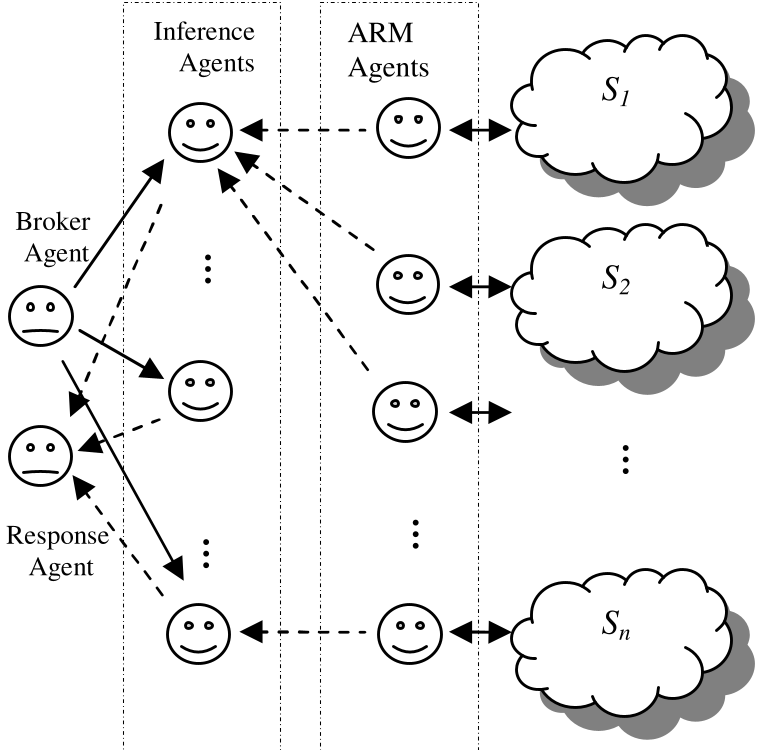
The authors propose a sophisticated architecture comprising four types of agents (ARMA, Broker, Inference, and Response) to automate the discovery process.
1. Game-Theoretic Association Mining (ARMA)
The Association Rule Miner Agents (ARMA) use the Apriori algorithm. To solve the problem of setting arbitrary thresholds (MinSup/MinCon), the authors apply a Nash Equilibrium model. Using the logic of the Prisoner’s Dilemma, agents are incentivized to provide knowledge even with lower confidence to ensure no potential link is missed during the fusion stage.
2. Logic-Based Inference (IA)
Once rules are mined (e.g., "If Person A and B are present, Person C is likely involved"), they are converted into First Order Logic (FOL). The Inference Agents then use forward chaining to derive new facts based on the query of arrested individuals.
3. Dempster-Shafer Evidence Fusion (RA)
The Response Agent (RA) faces the toughest task: merging conflicting or redundant results from different networks. By using Dempster-Shafer Theory, the system calculates a "Basic Probability Assignment" (BPA) for groups of people, providing a mathematical way to handle uncertainty across diverse datasets.
The Core Metric: Cooperation Distance (CD)
To validate the results, the authors define the Cooperation Distance (CD). This metric measures the "closeness" of a suspect to a query group through the supergraph. A lower CD suggests a higher likelihood of belonging to the criminal group.
Experimental Results
The system was tested on the CMU Robotics Institute collaboration dataset, simulating multiple social networks. The results proved that the fusion of rules from multiple agents produced a highly reliable ranking of associated individuals.
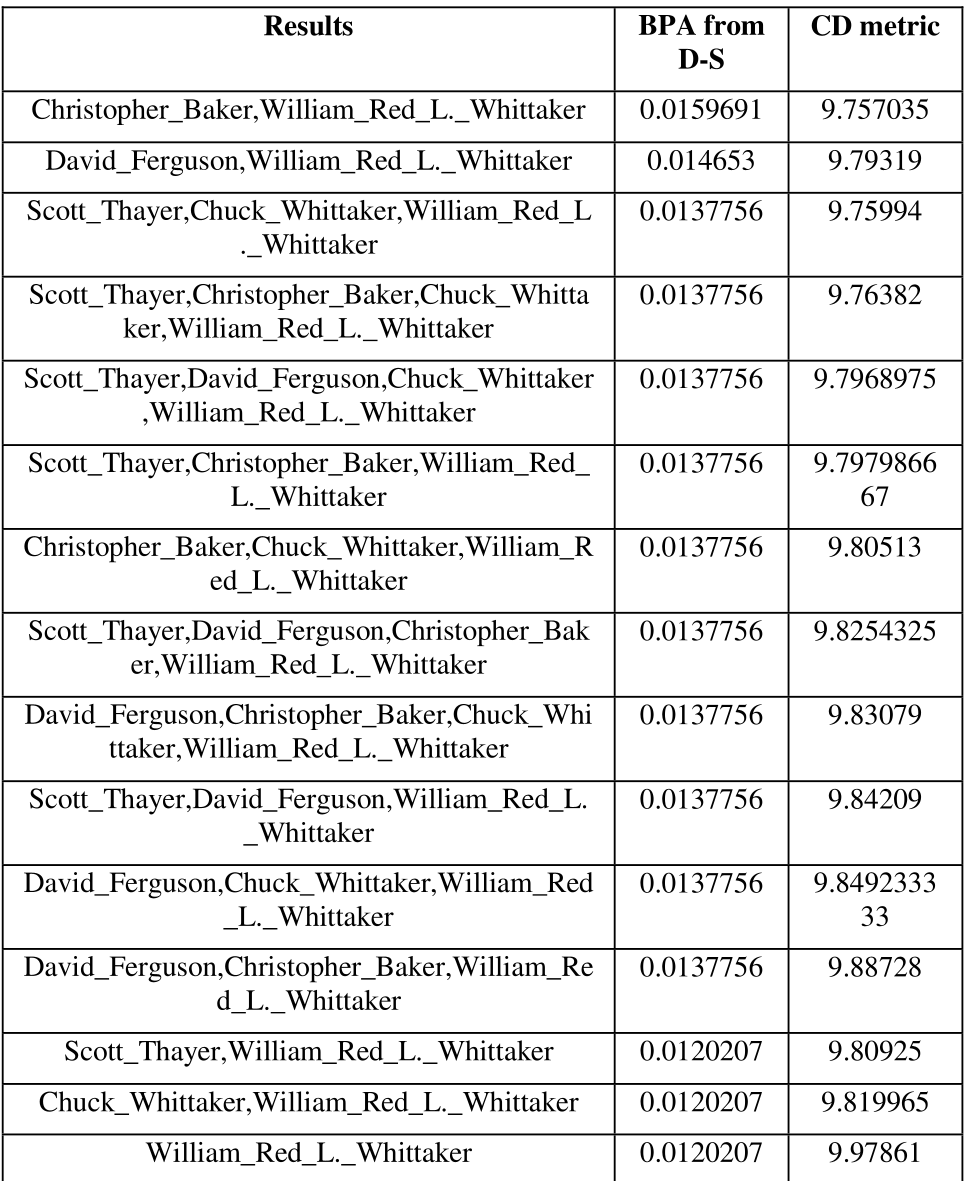
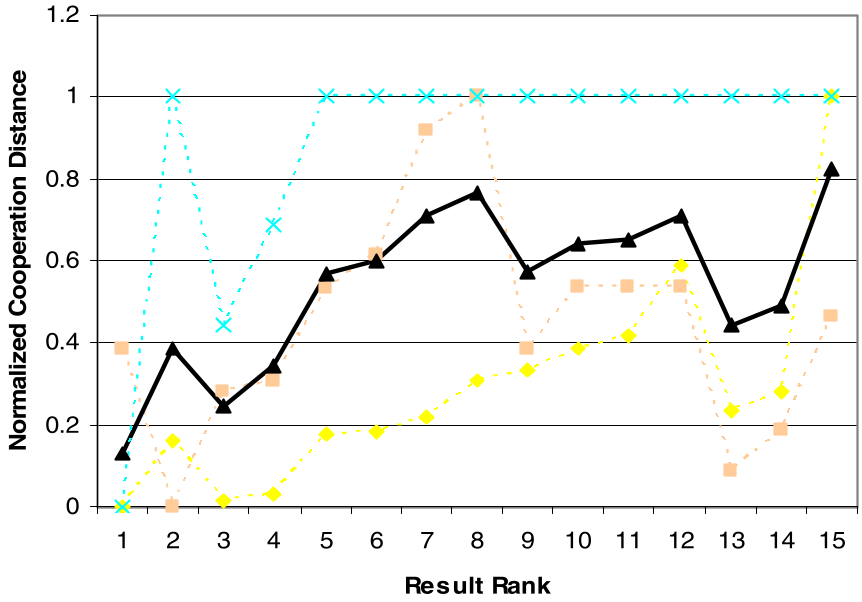
As shown in the table above, the system doesn't just return individuals; it returns subsets of people with their associated belief scores (BPA) and cooperation distances. Figure 6 in the paper shows a clear correlation between the system's ranking and the objective CD metric, validating the accuracy of the multi-agent approach.
Conclusion & Future Insights
This research moves criminal network discovery from a manual graph-traversal task to an automated, evidentiary-based system.
- Takeaway: By treating social links as event-based transactions, we can apply rigorous data mining techniques to unstructured social data.
- Future Work: The authors suggest moving toward Temporal Graphs to analyze the sequence of incidents, which would allow police to not only see who is connected but when and in what order criminal activities unfolded.