
SRMSH: Orchestrating Collaborative Reliability in Mobile Social Streaming
11318_A collaborative mobile architecture for multicast live-streaming social networks.
This paper introduces a collaborative mobile architecture for multicast live-streaming in multimedia social networks, featuring a novel hybrid protocol called Scalable Reliable Multicast Stair Hybrid (SRMSH). SRMSH achieves state-of-the-art reliability and efficiency by combining layered congestion control with distributed loss recovery to stimulate user cooperation in mobile environments.
TL;DR
The paper presents a collaborative mobile architecture designed for high-stakes multicast live-streaming within social networks. By introducing the SRMSH (Scalable Reliable Multicast Stair Hybrid) protocol, the authors merge rate-based congestion control with distributed loss recovery. This hybrid approach ensures that mobile users don't just consume bandwidth, but cooperate to maintain stream quality, effectively solving the throughput collapse common in volatile mobile environments.
The "Drop to Zero" Problem in Mobile Multicast
In the landscape of multimedia social networks, the struggle has always been the trade-offs between Congestion Control and Reliability.
Previous SOTA methods handled these in silos:
- STAIR (Simulated TCP's AIMD with Rate-based): Excellent at adapting to bandwidth but prone to the "drop to zero" problem—where a single loss event causes the receiver to aggressively dump its subscription layers, leading to poor user experience.
- SRM (Scalable Reliable Multicast): Robust at recovering lost packets through a "request/repair" cycle, but it lacks a "throttle"—it sends at a fixed rate regardless of network congestion.
The authors' insight was simple yet profound: Loss is not always a sign of congestion. In mobile networks, loss can be transient or interference-based. By separating these two, we can maintain high throughput while peers help each other recover lost data.
Methodology: The SRMSH Hybrid Engine
SRMSH is built on a formal specification using Communicating Real-Time State Machines (CRSMs). It functions through a dual-mechanism architecture:
1. The Staircase Congestion Control
SRMSH utilizes a multi-layered multicast approach. It adds a "Stair Layer" that cyclically increases its rate, emulating the "Additive Increase" phase of TCP. This allows receivers to probe for available bandwidth without massive control traffic.
2. Distributed SRM Recovery
When a receiver detects a gap in sequence numbers, it doesn't immediately drop its layers. Instead, it initiates an SRM-style request. Because this is a social network, nearby peers who did receive the packet can send a "Repair." This localized cooperation prevents the request from reaching the original sender, ensuring massive scalability.
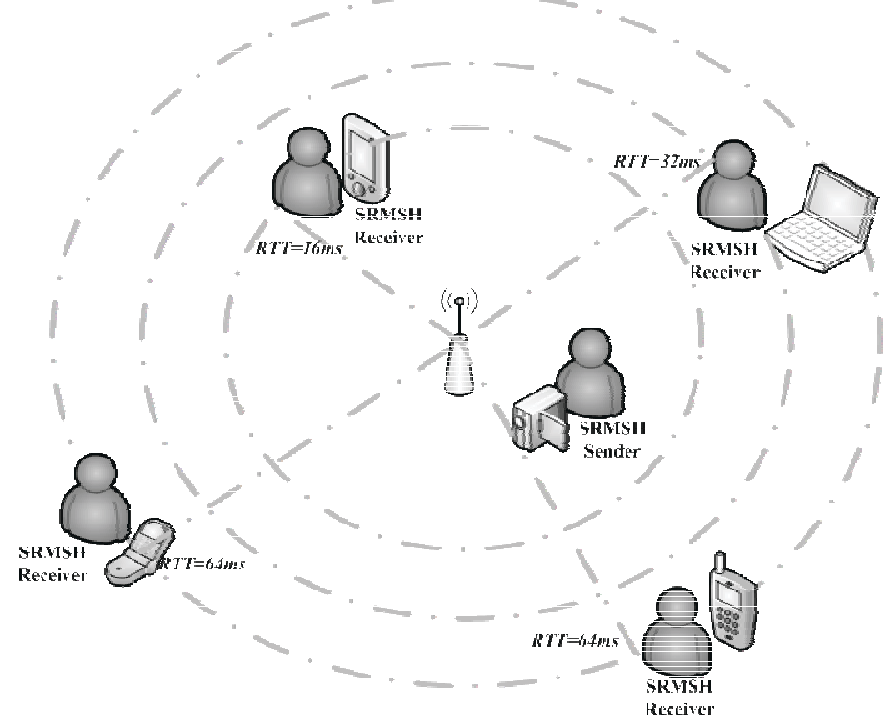 Figure 1: The architecture shows a central sender and mobile receivers cooperating over a Wi-Fi/cellular core to share and repair multimedia streams.
Experiments & Visual Evidence
The authors validated the architecture by simulating a real-world scenario where a moving user records video and streams it to multiple mobile devices (PDAs, Laptops) with varying RTTs.
- Layered Quality: As shown in Figure 2, the system successfully maps available bandwidth to image quality. Higher subscription levels result in higher pixel density, which the SRMSH protocol maintains even as users move across different network conditions.
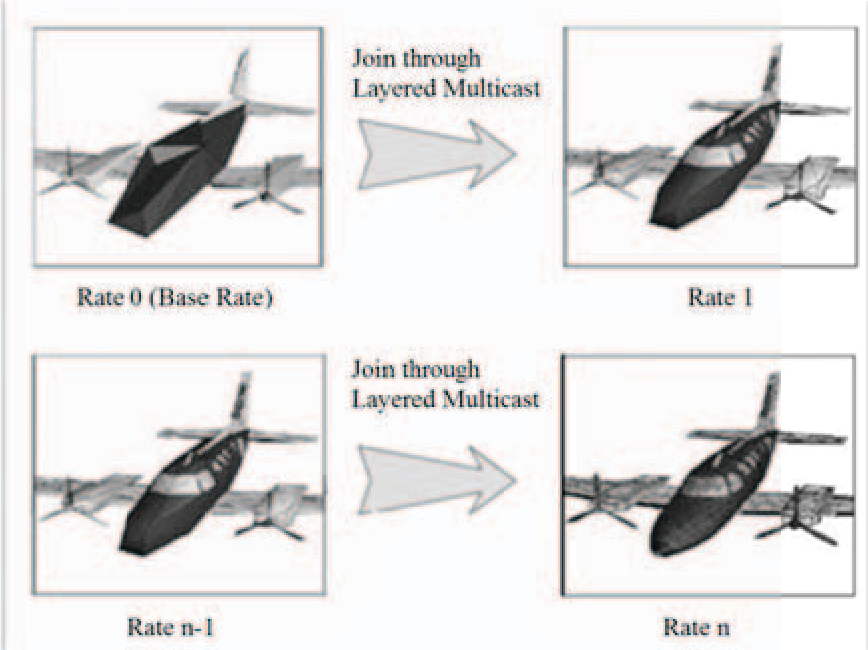 Figure 2: The visual representation of how SRMSH layers increase image resolution based on the success of congestion negotiation.
- Collaborative Recovery: Figure 3 illustrates the "Collaborative Loss Recovery" in action. The circles represent packets that were lost by one receiver but "healed" by a neighboring participant. This proves that the hybrid model prevents the throughput from dropping to zero.
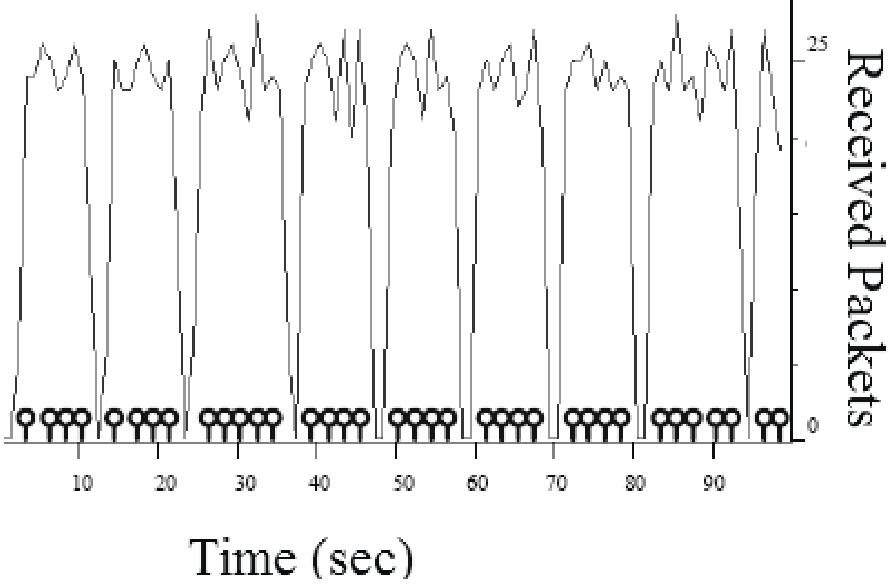 Figure 3: Received traffic analysis showing how peer cooperation recovers missing data segments.
Critical Insight & Conclusion
The true value of this work lies in its Human-Centric Design. It recognizes that in a social network, the proximity of users is a resource. By leveraging the base layer of a multicast session for "recovery signaling," SRMSH turns every receiver into a potential micro-repeater.
Limitations: While the simulation is robust, the paper primarily focuses on Wi-Fi environments. Transitions between Wi-Fi and high-speed cellular handovers (like 5G/6G) would require more complex RTT estimation than what was presented.
Future Outlook: The authors are already moving toward IPTV Social Networks. As we move toward more immersive, peer-driven media (like the Metaverse), the principles of SRMSH—distributed reliability and hybrid congestion control—will be foundational for maintaining synchronization across millions of concurrent users.