
SOCIO: Revolutionizing Collaborative Modeling via Social Network Chatbots
Collaborative Modeling and Group Decision Making Using Chatbots in Social Networks
The paper introduces SOCIO, a chatbot-driven framework for collaborative domain modeling within social networks like Telegram. By leveraging Natural Language (NL) processing and a soft-consensus mechanism, it enables both technical and non-technical stakeholders to build, branch, and refine models through familiar messaging interfaces.
TL;DR
Modeling is no longer confined to complex, heavyweight desktop applications. SOCIO is a chatbot framework that integrates the modeling process directly into social networks like Telegram. It allows stakeholders to build domain models using Natural Language (NL) and employs a sophisticated soft-consensus mechanism to help teams decide between different architectural alternatives without leaving the chat.
Background & Motivation: The Barrier to Entry
The initial stages of software development require heavy collaboration between technical engineers and non-technical domain experts. Traditionally, this happens in diagramming tools that are "unwieldy" and "intimidating" for non-experts. This creates a bottleneck where domain experts are sidelined, leading to models that don't truly reflect business needs.
Furthermore, when teams disagree on a design path, they often fall into endless unorganized debates in Slack or Email. There is a lack of a formal "branch and vote" mechanism that works within these conversational contexts.
Methodology: Chat-Driven Modeling and Consensus
SOCIO departs from the "diagram-first" approach, treating modeling as an add-on to a true discussion environment.
1. Natural Language as the Interface
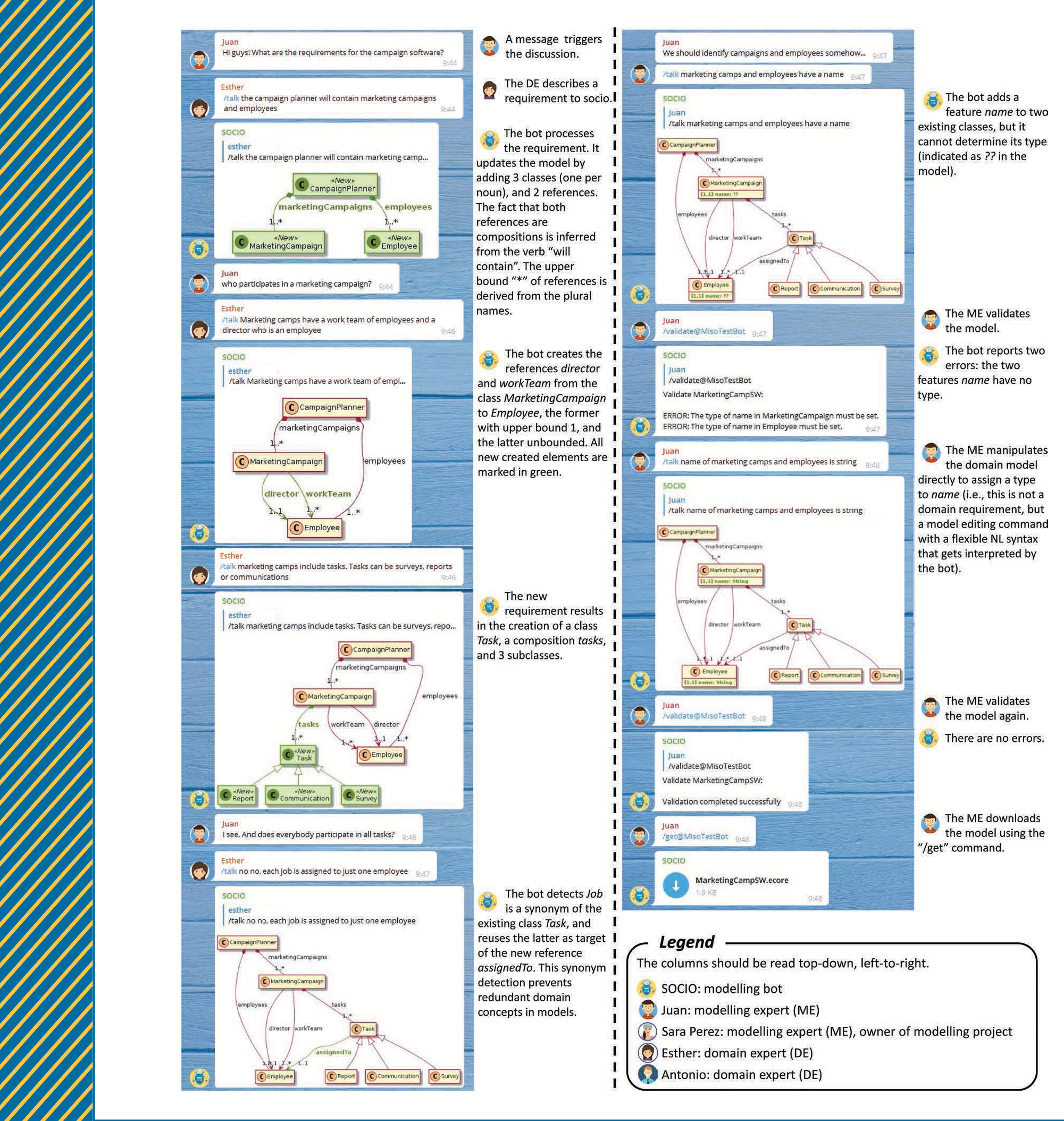
Instead of dragging boxes, users type commands like /talk. The bot uses the Stanford NL parser to extract subjects, objects, and verbs, automatically converting them into classes and relationships (e.g., "campaigns contain employees").
2. Model Branching and Soft-Consensus
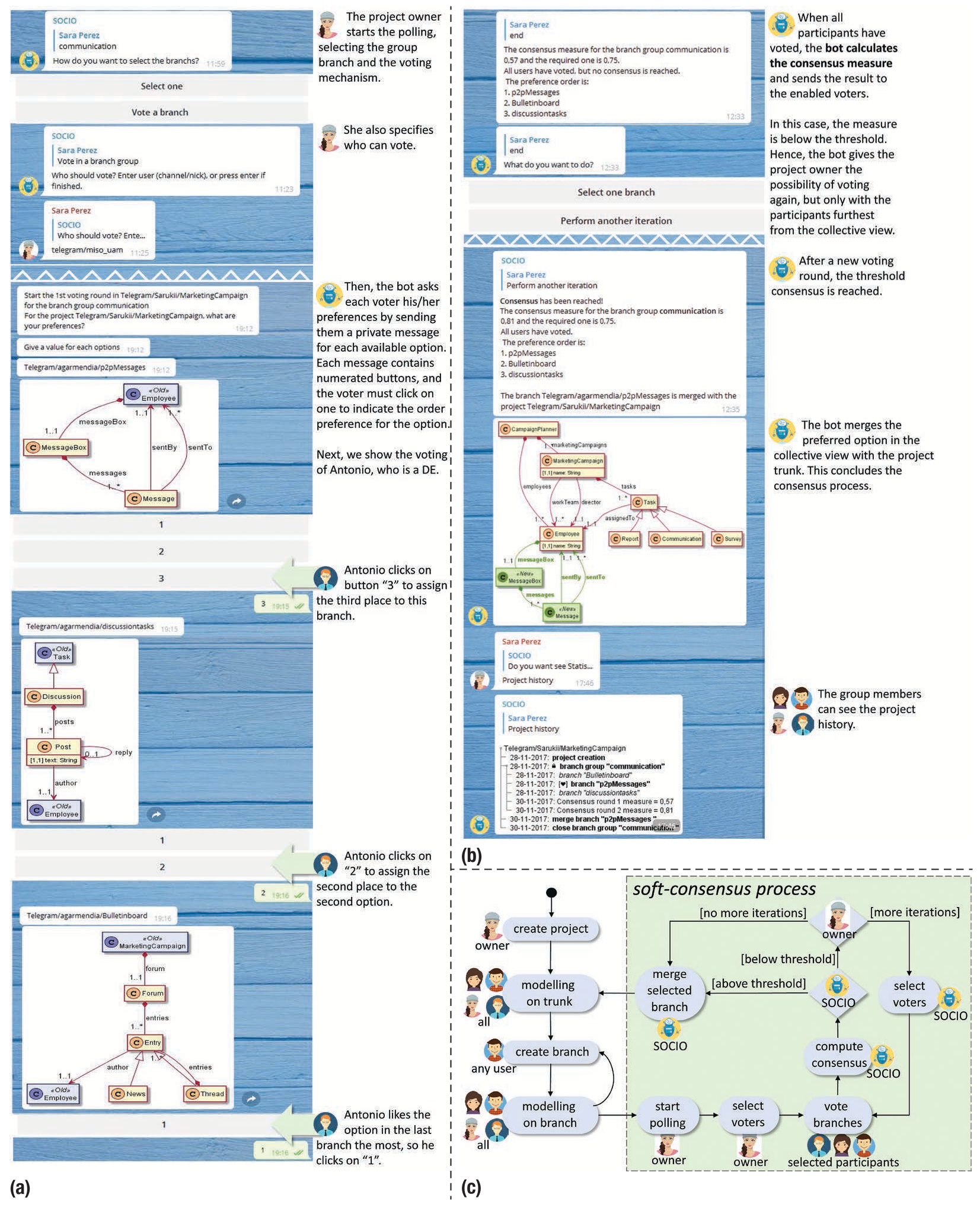
When multiple solutions arise—such as different ways to handle communication in a marketing app—SOCIO allows the creation of branch groups.
- Branching: Each alternative is developed in its own branch.
- Soft-Consensus: Based on fuzzy logic, this iterative process asks participants to rank or score alternatives.
- Convergence: If the group's consensus measure is below a threshold (e.g., 0.75), the bot identifies "outlier" voters and invites them to reconsider, promoting a shared agreement rather than a forced majority win.
Experimental Insights
In a study with eight researchers, SOCIO proved its worth in "unblocking" teams. Without the consensus mechanism, teams struggled with persistent discrepancies. With it, users felt the process was objective and scalable. While the NL accuracy (approx. 62.5%) suggests room for improvement (potentially via modern LLMs), the interaction model itself was highly preferred over traditional graphical editors.
Critical Analysis & Future Outlook
The Strengths
The genius of SOCIO lies in Traceability. Every element in the model is tied to a specific chat message, answering the "Why" behind every class and relationship. It captures the rationale of the design as it happens.
Limitations & Challenges
- NL Ambiguity: Human language is messy. Slang and abbreviations in social networks can trip up older parsers.
- Visual Feedback: While the bot sends pictures of the model, complex models might become unreadable on small mobile screens.
The Future: From Bots to AI Partners
As we move into the era of LLMs, the groundwork laid by SOCIO is more relevant than ever. Future iterations could involve bots that not only record requirements but actively suggest refactorings or predict quality issues in real-time as the team chats.
SOCIO proves that by meeting users where they already are—social networks—the "intimidating" task of modeling becomes as simple as sending a text.