
CPMN: Solving the Multi-Network Partitioning Puzzle with Anchor Nodes
Collaborative Partitioning for Multiple Social Networks with Anchor Nodes
The paper introduces CPMN (Collaborative Partitioning for Multiple Networks), a novel multilevel framework designed to partition multiple related social networks into non-intersecting subsets. By leveraging anchor nodes (users present in multiple networks), the method achieves 100% alignment of identical nodes across partitions while maintaining competitive load balance and edge-cut metrics.
TL;DR
In the era of multiple social identities, analyzing a single network is no longer sufficient. However, partitioning multiple interconnected networks for distributed processing (like MapReduce) is notoriously difficult. This paper introduces CPMN, a framework that uses "anchor nodes" to bridge different networks, ensuring that the same user always ends up in the same partition with 100% accuracy, thereby slashing communication overhead in large-scale social analytics.
Background: Beyond Single-Graph Partitioning
Modern social analysis often requires integrating data from Twitter, Facebook, and LinkedIn simultaneously. The users who bridge these platforms are known as anchor nodes.
When we use distributed frameworks like MapReduce, we must partition the graph. If "User A" on Twitter is on Server 1, but "User A" on Facebook is on Server 2, any cross-network analysis requires expensive data shuffling. Traditional tools like METIS are "blind" to these cross-network identities, leading to poor data locality.
Problem & Motivation: The Locality Crisis
The authors identify a three-way trade-off in multi-network partitioning:
- Alignment: Ensuring anchor nodes are co-located across networks.
- Load Balance: Ensuring every partition has a roughly equal work weight across all involved networks.
- Edge-Cut: Minimizing the number of connections severed between partitions.
Previous work either ignored the multi-network structure or used two-stage alignment that struggled with global optimization.
Methodology: The CPMN Framework
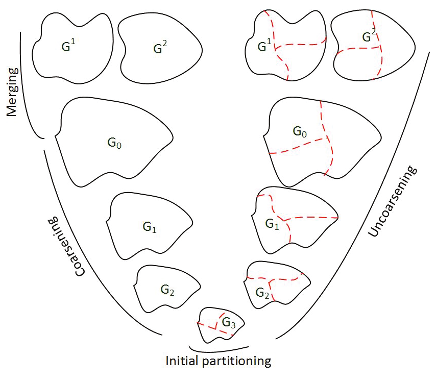
CPMN follows a sophisticated four-stage multilevel pipeline:
1. Merging Phase
Instead of partitioning networks separately, CPMN merges them into a single "super-graph" where anchor nodes act as the glue. This ensures that any partitioning decision applied to the merged node automatically applies to all its representations across different networks.
2. MHEM (Modified Heavy Edge Matching)
During the "Coarsening" stage, the algorithm collapses nodes to simplify the graph. CPMN’s MHEM strategy gives highest priority to matching nodes from different networks. This "cross-pollination" during coarsening makes it much easier to achieve multi-network load balance later.
3. MGR (Modified Greedy Refinement)
In the final "Uncoarsening" stage, the algorithm fine-tunes the boundaries. The authors modified the standard refinement to include a multi-network balance check (Equation 6), ensuring that moving a node to reduce edge-cuts doesn't overload a specific network on a specific server.
Experiments & Results
The authors tested CPMN against METIS using synthetic LFR benchmarks and a massive real-world dataset comprising Foursquare and Twitter (over 1M users and 400k+ anchors).
Key Findings:
- NMI (Alignment Accuracy): CPMN achieved a perfect 100%, whereas METIS plummeted as the number of partitions () increased.
- Load Balance: Despite the additional constraints, CPMN kept the imbalance within 5%, which is well within the tolerance for production MapReduce environments.
- Scalability: The time complexity and edge-cut ratios scaled similarly to METIS, proving that CPMN is viable for "Big Data" scales.
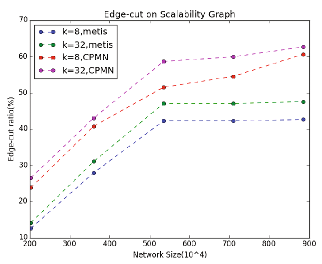 The chart above illustrates the massive gap in alignment (NMI) between CPMN and traditional methods.
Critical Insight: Why Does It Work?
The genius of CPMN lies in its "Global View". By merging the networks before partitioning and modifying the coarsening/refinement heuristics to be "network-aware," it prevents the fragmentation of an individual's digital identity across a cluster. This is a classic example of how incorporating domain-specific "Inductive Bias" (the knowledge that anchor nodes exist) can outperform general-purpose graph algorithms.
Conclusion & Future Work
CPMN provides a robust foundation for multi-network analysis. While the edge-cut is slightly higher than single-network methods, the 100% alignment of anchor nodes offers a massive boost to data locality. Future research could investigate even more efficient refinement strategies to close the edge-cut gap even further.
Author Note: This work is crucial for anyone building cross-platform recommendation engines or conducting large-scale social influence studies across multiple digital domains.