
Twitter as a Collaborative Engine: Decoding Information Access in Crisis Situations
•Information systems → Collaborative and social computing systems and tools; Information systems applications; Social networking sites
This study investigates explicit collaborative information access on Twitter during major crises (Hurricane Sandy and Ebola). By reconstructing conversation trees and applying LDA topic modeling, it characterizes the structural and semantic patterns of spontaneous user groups aiming to identify how social media facilitates shared information goals.
TL;DR
Social media is more than a broadcast tool; it is a space for spontaneous, large-scale collaboration. This study analyzes Twitter conversations during Hurricane Sandy and the Ebola epidemic to uncover how users form groups to solve information needs. It reveals that while we think we are talking to the "crowd," most collaboration happens in tiny, isolated "islands" of users, providing a roadmap for future AI-driven collaborator recommendation systems.
The Motivation: Beyond the Solitary Searcher
Traditionally, Information Retrieval (IR) is viewed as a solitary act. Even "Social Search" typically refers to an individual using their friends' likes or posts to find an answer. However, during a crisis—where information is scarce and the stakes are life-or-death—solitary search fails.
The authors argue that a significant portion of searches remains unsolved because users' immediate social neighborhoods are too small. They set out to understand the "Collective Information Access" that emerges when thousands of strangers use mentions, replies, and retweets to solve shared problems.
Methodology: Mining the Conversation Trees
To study this, the researchers processed millions of tweets, filtering for "usefulness" via a logistic regression classifier, and then performed a "tree reconstruction."
- Tree Reconstruction: Starting from a seed tweet, they traced interactions upstream to the root and downstream to all replies.
- Temporal Saturation: They discovered a "saturation point" at 120 minutes. Adding more time after two hours rarely changed the member list of a collaborative group, allowing them to define a stable unit of analysis: the Saturated Conversation Tree.
- Topic Modeling: Using Latent Dirichlet Allocation (LDA), they identified specific "micro-tasks" within the noise (e.g., "Vaccine research" vs. "Weather alerts").
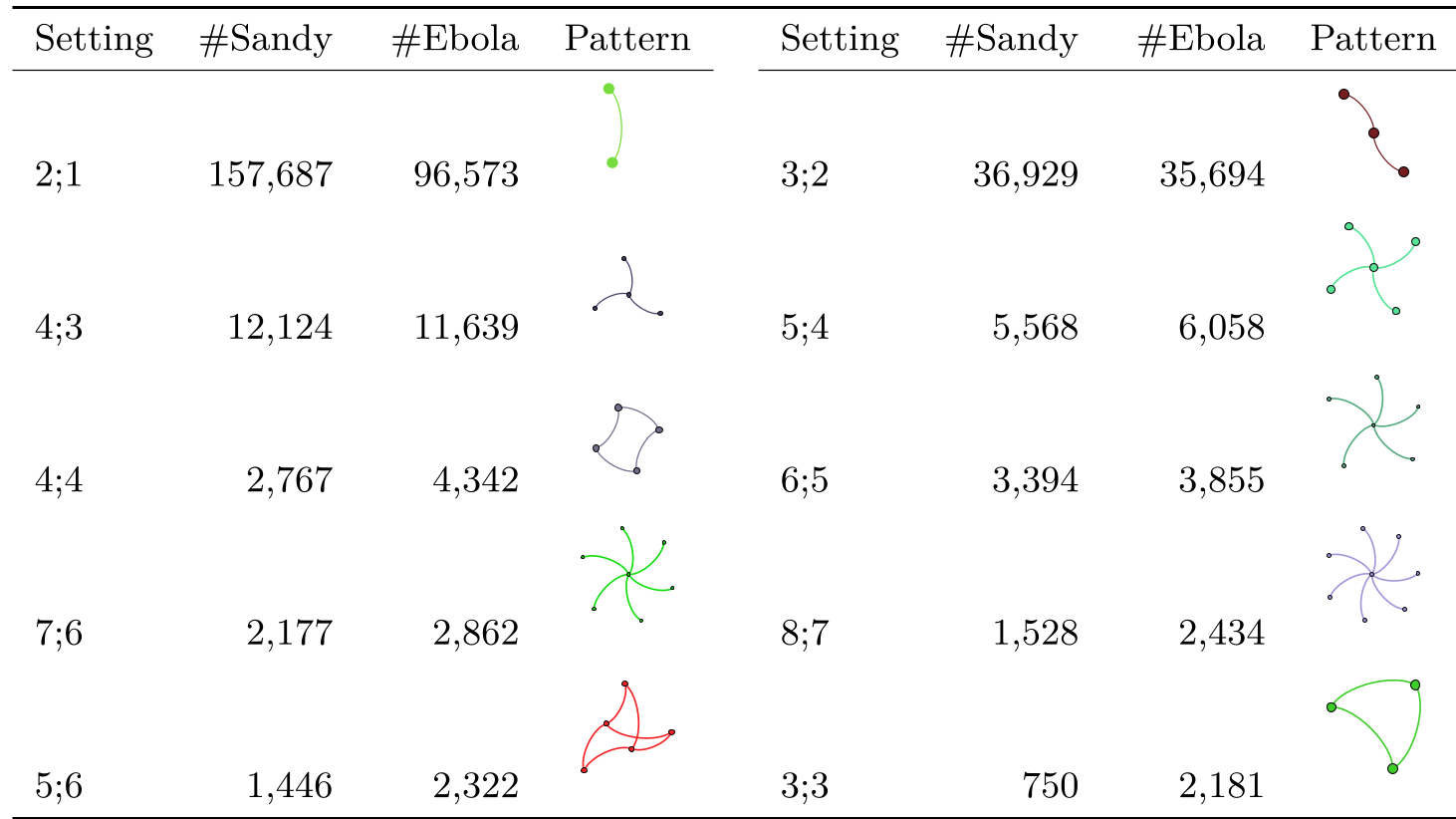 Figure 1: Common structural patterns identified in the study, ranging from star-shaped to flat, horizontal networks.
Deep Dive into Results: The "Disconnected Islands" Problem
The study yielded three major insights that challenge our perception of social media:
1. The Structure of Help
Most collaborative groups are small (2-7 users). They generally fall into two categories:
- Star-shaped: Influential users relaying info.
- Flat (Horizontal): Decentralized groups where everyone talks to everyone—essentially mini "work teams."
2. High Modularity, Low Connectivity
Perhaps the most striking finding: even when people are talking about the exact same topic (e.g., "Donations"), they often do so in isolated clusters. The researchers found modularity values as high as 0.96, meaning there is high density within groups but almost no connection between them.
3. The Time Factor (Sandy vs. Ebola)
The duration of a crisis changes everything.
- Short-term (Sandy, 3 days): Focused on specific "intra-topic" clusters.
- Long-term (Ebola, 1 month): Showed higher "inter-topic" connectivity (cohesion metric of 0.63). Over time, "intermediary" users bridge the gaps between different conversation islands.
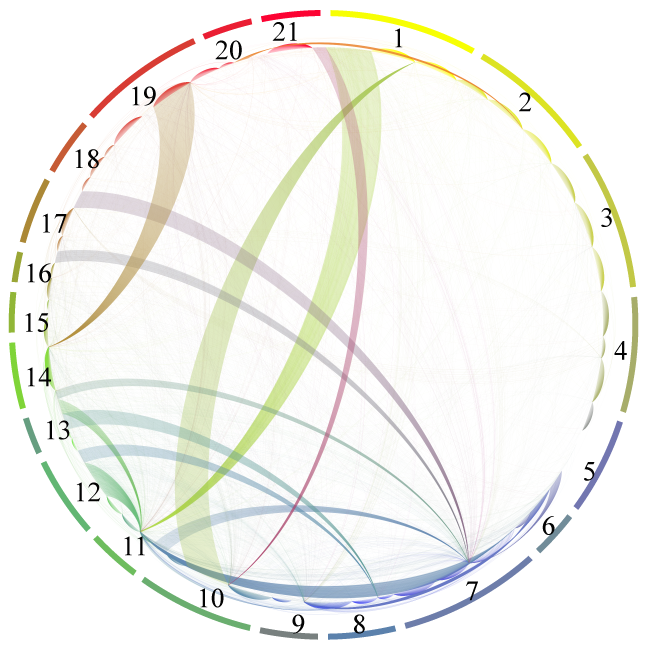 Figure 2: Visualization of inter-topic and intra-topic relationships. Note the higher complexity in the longer-duration Ebola network.
Critical Analysis: From Passive Analysis to Active Mediation
The value of this paper lies in its critique of current social platforms. We are living in a "digital desert" where similar information needs are being addressed simultaneously by different groups who never meet.
Future Outlook:
- Recommendation Systems: Imagine an AI that sees your "help" tweet and automatically @mentions a relevant group of experts who are discussing that exact topic in another "island."
- Intermediary Identification: Identifying the "bridge" users who transition between topics (like moving from "Prevention" to "Treatment") is key to accelerating situational awareness.
Conclusion
Crisis-related Twitter conversations follow predictable structural and temporal patterns. However, the organic growth of these groups is constrained by the current architecture of social networks. To move toward true "Collective Wisdom," we need algorithmic mediation that actively connects these disconnected islands of knowledge.
Takeaway: In the future of Crisis Management, search engines shouldn't just find content; they should find collaborators.