
CSDM: Solving the Credibility Crisis in Digital Content via Social Intelligence
A Collaborative Social Decision Model for Digital Content Credibility Improvement
The paper introduces the Collaborative Social Decision Model (CSDM), a framework designed to enhance digital content credibility in leisure e-services by harvesting social network intelligence. The method leverages personal experiences and social relationships to filter out unreliable user-generated content, achieving higher user satisfaction compared to traditional information retrieval systems.
TL;DR
In an era of "information smoke," finding trustworthy travel or leisure advice is increasingly difficult. This paper proposes the Collaborative Social Decision Model (CSDM), which moves away from generic global ratings and instead harvests "Social Network Intelligence." By weighting information based on the user's actual social relationships and shared interests (homophily), CSDM significantly improves the reliability and personal relevance of digital content.
Problem & Motivation: The Failure of Universal Ratings
Web 2.0 gave everyone a voice, but it also created a signal-to-noise ratio problem. In leisure e-services, users often encounter:
- Information Smoke: Massive amounts of irrelevant or low-quality data.
- Malicious Content: Intentional misinformation or covert advertising.
- The "Stranger Danger" of Data: It is hard to trust a review from a complete stranger whose tastes and standards are unknown.
Current e-services focus on efficiency but ignore the human nature of trust. The author argues that credibility is not an absolute value but a relational one—we trust people who are like us or known to us.
Methodology: The Architecture of Trust
The core of CSDM is the transition from "Decentralized UGC" to "Collaborative Social Intelligence." The model utilizes a multi-layered architecture to process information:
1. The Homophily Engine
Instead of treating all users as a monolithic crowd, CSDM identifies Proximity. This includes geographic proximity (people who visited the same spots) and interest proximity (people with similar tastes).
2. Weighted Computational Design
The model doesn't just average scores. It applies a sophisticated weighting system:
- Global Value (V): The baseline average of all system users.
- Social Value (Ω): A score weighted by the "trustworthy value" of friends in a user’s social network.
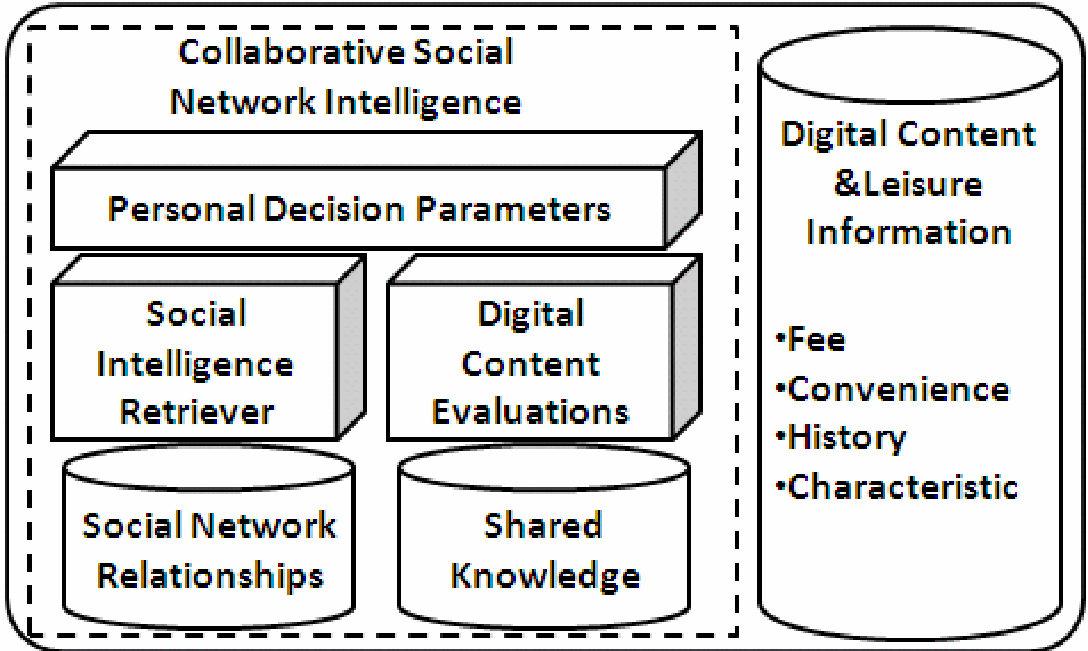 Figure 1: The CSDM components showing the interaction between the Social Network Relationship Database and the Digital Content Evaluation Module.
The Formula for Decision Making
The final score for a piece of content (like a tour spot review) is calculated as: Where represents the content value adjusted by social trust, and represents the user's personal preference for factors like cost, convenience, and history.
Experiments & Results
The author conducted an evaluation using a 7-point Likert scale focused on user perception. The study compared traditional leisure e-services with the CSDM-enabled version across four dimensions:
- Utility: Is the information actually useful?
- Convenience: How easy is it to reach a decision?
- Satisfaction: Overall user experience.
- Willingness to Use: Long-term adoption potential.
Key Finding: Users reported significantly higher satisfaction scores with CSDM. The "Relationship Sensibility" of the model allowed users to accept alternative information sources (their friends' experiences) over generic, potentially biased system-wide advertisements.
Critical Analysis & Conclusion
Takeaway
CSDM proves that Social Context > Big Data. For experiential services like leisure and tourism, a "small data" approach that prioritizes high-trust social ties outperforms "big data" approaches that prioritize volume.
Limitations
- Trust Barriers: Even with social ties, initial trust is hard to build in a digital environment.
- Transmission Costs: The model assumes ubiquitous wireless access and high participation, which may not hold in all regions.
- Cold Start: For users with small social networks, the model's benefits are limited.
Future Outlook
The next step for this research lies in integrating Relationship Sensibility with automated AI agents. Imagine an AI that doesn't just find "the best hotel," but finding "the hotel your most discerning friend would love." This shift toward customized, socially-aware digital services is the future of the experience economy.