
Beyond Geotags: Decoding the "Pulse" of a City through Passive Emotional Sensing
Collecting Behavior Logs with Emotions in Town
The paper introduces "Nicott," an iOS-based Location-Based Service (LBS) designed to collect town visitors' behavior and emotional states. It utilizes a front-facing camera to extract facial feature points alongside GPS and motion data, achieving a 91.1% precision in 9-class emotion classification using an SVM-based model.
TL;DR
Researchers have long struggled to understand how people actually feel while moving through a city because most people don't tweet their every emotion. This paper introduces a solution: Nicott, an app that uses the smartphone's front camera to passively track facial expressions. By mapping face muscles to emotional states, the researchers achieved over 91% accuracy in identifying the "vibe" of city strolls, even for users who never post a single word.
The "1% Problem" in Urban Sensing
Why do we need to track faces? The answer lies in the participation gap. In current Location-Based Services (LBS), roughly 99% of users are "lurkers" or passive observers. They travel, they experience, and they leave—leaving no digital footprint for urban planners to study.
Existing methods rely on:
- Geotagged Tweets: Extremely sparse (only 1% of users post).
- Physical Sensors: Good for location, but "blind" to human feelings like exhaustion or excitement.
The author's insight is simple but bold: Since people are already looking at their phones for navigation or event info, why not use that "face time" to sense their internal state?
Methodology: The Science of Digital Empathy
The research leverages the Nicott application, which serves as a smart-city guide for the Futako-tamagawa area in Tokyo. While users check event calendars or maps, the app performs two main tasks:
- Spatial Logging: Collects GPS, heading, speed, and 3D acceleration.
- Facial Feature Extraction: Using Saragih’s model, the app identifies 66 key landmark points on the user's face (eyes, mouth contour, eyebrows).
Mapping Emotions
Instead of simple "Happy/Sad" labels, the study uses a 9-class system based on Lang’s Model of Emotions. This model plots feelings on two axes:
- Valence: Pleasure vs. Sadness.
- Arousal: Calmness vs. Excitation.
 Figure 1: The Nicott interface showing the sensed facial feature points (g).
Experimental Wins and Challenges
An experiment with 55 subjects yielded a massive dataset of 90,000+ facial feature points. By processing these through a Support Vector Machine (SVM), the system achieved a striking 91.1% precision.
The "Neutral" Hurdle
The study noted a specific difficulty in classifying Class D ("Nice. Want better"). Because this state sits in the middle range of arousal, users often have a "poker face," making it hard for the algorithm to distinguish it from pure boredom or focused reading.
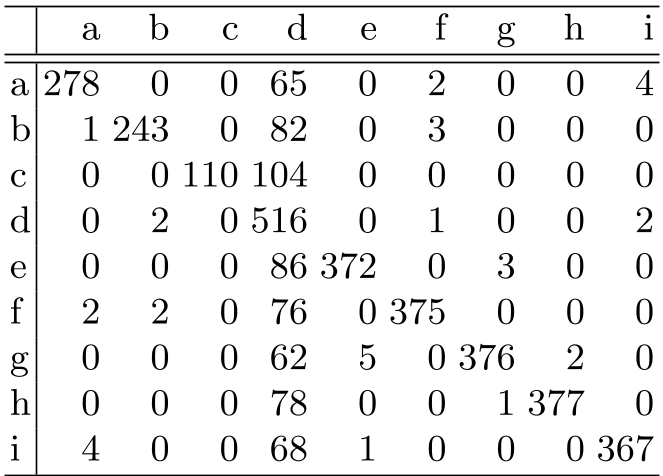 Table 3: Confusion matrix showing high accuracy across most emotional classes.
The Ethics: Would You Share Your Face?
Perhaps the most surprising finding was the Interview phase. While 41.8% of users were willing to share Personally Identifiable Information (PII) for the "public good," a whopping 49.1% were willing to share their emotions if it meant getting more useful local information. This suggests that "emotional data" is perceived as less sensitive than home addresses or names, opening a new door for personalized city services.
Critical Analysis & Conclusion
Takeaway
The shift from active posting to passive sensing is the next frontier for Smart Cities. Nicott proves that we can quantify the "emotional temperature" of a neighborhood efficiently.
Limitations
- Hardware Overhead: Constant camera usage and feature extraction can be taxing on battery life.
- Lighting and Angles: In a real-world "stroll," sunlight and various holding angles might degrade facial landmark precision.
- Individual Baseline: The study uses an individual-independent classifier; however, facial expressions vary culturally and personally.
Future Outlook
The logical next step is On-device Inference. By moving the SVM classifier directly onto the smartphone, the system could provide real-time emotional feedback without ever sending sensitive facial images to a central server, solving the privacy paradox once and for all.