
ColaOnto: Orchestrating Collective Intelligence for Knowledge Creation
A Collective Intelligence Approach to Collaborative Knowledge Creation
This paper introduces a collective intelligence framework for systematic collaborative knowledge creation, centered on a novel ontology called ColaOnto. The approach utilizes semantic argumentation and Ordered Weight Averaging (OWA) operators to derive community consensus from diverse user contributions.
TL;DR
In an era of information overload and "edit wars," how do we distill true community wisdom from chaotic online debates? This paper presents a systematic approach to Collaborative Knowledge Creation by introducing ColaOnto, a semantic ontology that structures arguments, and a quantitative framework that uses Fuzzy Logic (OWA operators) to measure consensus and individual expertise.
Background & Motivation: The Failure of Unstructured Collaboration
While Wikipedia and web forums have revolutionized information sharing, they are plagued by:
- Edit Wars: Constant reverts due to conflicting interests.
- Information Fragmentation: Valuable insights buried in reverse-chronological blog feeds.
- Lack of Trust: Difficulty in distinguishing expert opinions from noise.
The authors argue that we need more than just "aggregation"—we need Deliberation. Their goal is to move from simple voting to a dynamic process where arguments are logically linked, weighted by expertise, and synthesized into a collective "Position."
Methodology: The Core of ColaOnto
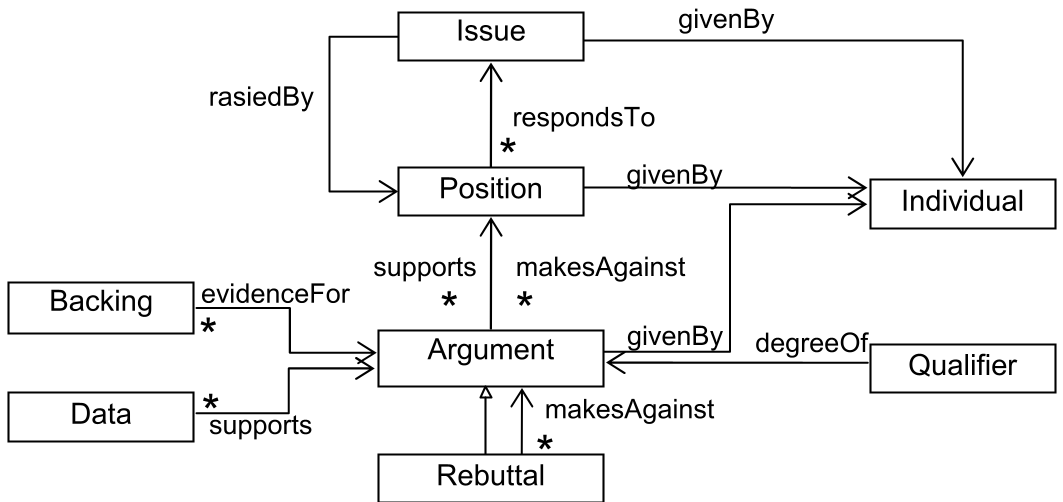
The researchers developed ColaOnto by synthesizing two classic theories:
- IBIS (Issue-Based Information System): Handles the macro-structure (Issues -> Positions -> Arguments).
- Toulmin’s Scheme: Handles the micro-structure of an argument (Data, Backing, Qualifiers, Rebuttals).
The Four Dimensions of Analysis
To evaluate whether an idea should become "Collective Knowledge," the system calculates:
- Degree of Argument (): Factoring in the quality of evidence (data/backing) and the user's confidence level.
- Degree of Individual Preference (): A normalized score of how much a user supports or opposes a specific solution.
- Degree of Position (): The "Community Score," calculated using OWA Operators to ensure that extreme outliers don't unfairly skew the consensus.
- Degree of Expertise (): A dynamic score that increases when a user's proposed solutions are accepted by the community, creating a meritocratic feedback loop.
Workflow: From Conflict to Consensus
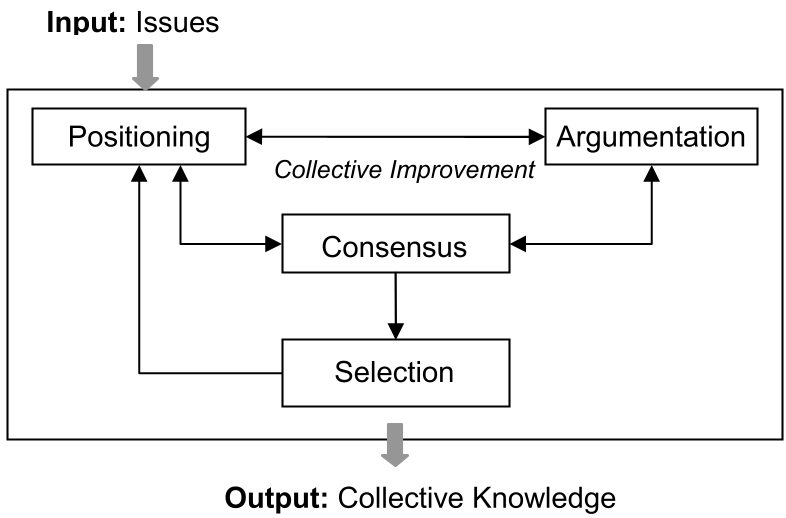
The process follows a four-stage lifecycle: Positioning, Argumentation, Consensus, and Selection. Unlike traditional Delphi methods which operate in rigid rounds, this approach allows for real-time, asynchronous updates.
Experimental Case Study: Global Warming
The authors tested the framework on a complex problem: Selecting the best energy resource to reduce carbon emissions.
Through the deliberation of multiple users (i1 through i4), the system analyzed arguments for Biofuels, Solar, Wind, and Nuclear energy. Even when specific users (like i2) strongly opposed the majority, the OWA operator successfully identified "Biofuels" as the potential position with a consensus level of 0.63, surpassing the required threshold.
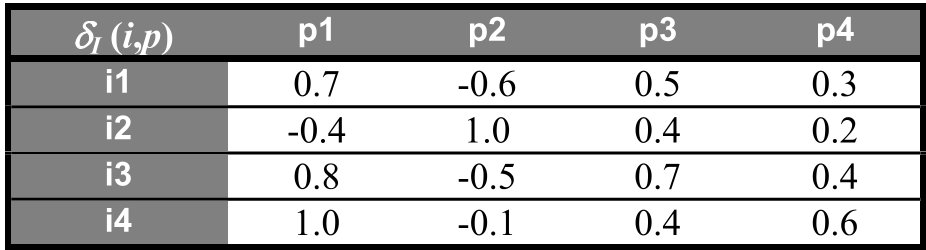 Table: Individual preferences across different positions showing high variance and conflict.
Critical Insight: Why This Matters
The brilliance of this work lies in its Inductive Bias toward structured reasoning. By forcing users to provide "Backing" and "Data" for their claims, the system increases the "cost" of low-quality trolling and rewards constructive participation through the Expertise Degree.
However, a potential limitation is the "Cold Start" problem: how do you incentivize a diverse crowd to perform the heavy lifting of semantic tagging required by ColaOnto? Future advancements in NLP could potentially automate the mapping of natural language into this ontology.
Conclusion
This paper provides a rigorous mathematical bridge between qualitative debate and quantitative decision-making. By treating knowledge creation as an algorithmic process of Collective Intelligence, it offers a blueprint for more civilized and productive digital democracies.