
Toward Collective Intelligence: Transforming Obesity Intervention via Social Robots and IoT
Toward Collective Intelligence for Fighting Obesity
The paper introduces a "Collective Intelligence" framework for childhood obesity intervention, integrating a humanoid robot (NAO) Health Coach with ubiquitous computing (UbiComp) systems. By leveraging machine learning and the Internet of Things (IoT), the system provides personalized behavior change coaching via Motivational Interviewing (MI) and a virtual community environment.
TL;DR
Obesity remains a critical global health crisis. This research explores a futuristic solution: a Humanoid Robot Health Coach named Zoey, backed by a Collective Intelligence network. By combining wearable sensors, virtual communities, and machine learning, the system provides highly personalized "Motivational Interviewing" (MI) to children, aiming to turn lifestyle changes into an engaging, collaborative journey.
Background: Beyond the Dashboard
Most health apps offer nothing more than a dashboard of numbers. This paper argues that the "One-size-fits-all" approach is the primary reason childhood obesity interventions fail. To truly impact a child's behavior, the technology must be ubiquitous, social, and adaptive. The authors position this work at the intersection of Human-Robot Interaction (HRI) and Ubiquitous Computing (UbiComp), creating a system that doesn't just track data, but actively participates in the child's environment.
The Problem: The Motivation Gap
Traditional interventions struggle because they aren't pervasive. A doctor sees a child once a month; a health coach might call once a week. The paper identifies that kids need support at the "Point of Decision"—when they are choosing a snack at the fridge or deciding between video games and outdoor play. Existing M2M (Machine-to-Machine) systems are often siloed, failing to share insights that could personalize the coaching experience.
Methodology: The Architecture of Intelligence
The core of the system is a Cloud-hosted Intelligence Layer. It doesn't treat the robot as an isolated toy but as the "interface" for a massive data engine.
1. The Collective Intelligence (CI) Engine
The authors define CI as a series of unsophisticated agents solving complex problems together. In this system:
- Unsupervised Learning (K-Means): Groups children into "persona segments" based on behavior patterns.
- Supervised Learning (Naïve Bayes): Predicts which motivational dialogue will be most effective for a specific segment.
2. Human-Robot Interaction (HRI) & SLU
The NAO robot utilizes a Spoken Language Understanding (SLU) service. Unlike older robots that required hard-coded commands, this system processes natural, often "disfluent" (grammatically incorrect) speech to determine Intent and Sentiment.
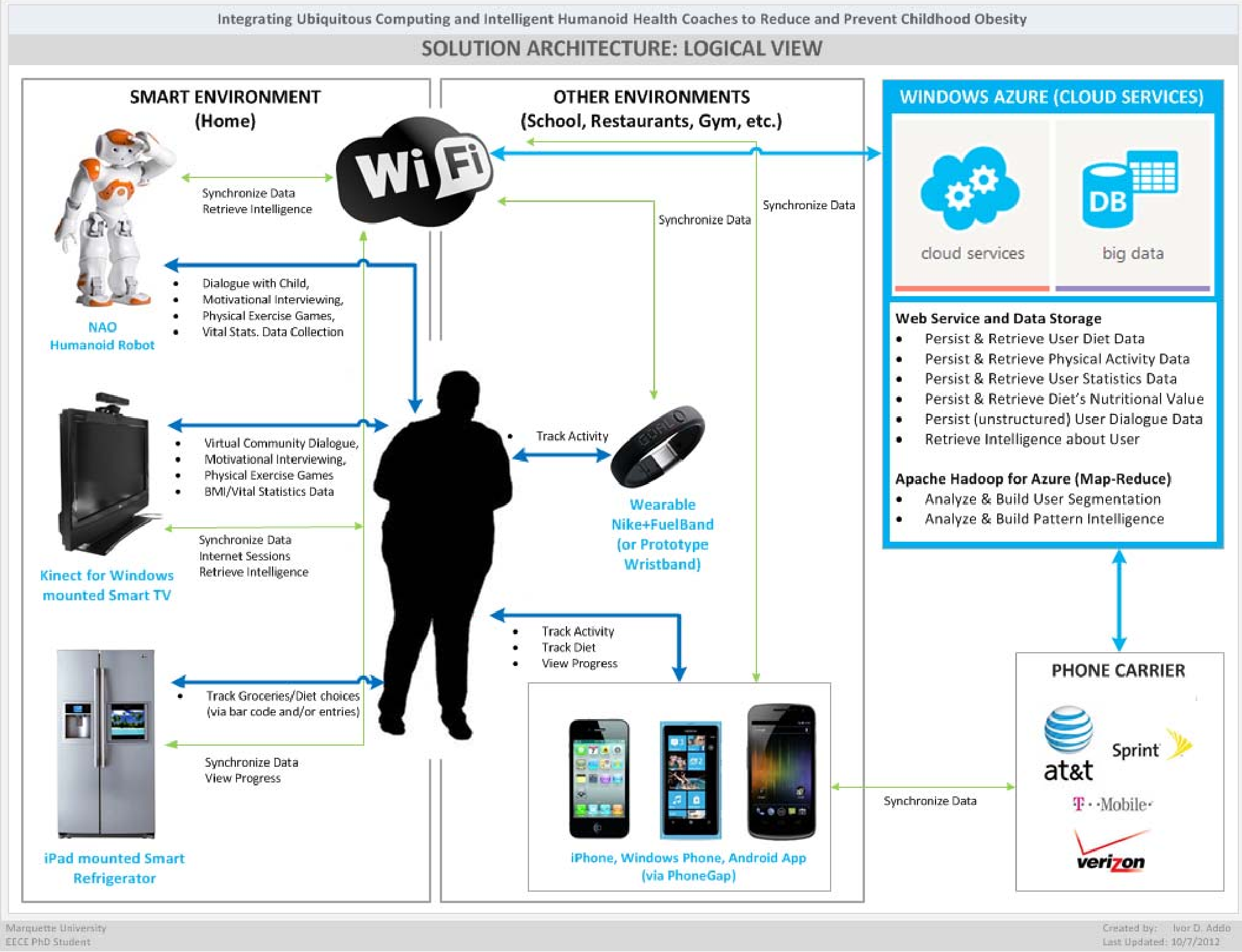 Figure 1: The logical view of the solution architecture, showing the interplay between Cloud services, the Robot, and the UbiComp environment.
3. Sentiment & Emotion Detection
To make the robot "believable," the team implemented a multi-modal emotion detection system. It analyzes facial expressions via Kinect sensors and processes verbal sentiment using a MAP (Maximum A Posteriori) Classifier.
This formula allows the robot to determine if a child's response is positive or negative, adjusting its "Zoey" persona in real-time to provide encouragement or empathy.
Experiments: Performance and Perception
The researchers conducted a preliminary study with 15 participants (ages 3-19).
- Trust and Privacy: While 80% liked the wearables, some expressed privacy concerns about having a robot in the home.
- The Power of Social Cues: Participants responded significantly better when the robot displayed social behaviors (eye contact, hand gestures, and tonal variation) compared to a static interface.
- Comparison with SOTA: The proposed strategy is one of the few to simultaneously integrate SLU, M2M networking, and psychotherapy (MI), as shown in the comparison table below.
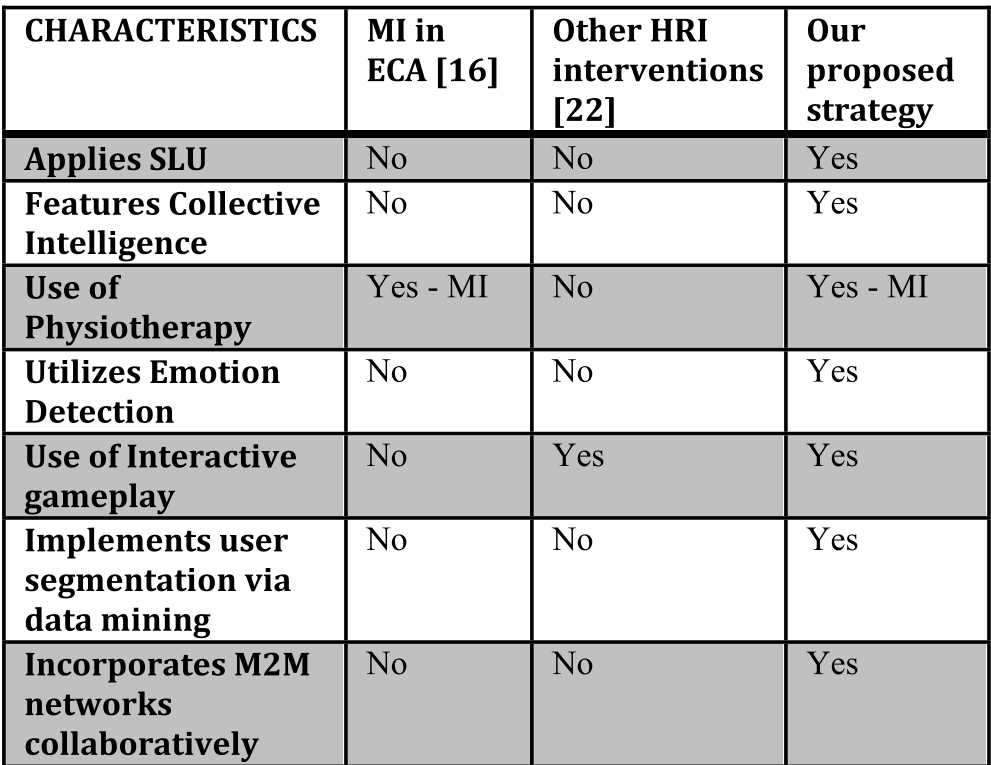 Figure 2: The unique position of the proposed strategy compared to existing HRI and Avatar-based interventions.
Critical Insight & Future Outlook
The true value of this paper lies in the M2M Collaborative Strategy. By using Hadoop Map-Reduce to mine "Big Data" from many homes, the system can learn that "Children in Persona A respond best to the Dragon-Quest virtual game after school," and push that intervention to all similar children automatically.
Limitations: The study is currently in its prototype phase ("Work-in-progress"). Long-term longitudinal data (6+ months) is still needed to prove that the initial "cool factor" of the robot doesn't wear off, leading to a return to sedentary habits.
Conclusion: This work paves the way for a new era of Pervasive Healthcare. Tomorrow's health coach won't just be an app on your phone; it will be a collective of intelligent agents—from your fridge to your robot friend—working in concert to keep you healthy.